

The proposal to create new provinces was presented by Interior Minister Mohsin Naqvi at an economic conference attended by leading industrialists. His suggestion stirred a hornet’s nest in the smaller provinces, particularly in Sindh, the second-largest federal province. Sindh has been particularly sensitive to any proposal to divide its territory since the inception of Pakistan, when Karachi was made the country's capital and later declared a federal territory. Mohsin Naqvi’s announcement jolted Sindhi nationalists out of their slumber.
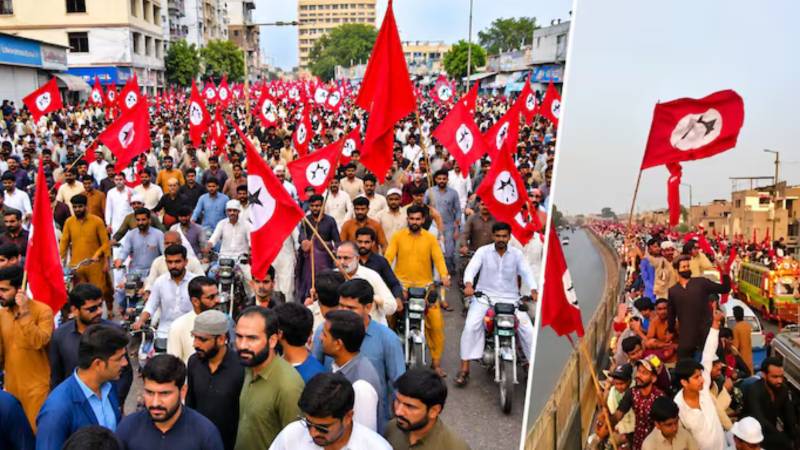
Following their protests against the construction of illegal canals drawing water directly from the River Indus, they had entered a period of political hibernation, characterised by inertia and complacency. They have now flexed their muscles and are up in arms, ready to fight for the territorial integrity of their motherland. The Steering Committee of the nationalists’ alliance held a massive rally in Karachi against the division of Sindh on Sunday, 22 November. The rally culminated in a mammoth public gathering outside the Karachi Press Club.
The Sindh Taraqqi Pasand Party, led by Dr Qadir Magsi, will march into Karachi on Sunday, 29 November. His march is being supported by Seraiki and Baloch nationalist parties. Dr Magsi enjoys considerable support in Sindh. His annual commemoration of Motherland Day in Hyderabad attracts large crowds. His upcoming rally is expected to break all previous records for nationalist protests. Dr Magsi had announced the schedule for his rally following a decision taken at the All Parties Conference held in Hyderabad on 12 October 2026. The Pakistan People's Party was represented at the conference by its provincial chief, Nisar Ahmed Khuhro. Other participating parties included the Sindh Taraqqi Pasand Party, Pakistan Muslim League (N), Pakistan Awami National Party, Sindh Hari Committee, Awami Jamhoori Party and Awami Workers Party.
The Sindh High Court Bar Association and Karachi Bar Association were also represented at the conference, which, among other things, condemned the proposal to carve out additional provinces or administrative units from within Sindh's geographical boundaries. MQM-P leader Maqbool Ahmed also announced a rally in favour of new administrative units in Karachi on 29 November. MQM leaders have also launched a provocative campaign ridiculing Sindh's nationalist leaders and their slogans highlighting the territorial integrity of their homeland. One of their senior leaders has audaciously asked Sindhis to leave Karachi, using his diminutive physical stature to question the growing population of Sindhis in the metropolis.
Anticipating possible law-and-order problems or a disturbance of public peace on 29 November, a PPP committee headed by Nisar Khuhro called on MQM leaders and suggested that they postpone their rally. Subsequently, the delegation also visited Dr Qadir Magsi in Hyderabad with the same request. Dr Magsi reminded Nisar Khuhro that his rally had been announced at the All Parties Conference and enjoyed the support of its participants. He could not postpone it. However, he assured the PPP delegation that the rally would remain peaceful.
PPP Chairman Bilawal Bhutto-Zardari, in his address at the Karachi Press Club, claimed that the proposal for new provinces had neither been discussed with him or the President nor presented before the Cabinet or Parliament. He was stating a plain truth. He also warned that there would be bloodshed if coercive measures were employed to circumvent the constitutional process for creating a new province or to suppress opposition to the division of Sindh. Bilawal's statement was prompted by underlying ethnic and linguistic tensions in Karachi and the city's history of bloody violence.
Defence Minister Khawaja Asif says that a comprehensive joint document is being prepared that will incorporate the viewpoints of all stakeholders. He should have enlightened us about who, or which authority, was undertaking this noble task. Mohsin Naqvi says that provinces will be carved out whether people like it or not, thereby implying that the decision has already been taken. Muhammad Ali Durrani, considered close to the security establishment, says that opponents of new provinces will be politically destroyed.
Rana Sanaullah has publicly confronted Mohsin Naqvi over his blunder in raising this sensitive issue at the wrong forum. The PML-N supreme leader, Mian Nawaz Sharif, has praised Rana Sanaullah as his loyal political aide. Prime Minister Shehbaz Sharif appears helpless in disciplining his ministers, even as divisions within the Cabinet over this contentious issue have spilled into the public domain. We wonder at whose behest Mohsin Naqvi has been advocating this controversial scheme and who is backing him.
The security situation remains precarious in Balochistan and Khyber Pakhtunkhwa. A new political tension is brewing in the country. Maulana Fazlur Rehman has protested against the police siege of his residence, which forced him to miss a lawyers' gathering in the city. Tensions are also rising in Karachi, fuelled by MQM-P leaders questioning the right of Sindhi nationalists to hold political rallies in the city to register their opposition to the division of their homeland or the separation of Karachi from Sindh.
The country's economy is still far from being out of the woods. We have been compromising our sovereignty by repeatedly appealing to affluent friends for rollovers of our loans. Inflation has pushed almost half of our population below the poverty line. Prices of everyday commodities and medicines have risen beyond the reach of even the middle class, let alone the lower-middle class and the poor. The job market remains stagnant. Rising fuel and utility costs have further aggravated people's hardships.
Instead of focusing on the problems faced by the people, the rulers have entangled the nation in a futile debate over new provinces. Is this a diversionary tactic? Have they considered all the political, economic, financial, administrative and constitutional implications that would confront the state following the creation of new provinces? We have not even been able to resolve the problems arising from the merger of FATA with Khyber Pakhtunkhwa. Nor have adequate funds been allocated for the development of the necessary administrative structures in the merged districts.
Is devolution the underlying purpose of creating new provinces? The non-controversial answer to the question of devolution lies in the administrative and financial empowerment of local governments, from union committees to municipal corporations. Sindh has elected functional local governments. Recently, the mayors of Larkana, Benazirabad, Sukkur, Hyderabad and Karachi held a joint press conference in Karachi to oppose the separation of Karachi from Sindh. Punjab, Islamabad, Khyber Pakhtunkhwa and Balochistan, meanwhile, have no functioning local governments.
The smaller provinces fear that dividing the existing federal units into multiple smaller provinces would enable the establishment to strengthen its grip over these territories. They also fear that, following the fragmentation of the existing federal units, the establishment might impose a new system of governance, replacing the current parliamentary form of government. Under such an arrangement, the majority province could exercise political and economic control over the smaller territorial units and appropriate their natural resources. All this confusion has been created by loose talk about the collapse of the existing system, its possible restructuring and the holding of a referendum, instead of following the constitutional process.