

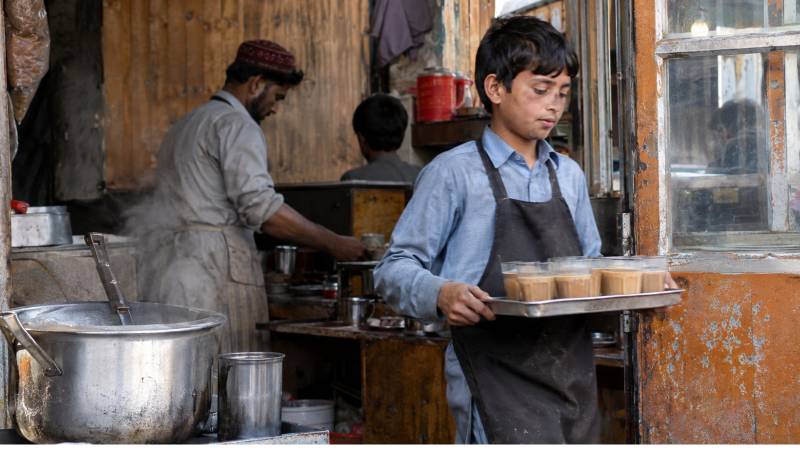
As much of Quetta gradually wakes up to begin another day, 10-year-old Arsalan (pseudonym) has already reported for duty, even during the cold winter months. Dressed in his school uniform, he arrives at a hotel at 6 am, where he works a two-hour shift before leaving for school at 8 am. While other children his age are getting ready for classes, Arsalan is already shouldering adult responsibilities instead of enjoying the freedom and innocence of childhood.
A fifth-grade student, Arsalan works to ease his family's financial difficulties. His father works as a cook at a hotel. As the eldest son, Arsalan believes it is his primary responsibility to help his father meet the family's needs. “I am the eldest son of the family with a younger brother to look after, so I arrive here early in the morning to earn a little money,” he says.
However, his daily routine comes at a price. His early morning shift leaves him with little time for the rest he needs before school. He finds it difficult to stay awake at work and says the owner sometimes reprimands or beats him when he dozes off. “I rarely get a proper sleep, and it disrupts my studies. I cannot maintain my concentration fully during class lectures,” Arsalan says.
Despite working regularly before and after school, his earnings are minimal. He says he has changed workplaces several times in search of fair wages, but better-paying opportunities have remained elusive. He also says that child workers are routinely underpaid and subjected to harsh punishment.
Despite the pressure of work and his family's financial difficulties, Arsalan has not abandoned his dreams. He aspires to pursue a career in medicine but fears that his family responsibilities and financial circumstances may stand in the way of his ambitions. “If I were financially sound, I would solely focus on my studies. I want to become a doctor, and I am trying to continue my education alongside this part-time work, but it is very hard to manage both,” he says.
Arsalan's circumstances are also taking a toll on his education. His teacher, Zohaib Hassan, says that long working hours have reduced his energy, weakened his concentration and affected his academic performance. According to the teacher, roughly 30 to 40 per cent of his students work after school, while Arsalan's classmate, Ali Naqi, works at a mechanic's shop from 3 pm until 9 pm.
The problem extends beyond individual cases. According to the Balochistan Child Labour Survey 2023–24, conducted across all 33 districts with the support of UNICEF and the Government of Balochistan, an estimated 201,352 children aged 5–17 are engaged in child labour, representing 3.7 per cent of children in this age group. The survey also found that 69 per cent of children engaged in child labour were not attending school, highlighting the impact of economic exploitation on children's educational opportunities.
The teacher says Arsalan's fatigue is evident in the classroom, where he struggles to concentrate during lessons. Despite efforts to seat him in the front row, he remains unable to absorb the lessons and frequently falls asleep during lectures. “He is almost chronically exhausted in class. He cannot remain attentive or comprehend what is being taught,” Zohaib says.
The physical toll of child labour is also reflected in the provincial survey. According to the Balochistan Child Labour Survey 2023–24, 48.8 per cent of children engaged in child labour reported work-related injuries or illnesses. These findings highlight the health risks associated with children's early entry into the workforce, extending beyond the educational difficulties experienced by children such as Arsalan.
The teacher observes that Arsalan often plays with small objects during lectures, possibly because school is the only place where he gets an opportunity to enjoy some of the simple pleasures of childhood. To help students who are struggling academically, the school has arranged additional catch-up classes for children in Grades 3 to 7. “These special classes primarily focus on basic reading, writing and numeracy skills which enable us to instruct children in accordance with their learning abilities rather than the specific grade curriculum,” the teacher states.
The teacher adds that the school has also begun identifying academically struggling students through dedicated registers to monitor their learning progress. However, parental engagement remains minimal, while teachers receive little institutional support in addressing the financial constraints that force children into work. “These children require adequate time to revisit their lessons at home. But when families face financial hardships, they cannot always provide the conducive learning atmosphere children need,” he adds.
Almas Tareen, a Quetta-based advocate, notes that the Balochistan Employment of Children (Prohibition and Regulation) Act, 2021, prohibits the employment of children below the age of 14. Section 20 of the Balochistan Shops and Establishments Act, 2021, also prohibits the employment of children in establishments, including hotels and restaurants.
“Even if a child works for mere two hours shift before the school, the employment is still not legally permissible,” the advocate says. The law also protects children against physical and psychological harm. The Balochistan Child Protection Act, 2016, identifies beating and other forms of corporal punishment as child abuse. “Employers who infringe child labour legislation may be prosecuted, imprisoned and fined,” he argues.
The advocate maintains that the Balochistan Labour and Manpower Department is primarily responsible for enforcing child employment legislation and monitoring business premises. The Social Welfare Department is also responsible for addressing child protection concerns through its District Child Protection Units.
Despite these legal provisions, child labour remains widespread across Balochistan due to poverty, unemployment, family dysfunction and social acceptance. The advocate emphasises that legislation alone is insufficient to combat this deeply entrenched practice without administrative responsibility, institutional accountability and social safety nets for financially vulnerable households.
“Poverty cannot be used to justify the exploitation of children and exempt employers of their legal liabilities,” the advocate adds. Arsalan's account reveals broader institutional shortcomings in efforts to curb child labour in Balochistan. A Child Protection Officer at the Social Welfare Department, Government of Balochistan, agreed to speak on the condition of anonymity. He points out that the lack of accurate statistics, poor coordination among government departments and ineffective enforcement have made combating child labour extremely difficult.
The officer argues that child labour is not merely a social issue but also an administrative failure, with numerous departments responsible for children's welfare failing to fulfil their responsibilities adequately. “Child labour is fundamentally a governance issue. The Labour Department, Social Welfare Department and other relevant institutions have collectively failed to address the problem,” the officer asserts.
The officer also highlights the absence of a functional implementation framework, arguing that existing child protection legislation cannot produce meaningful results without the necessary regulations, financial resources and operational capacity. He emphasises that government departments must work collaboratively and establish functional child protection centres to ensure that disadvantaged children receive adequate protection, education and rehabilitation. “Effective governance, administrative capacity and the robust implementation of existing laws are paramount in safeguarding children,” the officer concludes.