

“What is totalitarianism? If you want a picture of the future, imagine a boot stamping on a human face, forever”, George Orwell.
Since independence, we, as a nation, have encountered a number of crisis originating from the country’s odd geographical composition, ideological diversity, political and constitutional disruptions, poor economic planning and social and economic disparity among the constituents of the federation, and above all, the civil and military power imbalance. All these factors have been pushing the country in one crisis or the other throughout its short history.
The federal authorities failed to devise a just, fair, and workable system to run the country constitutionally, and distribute equitably the divisible pool of federal resources among the provinces in the West Pakistan, and between the eastern and western wings of the country, separated from each other by a stretch of 1000-kilometers of the hostile Indian Territory. Similarly, there was no fair allocation of federal superior services among federal constituents and both wings of the country.
During the period from 1949- 1965. Out of total allocations of 397 out of CSP cadre, there were 131 officers from East Pakistan against 56% of population, and 256 from West Pakistan. This anomalous situation looked like an internal colonization as termed by foreign and local writers such as Christophe Jaffrelot, Allen McGrath, Ian Talbot and H.T. Sorely, Stephen Cohen, Khalid Saeed, Nauman Omar, Feroze Hasan, Sherbaz Mazari, G.M. Syed, Hyder Bukhsh Jatoi, Hamida Khuhro – just name a few.
These factors remained a cause of friction between East and West Pakistan fuelling Bengali nationalism, and a sense of dissatisfaction among the small provinces in the western part. With a view to overcoming these causes of friction and federal disharmony, the rulers committed a blunder by amalgamating the four small provinces into one grand unit of West Pakistan in 1955 to balance the larger population of East Pakistan. This sowed the seeds of provincialism encouraging centrifugal forces to undermine the country. This opened the way for further political and administrative experiments in the country.
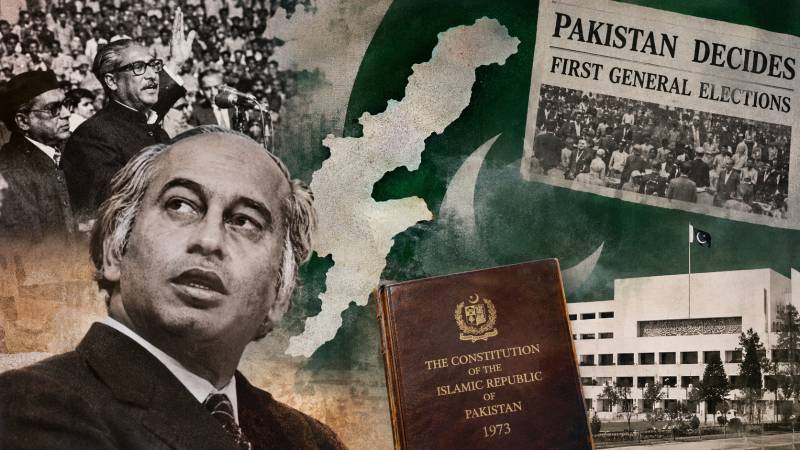
The Bengalis’ dissatisfaction over political, economic, financial and administrative matters finally culminated into the cessation of Bengal from Pakistan in 1971 after the civil strife sparked by military junta’s reluctance to accept the outcome of the results of the first general election in the country after independence. The Awami League of Shaikh Mujeeb swept the electoral landscape winning a comfortable majority to claim the federal government. The Military Junta declined to transfer power to him despite the worsening security situation.
Bhutto is wrongly blamed for aiding and abetting the separation of the Eastern Pakistan. What Bhutto wanted was to settle the constitutional differences between Awami League and Pakistan People’s Party before the formal session of the National Assembly to avoid its dissolution under General Yahiya’s Legal Framework Order which stipulated clearly that if the political parties represented in the National Assembly failed to frame a constitution within 120 days, the National Assembly would be dissolved and new elections held.
Bhutto was apprehensive of the intentions of the Generals – already busy in playing the main political parties against each other. He did not want to give an excuse to Generals to succeed in their conspiracy against plural and representative governance. Bhutto was a consummate politicians and knew very well that the politics was a game of opportunity and possibility. All his statements had contexts, and much of them were for the consumption of his party’s constituencies in the West Pakistan. Taking his two or three statements out of context and quoting them as evidence of Bhutto’s conspiracy against Pakistan is tantamount to spitting on the sky. Bhutto’ contribution to make the remaining Pakistan a viable and vibrant nation on the global scenario was a testimony to his matchless patriotism.
The public awareness of political, economic and constitutional rights confronts autocracy, plutocracy and hybrid or indirect military rule. Consequently, popular political leaders who challenge established power structures often face coercion, imprisonment, violence and even execution.
He toiled in sweat and moved like a hurricane covering the length, breadth of the country to restore the confidence of the nation. This was a grand restoration of a broken country, a demoralized nation and a despairing people. He gave them a Constitution and a Parliamentary form of governance. He resolved all the post-war issues with India and reset the country’s relations with both superpowers, and other major powers around the globe. Pakistan emerged as the leader of the Muslim world with a loud voice in the third world countries.
However, the composition of the federal structure of Pakistan still posed a challenge in working out an equitable distribution of federal pool of resources, and the allocation of superior services among the four federal constituents. Punjab has a big population and, based on the current demarcation of constituencies, sends 150 directly elected representatives in the National Assembly. This number is larger than the combined representation of all the three provinces. This means that any political party sweeping Punjab can form the federal government without seeking votes from any other province.
This makes our federal political governance hostage to the parliamentary strength of Punjab reducing the political significance of other provinces. That is why the mainstream political parties based in Punjab – Pakistan Muslim League – Nawaz, and Pakistan Tehrik-e-Insaf did not demonstrate any interest in the support of parliamentarians from other provinces. However, the law makers from Karachi city are accommodated in power corridors at the behest of the establishment to serve its purpose when called to do so. They are used as readymade tools to blackmail or undermine a defiant Prime Minister. The regimes of Muhtarma Benazir Bhutto, Mian Nawaz Sharif, and Imran Khan were blackmailed in the past by using them.
Some quarters that matter most do not want to see real and legitimate constitutional, plural and representative governance in the country which, if it takes strong roots, will surely challenge their monopoly over state’s economic resources, electoral and political process in the country, and expose their collaborators. The public awareness for their political, economic and constitutional rights confronts autocracy, plutocracy, hybrid or indirect military rule. Therefore, all the political leaders who become popular, and radiate revolutionary light, become anathema to these quarters. Such light is extinguished as quickly as possible by coercive measures, violence, harsh imprisonment, and even execution.
John Adam’s words that “facts are stubborn things”. I may add that facts are also bitter and nobody wants to listen to facts. However, there are people following the footprint of John Adam, dare to speak out their mind, write according to their conscience, and brings us face to face with bitter facts. Such writings, though on the decline, are full of bitter facts, and go a long way to enlighten people elaborating day to day, month to month and year to year events of our national history.
Such writers move with the trajectory of Pakistan from one political and electoral, and constitutional crisis to another, from Musharraf’s autocracy to Benazir’s romance with the adulatory crowds clamouring for democracy and economic prosperity, the post-Benazir civilian rule under Asif Ali Zardari, the third and tumultuous term of Mian Nawaz Sharif, the emergence of PTI, the subsequent hypocritical support to the PDM coalition to capture power, the general elections of 2024, the miracles of electoral form 47, and the current extra hybrid governance.
Now, we are switching to well touted experiment of multiple small administrative units like the unitary states of Afghanistan and Japan or the authoritarian state of China obscuring the difference between federal and unitary administrative structures. Our Constitution, following a national consensus, adopted a federal structure for the country. General Yahya dissolved the One-Unit, and restored the federal units after a unanimous demand by political leaders. We cannot change the federal structure of the country or the territorial boundaries of federal units without amending the Constitution.