

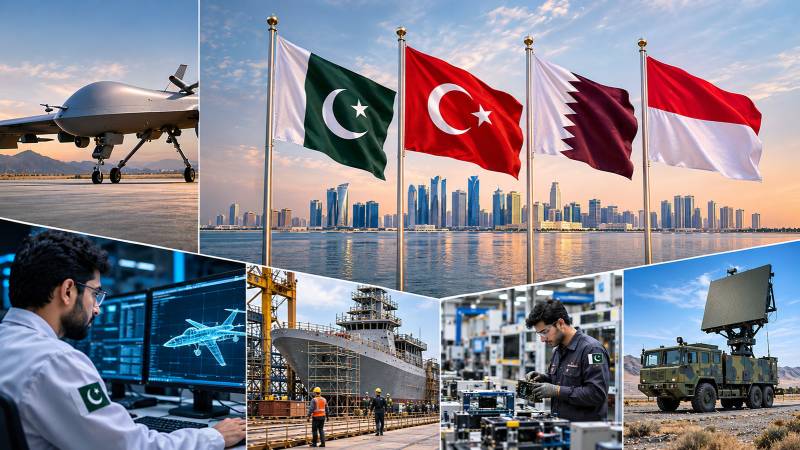
Pakistan’s economy will not recover solely through official statements. Meaningful progress requires reducing dependence on other countries, making effective use of technology, and developing industries that strengthen the current account. The Badr Accord, signed in Doha on 21 October 2026 by Pakistan, Türkiye, Qatar, and Indonesia, is neither a military alliance nor a defense pact. Rather, it is a partnership focused on industry and technology. This distinction is important if the Accord is to help Pakistan advance, rather than merely rearrange its existing challenges.
Each country in the partnership offers valuable strengths. Pakistan has experience in aircraft manufacturing, a defense industry, and skilled workers. Türkiye contributes advanced unmanned systems, sensors, electronics, and innovation. Qatar supplies funding, shares research and development costs, and opens new markets. Indonesia brings shipbuilding expertise and access to Southeast Asian customers. These combined strengths can lower costs, increase local production, and boost exports, but only if contracts ensure manufacturing and software development take place in Pakistan, protect intellectual property, and secure export rights before production begins.
Artificial intelligence is central to this industrial plan rather than merely an additional feature. Türkiye’s expertise in unmanned systems, sensors, and electronics encompasses autonomy software, sensor-fusion algorithms, and electronic-warfare decision systems. These capabilities are essential to the effective operation of platforms and radars. Pakistan can manufacture airframes and hardware, but it will benefit from the algorithms only if contracts guarantee access to source code, permit local modifications, and involve Pakistani teams in development. Without these provisions, the partnership risks perpetuating existing dependencies: hardware is produced locally, while the most valuable components remain abroad. With appropriate contractual terms, collaborative AI development can build substantial expertise and strengthen Pakistan’s industrial base.
These five main areas will only deliver quick economic benefits if managed well. Joint unmanned systems can replace imports, but only if software transfers are secured. Working together on surveillance, radar, and electronic warfare can save foreign currency, especially if Pakistan gets rights to develop key data-processing algorithms. Naval projects that combine Indonesian shipbuilding with Pakistan’s location can lower costs and create shipyards for both local and foreign fleets. Making spare parts together is the fastest way to improve cash flow. Every part made locally instead of imported helps the current account and speeds up repairs. Training and standardization, which usually cost money, become valuable when they create Pakistani teams who can update and certify both hardware and software.
The true test lies not in the overarching agreement but in its details: who owns the production, who owns the software, and who is authorised to sell the systems. These factors will determine whether the Accord represents meaningful progress or merely another announcement.
These results depend on the Accord’s clearly defined boundaries. It does not guarantee automatic military assistance, intelligence sharing, or access to external systems; these require separate agreements. Its success depends on establishing clear programs, timelines, and financial commitments. If these remain unclear, or if intellectual property remains with its original owners, the Accord will not benefit Pakistan’s finances or industry. Regional misunderstandings could also harm the economy. If other parties perceive the partnership as a threat, Pakistan could face higher borrowing costs, reduced market access, and increased pressure to purchase equipment expenditures the budget cannot accommodate. Careful and transparent diplomacy is not merely a political consideration; it is also an economic necessity.
For Pakistan’s government, the path to recovery is clear but narrow. The Ministry of Defence Production, together with the Ministry of Finance and the Planning Commission, should focus first on projects that are already possible: unmanned systems, surveillance and counter-drone packages, and contracts to replace imported spare parts. These contracts should clearly list AI modules as separate deliverables, with milestones for technology transfer, source code access, and local modification rights. Qatar’s funding should come as equity or grants tied to these milestones, so research costs do not become government debt. Any project that cannot show savings from import substitution or secure outside funding within a set time should be put on hold.
Local industry and universities should be involved from the beginning. A set portion of subsystems, components, and AI packages should come from Pakistani companies and university labs. This approach turns the Accord’s promises of shared skills and production into real benefits for the local economy and workforce, especially in software. A joint monitoring group, reporting to the Prime Minister’s Office, should publish quarterly updates on hardware localization, algorithm transfer, budgets, and delivery timelines. Any extra costs or delays in technology transfer should be clearly shown in the federal budget, making financial and technical risks easy to see.
Official communications regarding the Accord should focus exclusively on its technical aspects. The Foreign Office and the Ministry of Defence Production should present it as an instrument for enhancing defence readiness and sharing industrial costs, including those associated with the software required to operate the hardware. Public statements and meetings should avoid any reference to the formation of a geopolitical bloc. This measured approach will help safeguard the export rights Pakistani companies require for the partnership to deliver benefits beyond import substitution.
Economic recovery will not occur solely because four countries have signed an agreement. It depends on contracts that require local content, protect intellectual property, employ funding structures that avoid increasing government debt, and establish clear timelines for identifying problems. Without these provisions, the Badr Accord may merely shift dependence: hardware would be produced in Pakistan, while key software remains abroad, leaving financial challenges unresolved. If Pakistani institutions use the partnership as a genuine industrial policy tool and adhere to these principles, the Accord could help mitigate external risks and build substantive industrial capacity in both hardware and software. The true test lies not in the overarching agreement but in its details: who owns the production, who owns the software, and who is authorized to sell the systems. These factors will determine whether the Accord represents meaningful progress or merely another announcement.