

Martin Luther King famously said that “the arc of the moral universe is long, but it bends towards justice.”; ie the struggle for justice and freedom may be hard, tortuous, and long, but in the end, justice prevails, the good triumphs over evil, love over hate. In “The World After Gaza,” Pankaj Mishra disagrees; “There is already too much evidence that the arc of the moral universe does not bend towards justice”. Mishra tells the story of two Jewish writers, Jean Amery and Primo Levi, both survivors of the Holocaust; both early supporters of Israel, who later became disillusioned and disturbed by reports of torture in Israeli jails and the conditions of Palestinians. Their deepest fears remained and their hope in a better world faded; both committed suicide.
Chris Hedges addresses this issue in a particularly insightful manner in one of his recent podcasts on the genocidal war in Gaza. He is a Presbyterian Minister, and his approach, though different from King, is also rooted, like King, in his religious views: “We can’t say that love triumphs; however, in their perpetual struggle, tyranny and injustice cannot conquer and crush love and its public expression, justice. We fight for justice not because we will win, but because we must, because that is the only moral thing to do.”
Chris supports his position with the help of two books: A novel, Life and Fate by Vasily Grossman, and Shielding the Flame, an interview with Marek Edelman, with the Holocaust as background and context. Grossman grapples with the complexities of hope and justice in the dark times of despair.
“My faith has emerged … from the concrete of the gas chamber. I have seen that it is not man who is impotent in the struggle against evil, but the power of evil that is impotent in the struggle against man. The powerlessness of kindness, of senseless kindness, is the secret of its immortality. It can never be conquered. […] Human history is not the battle of good struggling to overcome evil. It is a battle fought by a great evil struggling to crush a small kernel of human kindness.”
Where does the poetry of Faiz Ahmed Faiz and Mahmoud Darwish stand in this struggle between good and evil, hope and despair?
For Mahmoud Darwish, poetry was not always about predicting victory. "My role is to be here," he said during the siege of Beirut. Like Faiz, he evolved from revolutionary anthems to a more profound meditation on exile and love
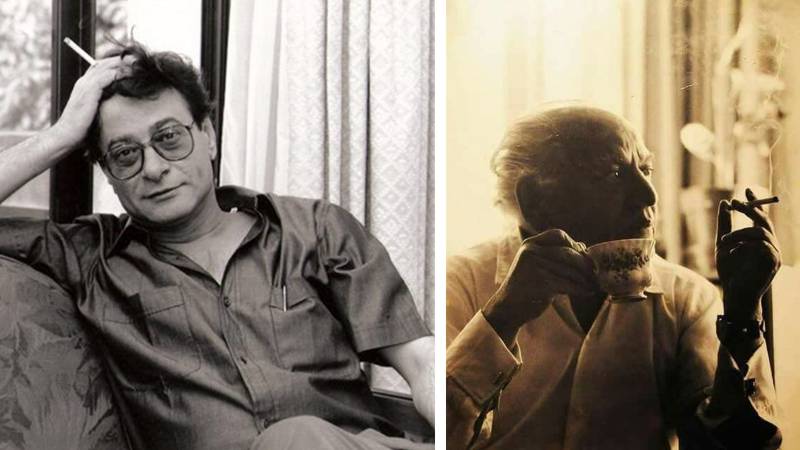
Faiz and Darwish were adored by millions of their fans within their lifetime. Both wrote lyrical poems of love, longing, loss and exile. My own sense is that poems of Faiz move between hope (mostly) and hopelessness (occasionally); between optimism that justice will prevail to dark forebodings that all may not end well. Darwish, specially towards the latter period, seemed to be more open ended; from loss of home and exile, he arrived at a point where poetry and language itself was the ‘home.’ “I have learned and dismantled all the words in order to draw from them a single word: Home.” (From the poem “I Belong There” in Unfortunately, it was Paradise)
Faiz was eulogised as the poet of revolution, ‘of inqilab.’ For the politically conscious socialists and humanists, the expectation from his poetry included a sense of the victory of justice and equality over inequality and oppression, of love over hate. And Faiz did not disappoint them. In several of his poems, especially during the early and middle period, we find an echo of the spirit of Martin Luther King. The iconic "Wa yabqa wajhu rabbika" (وَبَقِيَ وَجْهُ رَبِّكَ) popularly known as “Hum Dekhenge” exemplifies this variety of his poetry. Faiz brings down one line of Quran’s verse to earth, with a variety of religious and worldly symbols, foretelling the end of tyranny and a promise of paradise on earth. His collection Mere Dil Mere Musafir, dedicated to Yasser Arafat, was written during his exile and stay in Beirut. Here, along with Darwish, Faiz experienced Israel’s bombardment and siege. Here, he wrote poems marked by both the promise of victory of the righteous, as well as hopelessness, rage, despair, and a sense of uncertainty about the outcome. His poem “Ek taraana mujahideen-e Filasteen ke liye” (An anthem for the Palestinian fighters) is full of hope.
“ham jīteñge / haqqā ham ik din jīteñge / bil-āḳhir ik din jīteñge”
(We shall win; By God, we will win/ Eventually, one day, we will win)
Not so hopeful, in fact quite unsure of the outcome, is the poem “Is waqt to yun lagta hai.”
Even more sceptical of the final victory is the following ghazal:
“āvāra hai phir koh-e-nidā par jo bashārat- tamhīd-e-masarrat hai ki tūl-e-shab-e-ġham hai
(Is the voice from the heavens a harbinger of good news, or just an extension of our sorrows?)
jis nuur se hai shahr kī dīvār daraḳhshāñ- ye ḳhūn-e-shahīdāñ hai ki zar-ḳhāna-e-jam hai
(What is this glow on the city’s walls- the blood of martyrs, or the regalia of Jamshed?)
halqa kiye baiThe raho ik sham.a ko yaaro- kuchh raushnī baaqī to hai har-chand ki kam hai
(Keep shielding the candle, my friends; even though the flame is fading, there is still a bit of light)”
The last line echoes the words of Marek Edelman, in Shielding the Flame: the flame is often extinguished in the end, but the least we can do is to shield it as long as we can.
In “Ye maatam-e waqt ki ghari hai” Faiz expresses conflicting emotions of despair at the world, as well as its embrace; a kind of Nietzschean Amor Fati and Hanna Arendt’s Amor Mundi:
“ye jāma-e-roz-o-shab-gazīda / mujhe ye pairāhan-e-darīda; aziiz bhii, nā-pasand bhī hai; kabhī ye farmān-e-josh-e-vahshat / ki noch kar is ko pheñk Daalo/ kabhī ye isrār-e-harf-e-ulfat / ki chuum kar phir gale lagā lo”
(This torn fabric of the days and nights/ I both love and detest it; at times my passion demands that I tear it apart; at other times, love insists that I embrace it).
In “aaj shab koyee naheen hai” and “Kya karen” written in Beirut, Faiz sounds at the edge of despair, confused and heartbroken:
“ye hai bhī yā nahīñ, batā / ye hai, ki mahz jaal hai / mire tumhāre ankabūt-e-vahm kā bunā huā
jo hai to is kā kyā kareñ / nahīñ hai to bhī kyā kareñ / batā, batā, batā, batā”
(Is this real, tell me, or is it just a web of illusion/ woven by the spiders of your and my desperation)
Faiz and Darwish used the metaphor of erotic and romantic love for a human beloved for their love of the homeland – both enduring and precarious. Aamir Mufti reads “Ya’d” (“Memory” or “Remembrance”)- “Dasht-e- tanhai me.n ai ja’n-e jahan larza’.n hain” by Faiz as the lamentation not just of a lover separated/displaced from a human beloved, but of someone yearning for wholeness and unity of an undivided culture/home.
Darwish was called the ‘poet of resistance,’ of Palestinian nationalism. As Dalya Cohen-Mor argues in Mahmoud Darwish-Palestine’s Poet and the Other as the Beloved, he was expected by his audience to remain loyal to the homeland. Even the poem he wrote, dedicated to his mother “For my Mother” was sung as a kind of national anthem.
In a famous early poem, “Identity Card,” Darwish is angry and rebellious:
“Write it down! / I am an Arab / And my identity card number is fifty thousand
I have eight children / And the ninth will come after a summer/ Will you be angry?
[…] I do not hate people / Nor do I encroach / But if I become hungry / The usurper’s flesh will be my food / Beware … / Beware … / Of my hunger / And my anger!”
Towards middle and end of his life, Darwish kept his poems focussed on love, loss and exile, not overtly political, propagandist, or even hopeful of victory. Committed to resistance, and steadfastness, his poetry became more lyrical and open ended. Darwish’s collection The Butterfly’s Burden and In the Presence of Absence contain most of these later poems.
In “State of Siege,” Darwish starts with a few lines about hope:
“Here, by the downslope of hills, facing the sunset / and time’s muzzle,/ near gardens with severed shadows, / we do what the prisoners do / and what the unemployed do: we nurture hope”
Towards the end of the poem, hope appears both necessary and a kind of affliction:
“To resist means: to be certain / of the wellbeing of the heart and testicles, / and of your chronic illness: / the illness of hope.”
He maintained, much like Marek Edelman and Vassily Grossman, that the ability to love is itself a “form of resistance: we Palestinians are supposed to be dedicated to one subject — liberating Palestine. This is a prison. We’re human, we love, we fear death, we enjoy the first flowers of spring. So to express this is resistance against having our subject dictated to us. If I write love poems, I resist the conditions that don’t allow me to write love poems.”
In a poem about exile that carries echo of “Dil-e man musafir-e man” by Faiz, Darwish writes:
“Nothing carries me or makes me carry an idea: not longing / and not promise. What will I do? What will I do without exile, and a long night/ that stares at the water?” (What Am I Without Exile)
Redemption is possible, Faiz and Darwish seem to suggest, but there are no guarantees, no certainties. One can only save and retains one’s own humanity.
“Then What? / A woman soldier shouted: / Is that you again? Didn’t I kill you? / I said: You killed me […] and I forgot, like you, to die.” (from “In Jerusalem”)
“An eagle settles on our bodies, and we chase after dreams. May we find them.
They soar behind us to find us here. There is no escape!
We live our death. This half-death is our triumph” (from “Winds shift against us”)
Darwish seems to be less certain of the arc of moral universe bending towards justice. In “Memory for Forgetfulness,” he talks of war, politics and the role of the poets and artists.
“What are you writing in this war, Poet?”
—I’m writing my silence.
—Do you mean that now the guns should speak?
—Yes. Their sound is louder than my voice.
—What are you doing then?
—I’m calling for steadfastness.
—And will you win this war?
—No. The important thing is to hold on. Holding on is a victory in itself.
—And what after that?
—A new age will start.
—And when will you go back to writing poetry?
—When the guns quiet down a little. When I explode my silence, which is full of all these voices. When I find the appropriate language.
—Is there no role for you then?
—No. No role for me in poetry now. My role is outside the poem. My role is to be here, with citizens and fighters.”
As Darwish wonders why artists and poets were expected to inspire hope with their writings during Israel’s bombardment of Beirut, he relates an interesting conversation with Faiz:
Yet our great friend from Pakistan, Fayiz Ahmed Fayiz (sic!), is busy with another question: “Where are the artists?”
“Which artists, Fayiz,” I ask.
“The artists of Beirut.”
“What do you want from them?”
“To draw this war on the walls of the city.”
“What’s come over you?” I exclaim. “Don’t you see the walls are tumbling?”