

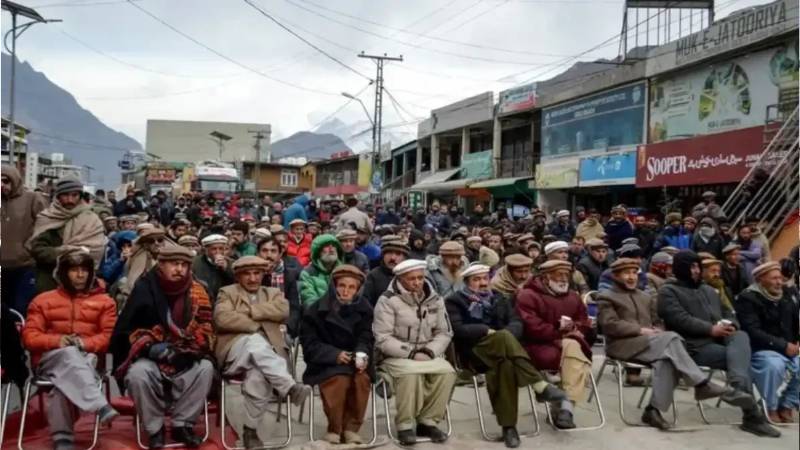
The inconclusive meeting of the federal committee on 16 September has once again exposed Islamabad’s inability to decisively resolve the Gilgit-Baltistan (GB) growing trade crisis. For over two months, local traders have staged a sit-in at the Sost Dry Port, blocking cross-border trade and travel with China. Over 200 containers remain stranded, some carrying goods that have already perished. Each passing day adds to demurrage costs, deepens local resentment, and undermines confidence in Pakistan’s ability to govern one of its most strategically sensitive regions.
At first glance, the dispute seems to revolve around customs duties and taxes. The Federal Board of Revenue’s decision to impose sales tax, income tax, excise duty, and withholding levies on goods imported via Khunjerab Pass is the immediate cause. But the issue goes far beyond tariffs. The protests have taken on a political character, with the rallying cry of “No Taxation without Representation” resonating across the mountainous region.
For GB’s people, the contradiction is glaring. How can a region with no seats in Pakistan’s National Assembly or Senate be asked to pay federal taxes? The answer lies in decades of neglect, ambiguity, and political exclusion. The imposition of taxes has simply brought these contradictions to the surface.
Economic Desperation
Gilgit-Baltistan’s economy is fragile at the best of times. With limited industrial development, the region has historically relied on small-scale cross-border trade, subsistence agriculture, and a modest tourism sector. Families have long sustained themselves by importing consumer goods from China—cloth, pottery, stationery—and selling them locally or in markets further south. For many, this trade was the only viable means of survival in a remote region with limited opportunities.
Tourism offered another lifeline. The spectacular Karakoram and Himalayan ranges drew climbers and trekkers from around the world, while domestic visitors increasingly flocked to Hunza and Skardu. Yet even here, GB’s residents often found themselves sidelined. Hotels, prime land, and tourism ventures were gradually acquired by investors from outside the region, leaving locals with few ways to benefit from their own natural assets.
The imposition of federal taxes has squeezed these fragile livelihoods further. Import costs have risen, margins have shrunk, and young people face even fewer options for employment. For many educated youth, migration to big cities or abroad has become the only realistic path to a future.
The sit-in at Sost cannot be dismissed as a passing disturbance. It strikes at the heart of Pakistan’s Kashmir policy and its economic partnership with China
This explains why the protests enjoy mass backing. They are not confined to traders alone but are supported by civil society groups, opposition parties, religious organisations, and ordinary residents. The sit-in at Sost has grown into a broader expression of disenchantment with the state.
The blockade has already had ripple effects. Tourism has been disrupted. Pakistani students studying in China have faced difficulties in crossing the border. Chinese nationals and traders have been stranded, sparking concern in Xinjiang. What began as a local protest is now affecting bilateral flows of people and goods. The economic costs are rising by the day. The political costs may prove even higher.
Unavoidable Choices
The sit-in at Sost cannot be dismissed as a passing disturbance. It strikes at the heart of Pakistan’s Kashmir policy and its economic partnership with China. Successive governments have avoided granting GB full provincial status, citing the unresolved nature of the Kashmir dispute. But for GB residents, this has meant permanent limbo, excluded from federal decision-making, denied representation in parliament, and deprived of a fair share in national resources.
Over the years, Pakistan has experimented with limited reforms in GB. Local assemblies were introduced. Administrative powers were devolved on paper. Yet none of these changes resolved the underlying problem: lack of real authority and representation. For residents, the reality remains the same: their voices carry little weight in Islamabad, and their economic grievances remain unaddressed.
The current protests make clear that piecemeal reforms are no longer enough. GB’s people are distinct in culture, geography, and history. They see themselves as having chosen Pakistan voluntarily at its inception, and resent being treated as a bargaining chip in a dispute elsewhere.
From Islamabad’s perspective, the trade protest has now become too costly to ignore. The Khunjerab Pass is not only the gateway to China but the symbolic starting point of the China-Pakistan Economic Corridor (CPEC). Smooth flows of goods and people through this corridor are critical to sustaining the partnership with Beijing. Continued unrest at Sost undermines confidence in Pakistan’s ability to safeguard CPEC.
Either Islamabad moves proactively to address GB’s grievances, or it risks recurring crises that will damage national unity and undermine CPEC
China is already concerned. Businesses in Xinjiang dependent on cross-border trade have reported losses. The spectacle of stranded Chinese nationals and students at Sost has raised alarm. For Beijing, CPEC is a flagship project of the Belt and Road Initiative. For Pakistan, it is the lifeline of its economic strategy. Neither can afford to let the protests drag on.
Nor is China the only external factor. India is watching closely, eager to exploit unrest in GB to its strategic advantage. Every additional day of indecision in Islamabad provides fodder for India’s diplomatic narrative.
For Pakistan, the stakes are strategic as well as economic. So what should be done?
First, the federal government must honour the Prime Minister’s promise of a one-time amnesty. Containers stranded at Sost should be released immediately, with waivers on demurrage fees. Traders who have already suffered losses must be compensated, at least partially, for perishable goods that have spoiled in the open.
Second, a practical tax mechanism must be formalised. Goods consumed within GB should be exempt from federal taxes, while consignments destined for the rest of Pakistan should be taxed normally. This arrangement balances fairness to GB residents with the federal government’s broader fiscal needs.
Third, GB representatives must be involved in future policy-making. Customs and trade rules cannot continue to be imposed unilaterally from Islamabad. A joint federal–GB oversight committee could provide a more transparent and participatory mechanism.
These steps will not resolve the deeper political question. But they can defuse the immediate crisis and buy time for more fundamental reforms.
The Way Forward
In the longer run, Pakistan must face the unavoidable choice of addressing GB’s ambiguous status. Designating the region as a Special Economic Zone with tax incentives could offer short-term relief. However, economic concessions alone will not be sufficient. Without constitutional clarity, the cycle of protest and resentment will continue.
Provincial status is one option. Interim fiscal autonomy is another. Both would require political courage and consensus in Islamabad. Yet the alternative permanent limbo is no longer sustainable. The longer GB is excluded from Pakistan’s political mainstream, the deeper its sense of alienation will grow.
Offering political and economic incentives does not have to wait for a Kashmir settlement. Pakistan can uphold its principled position on Kashmir while simultaneously integrating GB more fully into the federation. Indeed, stability in GB strengthens Pakistan’s hand in any future negotiation, whereas unrest only weakens it.
The choice, then, is clear. Either Islamabad moves proactively to address GB’s grievances, or it risks recurring crises that will damage national unity and undermine CPEC.
The sit-in at Sost is not simply about taxes. It is about trust. It is about whether the people of GB believe they have a fair stake in Pakistan’s future.
Compromise, not delay, is the only way forward.