

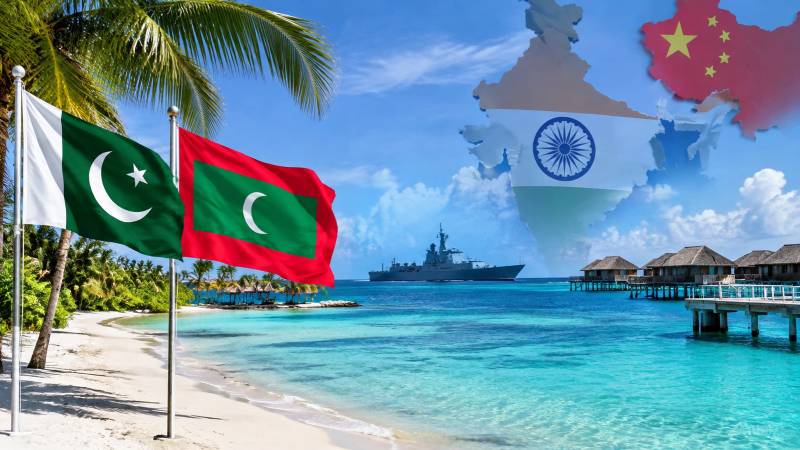
The recent visit of Maldivian President Mohamed Muizzu to Pakistan was more than just a simple diplomatic exchange; it was a testimony of Islamabad's pivotal role in the increasingly competitive realm of India-China relations in the central Indian Ocean. During the visit the two sides signed 20 MoUs, covering almost all aspects of mutual cooperation including the maritime sector. These MoUs may open new avenues for strengthening the bilateral ties between the two South Asian states.
The archipelagic Maldives consists of around 1,190 islands, out of which about 200 are inhabited. Its position is close to the Eight-Degree Channel and the southern sea routes like Huvadhu Kandu (also called the One-and-a-Half-degree Channel), place it very near to important Sea Lines of Communications for transport between Asia, Africa, and the Middle East. Located about 640 km away from Diego Garcia, the Maldives finds itself in a sensitive maritime area. Although these routes have strategic significance, it has neither capability nor the will to control them.
Traditionally, India had enjoyed strong relationship with the Maldives during a three decades (1978-2008) long reign of Maldivian president Maumoon Abdul Gayoom, but a significant sway of Maldives relationship from India to China started brewing after the Gayoom’s rule. Through various infrastructure initiatives, the Chinese presence in Maldives grew significantly during Abdulla Yameen's tenure (2013-2018). In 2017, Yameen's administration signed a thousand-page FTA (free trade agreement) with Beijing, which resulted in political turmoil in the Maldives.
The major reason behind the political unrest was reportedly, the passing of FTA by the Yameen government in the absence of opposition, and it also took just thirty minutes to conclude this mega initiative. The protests in the Maldives against this hastily passed agreement led to the imposition of an emergency in the country to control the situation. Major Maldivian opposition members even requested India to intervene; however, India did not take any action like India had done during its ‘Operation Cactus’. It is worth mentioning here that, India had rescued the government in Male from an attempted coup orchestrated by Maldivian conspirators with the help of PLOTE militants of Sri Lanka in the November 1988, at the invitation of Maldives’s President Maumoon Abdul Gayoom.
Moreover, the profound engagement of China with the Maldives has raised serious concerns for India. According to Manoj Joshi, fellow at Observer Research Foundation New Delhi, development of a port in Addu City and plan of a housing project at the Gadu Island, (where the British military was originally stationed during the World War II), may indicate Chinese plan of establishing a naval base. Moreover, Retired Vice Admiral Shekhar Sinha has opined that, the location has the potential for submarine operations and is suitable as a landing station for China to link her PEACE submarine cable network, and ultimately it may increase Beijing’s capacity to influence the information flow.
Furthermore, in 2018, India faced a diplomatic setback, when Yameen’s government refused to extend arrangements for using two Indian helicopters, these helicopters were used for maritime reconnaissance, medical evacuations, and search-and-rescue operations and helped India to have presence in waters of strategic importance. Thus, this decision was a manifestation of the deterioration of the bilateral relationship between the two regional states considering increasing Chinese presence has further jeopardized India’s maritime security ambitions.
Pakistan and Maldives have concluded multiple agreements based on their collaboration in defence, maritime security, information technology, cybersecurity, artificial intelligence, fisheries, agriculture, tourism and aviation.
After the end of Yameen's administration, relations between India and the Maldives slightly improved under President Ibrahim Mohamed Solih (2018-2023). Improved relations seemed to be the result of financial support from India, infrastructure projects, and involvement in strategic relationships. Nonetheless, the growing Indian military presence was domestically opposed in the Maldives and sparked the ‘India Out’ campaign, which ultimately resulted in the victory of Mohamed Muizzu in the elections held in September 2023.
Subsequently, the change of regime in the Maldives, reintroduced strategic competition and a significant shift in its relationship with India. Newly elected president Muizzu demanded the removal of Indian military personnel, while agreeing for the deployment civilian specialists in the month of May 2024. At the same time, Malé continued its strengthening of the relationship with China and signed a military cooperation agreement. However, India is making endeavors to forge better relationship with Maldives, and in this regard prime minister Modi visited the Maldives in July of 2025, while the host country also received a loan of $565 million from India.
Amidst the strategic environment described above, Pakistan and Maldives have concluded multiple agreements, based on their collaboration in defense, maritime security, information technology, cybersecurity, artificial intelligence and enhanced digital skills, fisheries, agriculture, tourism, aviation, and in the recruitment of medical personnel. The joint efforts in the areas of defense and maritime activities can lead to an increase in practical cooperation. Moreover, the agreements in the areas of fisheries and agriculture can pave the way for setting new standards in the cooperation in the Blue Economy. The Maldives may also enhance its disaster management capacity and effectiveness of coastal safety measures and environmental monitoring of natural disasters and tourism-related risks
As usual the growing ties between Pakistan and Maldives, are minutely observed in India. The analyst Aditya Gowdara Shivamurthy from Observer Research Foundation has equated current high-level interactions of Maldivian authorities with Pakistan, as a test for India’s influence in Maldives in his article “As Maldives Diversifies, India Must Clearly Define Its Red Lines.” He postulates, that India might have to go beyond its economic and diplomatic tools if it fails to set clear strategic boundaries.
Pakistan is continuously playing a stabilizing role in the Indian ocean region, and announced MoUs offer no key deployments, or control over sea routes. Rephrasing in a manner otherwise would exaggerate Pakistan’s achievements and erode trust. In economic terms, the two countries intend to bring their trade volume from $13 million to $200 million within the next two years. Proposed flights from Karachi to Malé, and improving maritime operations as well as developing cooperation in both food and drugs industries should create solid connections, but the high aim needs involvement of the private sector, clear projects in place and thorough monitoring.
Hence, the recent high-level engagement, opens an economic and diplomatic channel for Pakistan but more importantly, it presents a strategic opportunity. The rivalry over influence between India and China continues in the Indian Ocean region, meanwhile Maldives is seeking to carve its own path. If Pakistan continues to interact with Maldives in economic and maritime cooperation, along with strategic partnership with China, it will become an important player in the central Indian Ocean region.