

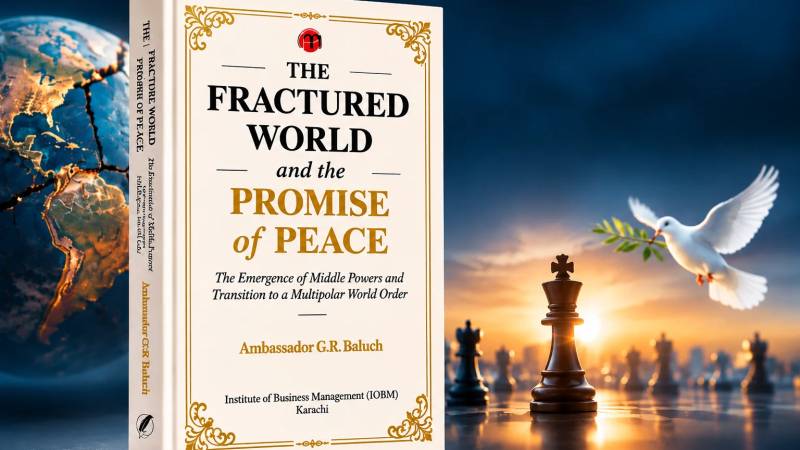
The Fractured World and the Promise of Peace is the outcome of the intellectual labour of Ambassador Ghulam Rasool Baluch. He has spent two precious years of his waning summers following, observing and analysing the events that have been taking place around us on this planet, committing his observations to paper, and collecting and compiling them into a manuscript for the publication of this voluminous book, which we are launching today. Perhaps he undertook this intellectual work partly for his own pleasure, driven by a compelling sense of pride in his God-given skill of blending the faculties of his mind with the rhythm of his pen and the tempting fragrance of paper. But these could not have been the only reasons for becoming a writer.
These motivations may be present as secondary impulses in a budding writer. The reason that, in my view, compels a writer to take on the challenge of authorship is far greater than petty personal considerations. The writer believes in the transformative power of the written word and its influence on society. It stimulates unceasing discourse and debate, challenges stereotypes and mindsets, and sets in motion a process of reform, change and even revolution. This is an empirical truth recognised by social scientists in their volumes.
A substantial number of historians believe that the French Revolution was spurred by the powerful writings of Voltaire (1694–1778) and Jean-Jacques Rousseau (1712–1778). Undoubtedly, Rousseau's Confessions and The Social Contract left a powerful impact on Western political thought. Victor Hugo's Les Misérables and The Hunchback of Notre-Dame shook the conscience of post-revolutionary French society. Tolstoy's War and Peace, The Cossacks, Anna Karenina and other writings paved the way for the Bolshevik Revolution.
In our Subcontinent, the works of Shah Waliullah (1703–1762), Sir Syed Ahmed Khan (1817–1898), Justice Amir Ali Shah (1849–1928) and Allama Muhammad Iqbal (1877–1938) went a long way towards lifting Muslims out of their despairing and despondent condition. We can well imagine the impact of Shah Latif's compendium on Sindh's society.
By corollary, I believe in the transformative power of an author among his readers and followers. I shall not allow Ambassador G.R. Baluch to claim an exception to this observation. I have personally witnessed his daunting presence in roundtable discussions, debating rooms and seminars. Through constant hard work, resilience and tenacity, he has sharpened his analytical and writing skills, surpassing many of his contemporary writers, including me. Believe me, his writing speed outpaces that of a fast reader. This is something of great pride for his friends and colleagues.
There are many fields of authorship. Scholars have broadly divided them into fictional and non-fictional categories. There are also various forms of writing, including poetry, research-based thematic books on subjects ranging from religion and the social sciences to particular phases of history. There are also biographies, autobiographies, travelogues, anthologies and so on and so forth. Versatile scholars simultaneously write about various subjects with ease and comfort.
The author has been closely following and analysing the events. His rich background in diplomacy was helping him to view from a third neutral prism the raging war; the strategic moves and counter moves of the adversaries to outweigh each other; the parallel peace talks between the warring parties, mediated by Pakistan, and the prospects of peace.
The Fractured World is not a research-based thematic book outlining an idea and navigating a treasure trove of existing literature by referring to books, taking notes, compiling references and inserting them into a manuscript to create a recognisable, tangible and harmonious link between one's chosen subject and the outcome of the research. Rather, The Fractured World falls within the category of an anthology and covers the unsettling events that have been unfolding before us and impacting our lives in profound ways. The author has been covering these events for the past two years, particularly the ongoing war in the Middle East and its global political, economic and electoral repercussions.
The author has been closely following and analysing these events. His rich background in diplomacy has helped him view the raging war through a neutral, third-party perspective, examining the strategic moves and countermoves of the adversaries as they seek to outmanoeuvre each other, the parallel peace talks between the warring parties mediated by Pakistan, and the prospects for peace. No event, no development in the war, no strategic or tactical move, and no detail has escaped the attention of Ambassador G.R. Baluch. We find an exhaustive account of the war and peace talks in this book.
Ambassador Baluch has not only contributed to an understanding of the complexities of war and peace among teachers and students of the social sciences but has also collected, compiled and published his writings to serve as a research guide for future historians. The Fractured World will undoubtedly attract the attention of researchers and writers in the years to come. No legacy is more precious than leaving behind manuscripts that chronicle the events of one's time.
Anthologies, autobiographies and travelogues are, in my view, more authentic because the writer is a witness to the events taking place. He maintains a diary or commits his observations to paper. Conversely, research books are often written centuries after a particular phase in the evolution of human existence. The writer tries to dust off the pages of old volumes, separate the chaff from the wheat, pierce through layers of bias, exaggeration and falsity, and compare references to arrive at a relatively authentic conclusion.
The creation of two successive states in the Subcontinent has not yet receded into a distant phase of history. Many scholars have written about the struggle for Pakistan, but they have arrived at different conclusions. For instance, consider the books on Pakistan by Dr Ishtiaq Hussain Qureshi, Ayesha Jalal, Pervez Hoodbhoy and Aitzaz Ahsan. They have all arrived at different conclusions.
The administration of the Institute of Business Management has discharged a great responsibility by ensuring the publication of The Fractured World. This book will prove to be a valuable and authentic reference for its teachers and students. I have written over 300,000 words, or approximately 700 pages, covering Pakistan's political and economic difficulties, disputes between our federal constituents, the chaotic conditions in Balochistan and Khyber Pakhtunkhwa, as well as current events of international concern. I intend to publish these writings as anthologies. Hopefully, I shall also find a source to publish this material in two or three separate volumes.