


An account of the first part of this sojourn in Lahore city, through Kotwali-Wala Bazaar until exiting on the Fort Road in front of Shahi Qila’s majestic elephant-friendly Maseeti gate appeared in this space about a month ago.
The narrative of this second part of the walk starts at the Fort Road and goes through the twin Cheet Ram streets in the Hira Mandi area, Tibbi Bazaar, Bazaar Hakiman and Indroon Bhaati with exit through the Bhaati Gate to the Circular Road.
The Maseeti Gate or Masjidi Gate was so named after Emperor Jahangir built the Marium Zamani Mosque across the road in front of the Qila Gate. This small exquisitely decorated mosque was built in memory of his mother, more famously known as Maharani Jodha Bhai. The mosque was converted to an ammunition depot during the Sikh era, and came to be called Baroodkhana Mosque, but released to Muslim worship by the British.
As one strolls south on the footpaths along the Fort road from the Maseeti Gate and turns right along this wall towards the Roshnai Gate, the neglect and deterioration of the Fort is evident. It is understandable that this Mughal structure is now over four hundred years old, and its bricks and mortar are susceptible to damage by natural elements of extreme temperature variations, humidity and rain. However, what is inexcusable is the grass and bushes growing on its walls. It is common knowledge that vegetation growing out of walls and roofs has roots travelling through the structures. Water seeps through these cracks and ultimately causes much irreparable damage.
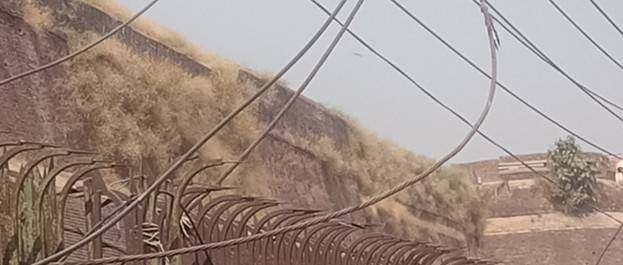
The Walled City of Lahore does an admirable job in the Fort when they find funds from international donors. But elsewhere, where only care and a little supervision is required, as in the case of removal of vegetation from the Fort walls, the neglect is noticeable.
The Qilla Road has footpaths on both sides of road. High voltage electric poles with myriad of cables hanging from their top, which must have existed before the footpaths were constructed, now lie embedded in these walkways, and cause much consternation as one passes hugging them but it is one of the hazards that cannot be avoided in the zigzagging streets of an ancient city.
When the British occupied Fort in 1849, its southern wall, now filled with wild vegetation, was intact up to the new Roshnai gate. The British were in no fear of invaders. They demolished the central portion of the wall and created two sets of stairs as convenient entry points to their offices. In his youth, this author would enter the fort through these stairs and climbing over the low iron gate, disregarding the objections of the fort staff. Due to security concerns, a metallic fence has now been erected along the footpath that runs all the way to the western corner of the Shahi Mosque with a small gap at the Roshnai Gate.
The land across the road opposite the southern wall of the Qilla, used to be an open space that was converted to a park during 1980s and is still well maintained. This is the very place where the British installed the tube wells in 1883 to feed the water works tanks that formed the first water supply scheme of the city. Beyond the park towards the city is the Baroodkhana Bazaar. One length of the park with its main gate is on the Heera Mandi Bazaar leading to the Food Street and the Fort on one side and the Phujja Sri Paye on the other. Opposite this gate is the popular, and one that continues to be our family’s favourite spot for festive breakfast, Taj Sweets serving delicious halwa-puri. This shop is between the twin Uncha and Neecha Cheetram streets that merge short of Taxali Gate near Tibbi Bazaar. I entered the Neecha street on the left; a street that was once a part of the flesh trade and the singing girls. For a little time in the 1940s, it was also the abode of a young voluptuous teenage singer from Kasur named Allah Rakhi Wasai, who would later rock the music world as Madam Noor Jahan. The street is now occupied by cottage industry catering to shoe making business.
Neecha Ram street enters a misaligned Chowk, where it bifurcates with the right lane continuing with the same name and the left lane as Sheikhupurian Bazaar. Between the two lanes at the head of the Chowk, this author passed by a shop serving breakfast to a set of clients on a table outside the shop. The clients included a lady and a couple of gentlemen who, to his (in)experienced eye, appeared from the oldest profession. Evidently, though the business has lost its vibrancy, there is still some activity around the Tibbi Bazaar area.
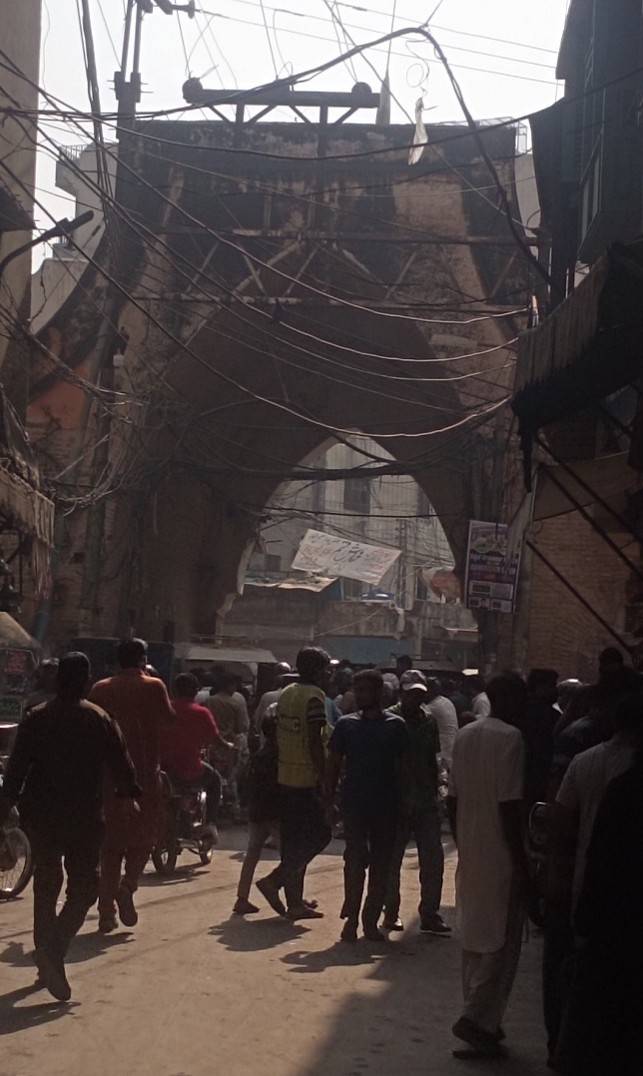
The plaza on the left at the Chowk used to be the Tarunnum Cinema which did brisk business in its heydays till the Islamic zealotry of Zia regime discouraged cultural activities and put an end to the film industry. The Chowk, however, is still called Tarunnum Chowk. Around the plaza, the road makes a small loop to the left, with the Bazaar Sheikhupurian taking off to the right and the left street leading to Bhaati Gate. Along the latter way, one walks past layers of history. This road starts as Tibbi Bazaar, changes name to Bazaar Hakiman and then to Androon Bhaati Gate before exiting through one of the few original wooden surviving gates of the city.
The reputation of this area has evolved over the centuries from extremely honorific to the most depraved. It commenced its life during the Mughal era as the Shahi Mohalla, meaning the Abode of the Royals
Bhaati Gate area has been called the Chelsea of Lahore. Chelsea is an area in west London that has been home to many leading figures in politics, art, literature and music. Some of these, from a long list, include Thomas Carlyle, Francis Bacon, Agatha Christie, Enid Blyton, T.S. Eliot, Ava Garland, Judy Garland, Mick Jagger and Lloyd George. The Bhaati Gate Bazaar too has been home to a large number of people who late rose to great fame in various walks of life. Khateeb Badshahi Mosque Maulana Ghulam Murshid was one of the residents here. Sir Abdul Qadir, editor of the pioneering newspaper Makhzan, lived in a Gali off Bazaar Hakiman. Dramatist Agha Hashar resided here for a long time till his wife died. Poets Dagh Dehalvi, Muhammad Hussain Azad, Allama Iqbal, Tanvir Naqvi and Sir Shahbudddin lived here for a time.
Muhammad Tufail started his Naqoosh magazine, perhaps the most prestigious Urdu publication ever, from Jogi Mohallah. The Bazaar was the abode of honorary physician and surgeon, Dr Muhammad Hussain and Dr Rahim Khan, to the Viceroy in 1860s. Dr. Pandat Perbhurat Shastri and Dr. Shafi, principals of Oriental College resided here for some time. Ghulam Abbas, the famous short story and film script writer were residents before moving to Bombay. Film director A.R. Kardar, cricketer A.H. Kardar, music director Khawaja Khurshid Anwar and many actors lived in the Bazaar.
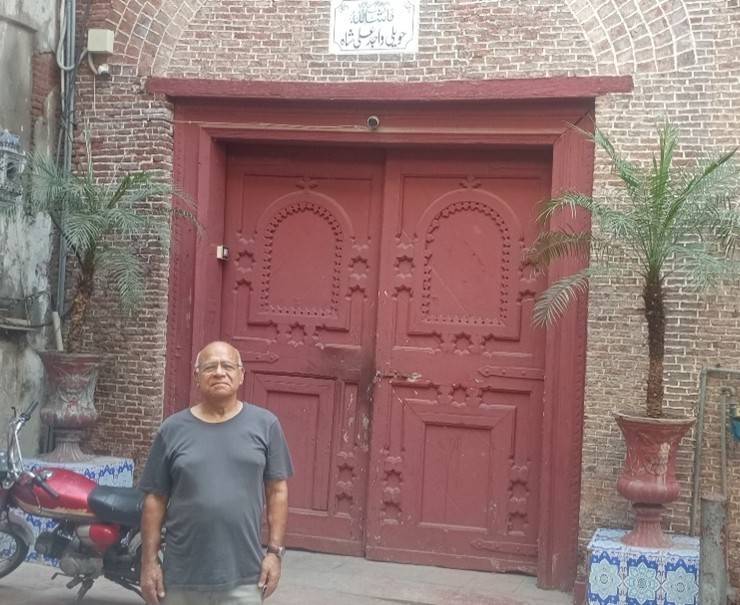
For a visitor like this author, who is trying to absorb the various layers of history, the walk is slow and deliberate. The reputation of this area has evolved over the centuries from extremely honorific to the most depraved. It commenced its life during the Mughal era as the Shahi Mohalla, meaning the Abode of the Royals, which is understandable. Its exalted position continued till the Sikh period when generals and ministers lived here. Havelis, especially of Todar Mal (now Haveli Wajid Ali Shah), Fakir brothers, Dhian Singh Dogra, Barood Khana, etcetera litter this area. During the latter Mughal and Sikh eras, courtesans established their trade in these localities. In the British era, the area came to be known for profane and suggestive dancing and risqué trade. In 1960s, loitering the streets along with my cousins as curious teenagers, this author has seen dance performances in the houses at the Heera Mandi Chowk, and sighted some famous film actresses of that time moving from one house to some other. On both sides of the Heera Mandi street upto Tarunnum Chowk, girls could be seen standing in the first-floor galleries in the evening, soliciting clients. It was known as the area of the higher-end flesh trade frequented by leading politicians and businessmen. Lower-end practitioners were found in the Tibbi Mohalla.
As can be observed, when the area was becoming notorious for harlotry, it was simultaneously gaining reputation as center for the literati and the intelligentsia. Hakim Ahmad Shujah, a scion of the Hakim family whose relationship extended to the Fakir and the Syed families (Syed Babr Ali, owner of Packages and founder of LUMS), wrote a book titled ‘Chelsea of Lahore’, signifying the importance of the area as an abode of writers and poets. The book, incidentally, is available online in pdf format.
The initial portion of this road, as stated above, is called Tibbi Bazaar. The locality on the right bounded by Bazaars Tibbi (in the east), Sheikhupurian (in the north) and Mohlian (in the west), and Gali Judge Latif (in the south) is the Tibbi Mohallah. Tibbi means a raised ground which must have been the case way back before repeated constructions, demolitions and re-carpeting of streets nearly levelled it off. Gali Judge Latif is named after a resident, a civil servant of the later 19th century, who is the author of a well-researched book written in 1892 titled ‘Lahore: Its History, Architectural Remains And Antiquities.’ If not for this book, much of the history of Lahore would have been lost. Tibbi Mohalla and the eponymous portion of the street became synonymous with flesh trade during the British period. Before that it was abode of dancers and courtesans who entertained the Sikh elite and royalty. The British soldiers, poorly educated and ill-refined, didn’t appreciate the subtle footwork, spins and expressions of Kathak, the dominant dance form of north India and were rather practical with the ladies of this locality. Along the Tibbi Bazaar, midway between the Tarunnum and Tibbi Chowks, is the Masjid Naumania, which has been described as the true depiction of Ghalib’s verse, ’مسجد کے زیر سایہ، خرابات چاہیے’ meaning, ‘Worldly affairs should continue under the shadow of the mosque.’ Mazar Pir Raza Shah Qadri at the Tibbi Chowk was also favoured by the ladies of the night to find spiritual solace. The locality on the east side of the Tibbi Bazaar is Kucha Tehsil, so called because of the office of the Tehsildar during the Sikh era.
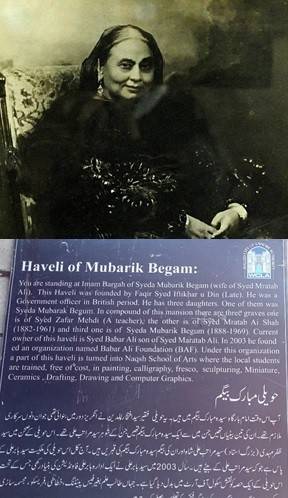
Walking past, there is the Haveli Mubarik Begum on the left. Syeda Mubarik Begum was born in Fakir family and married to Syed Maratab Ali, a businessman and a philanthropist. They are parents of Syed Babur Ali mentioned above.
Little ahead, on the right is the house where Allama Iqbal stayed during his Government College days. Famously, he wrote his first poems here on the raised platform (tharra) of the house. The platform is well maintained with a metal enclosure and a signboard stating that Iqbal started writing his poetry there. I climbed the three steps onto the red coloured platform, feeling the weight of history as I imagined a young boy sitting on the side of an open bazaar, assembling the words to craft his first poems and commencing a poetic journey that would make him immortal as an Indian nationalistic poet, a Muslim renaissance thinker and one of the founding fathers of a new nation. Iqbal recited his poetry for the first time in the Urdu Bazm Mushaira held in a local haveli.
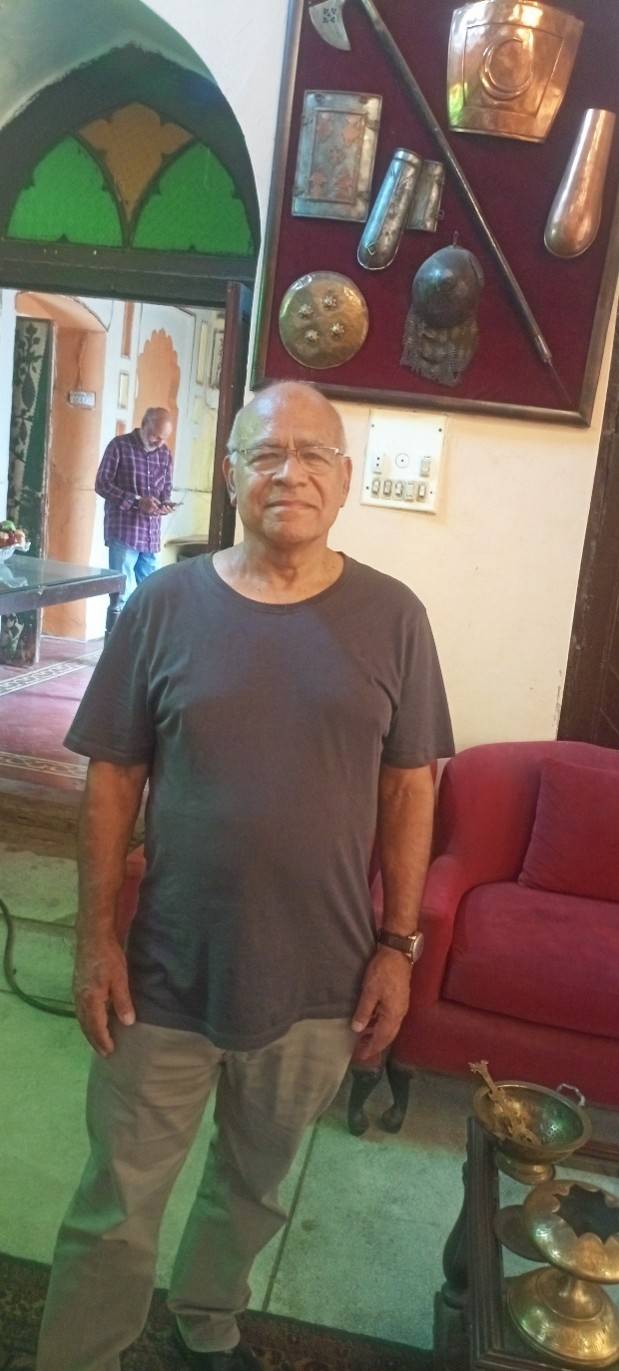
A little ahead on the left side is Kucha Fakir Khana and the Fakir Khana Museum, meticulously maintained by the Fakir family. Famously, three brothers, Fakir Azizudding, Fakir Imamuddin and Fakir Nooruddin, who served the Sikh Darbar of Ranjit Singh as hakims, diplomats, administrators and courtiers, resided here. The family has a long history traced to the ancient town of Chunian near Kasur. Haveli of Fakir Imamuddin is adjacent to that of Haveli Mubarik Begum. A family historian traces their lineage to Bokhara and Arabia, as most prominent families of Pakistan like to do instead of taking pride in being sons of this soil. The family has been living in Lahore since the mid eighteenth century and continues to belong to the area, also maintaining the Museum. This author walked into the museum where the staff allowed me a limited time because of a visiting foreign delegation. The museum houses many antique items including rugs, paintings, weapons and dresses.
Galis and Mohallas opening up on Bhaati Gate Bazaar tell stories in their self-explanatory names. They include Jogi Mohallah, Fakir Khana Gali, Teer Wali Gali, Peer Bhola Gali, Rajput Street, Mohallah Jalwattian, Mohalla Pat Rangan, Kucha Islam Khan, Khajoor Gali, etc. Each of these streets bifurcates every about a hundred yards, forming a winding, labyrinth maze. Every house in every Gali has a history dating back to Sikh and Mughal era.
As one approaches the Bhaati Gate, there is a shuttered Gali on the left where there used to be a police station but has now been shifted. I entered the Gali and found a couple of youngsters collecting contribution for a mosque. I sincerely hoped that some opportunists do not occupy this priceless land in the garb of establishing a mosque. This patch of road is too crowded for any organised activity. About a hundred meters short of the Gate, I stood on one side of the road and witnessed an endless horde of pedestrians and motorcyclists jamming the exit from both directions. Perhaps it was crowded due to the Friday prayers time. I recalled that in my childhood, tongas used to ply through the Bhaati Gate Bazaar all the way to the Hira Mandi but no more. Nowadays, that is impossible due to overcrowded streets. It took me a good fifteen minutes before finding the courage to plunge into this crushing crowd to cross over to the open space along the Circular Road in front of the Data Darbar on the right, Mori Gate on the left and the Lower Mall across. The bird market that had sprang up along the wall on the right has now been demolished. Exiting the Gate ended my delightful sojourn through the famous Bhaati Gate and its Bazaars.