

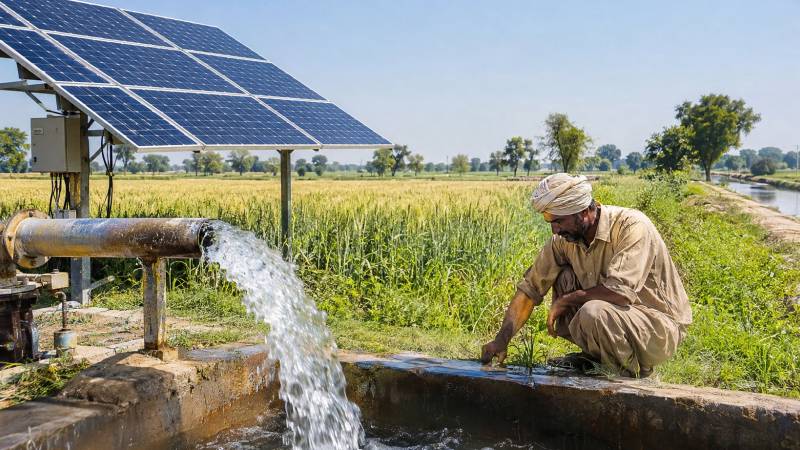
The farmer's electricity bill can disappear. His water problem cannot. Across Punjab, solar panels are making irrigation affordable for farmers battered by expensive inputs and uncertain crop prices. A pump that once required another purchase of diesel can now run on sunlight. For the cultivator trying to save a standing crop, that is liberation. For the aquifer beneath him, it means an important restraint on extraction has weakened. Punjab is celebrating the first consequence without adequately accounting for the second.
The findings of FAO's Water and Land Accounting in Punjab, reported this week, put annual groundwater depletion at approximately 4.5 million acre-feet (5.5 billion cubic metres). The province was drawing down its underground reserves to sustain its farms, cities and economic activity. Yet the assessment covers 2012 to 2017. The warning reaching us now rests on an account that ended nine years ago.
We are discussing an old deficit while the economics of extraction have changed around it. What makes this stranger still is that the missing account is not a proposal awaiting approval. It is a duty already written into law. Punjab Irrigation Department data shows what followed. In 2004, approximately 641 square kilometres of the mapped area had groundwater deeper than 60 feet. By 2014, that area had reached 3,100 square kilometres. By 2024, it was 7,701: a twelvefold expansion in twenty years.
Lahore's reported average depth to groundwater increased from approximately 31 feet to 78 feet over that period. Pakpattan's rose from 29 to 73 feet. Between 2014 and 2024, groundwater became deeper in 30 of the 31 listed districts. And that dataset ends in 2024. Meanwhile, Ember and Renewables First estimate that agricultural solar deployment across Pakistan reached 8.1 gigawatts by June 2025, approximately four-fifths of it off-grid. Reuters subsequently reported that farmers interviewed in Punjab were irrigating more frequently after adopting solar pumps.
These findings do not tell us the precise size of Punjab's groundwater deficit today. Rainfall, floods and recharge also affect the balance. They do give us compelling reason to believe that pressure on already stressed aquifers has intensified. An account ending in 2017 cannot answer the questions raised by this transformation. Nor can the farmer answer them alone.
When canal water fails to arrive, he cannot postpone his crop's need for moisture until the department repairs an outlet. When electricity becomes unaffordable, he cannot ask the wheat to wait for tariff reform. He finds a solution: a tubewell, solar panels, a deeper bore. Each investment keeps production going. Each allows the state's failure to remain less visible. Eventually, the farmer reaches a limit that another private investment cannot overcome.
A water charge that is not spent on the water system becomes taxation by another name, and the farmer can tell the difference without reading a budget document.
The aquifer is shared. One farmer's pumping affects the water available to others. Those with the means to deepen wells can continue extracting while poorer neighbours struggle. The state cannot leave access to this common resource to a competition over who can afford the next bore. But it cannot credibly regulate groundwater while neglecting the canal system that should reduce dependence on it. Punjab's ageing irrigation network carries accumulated maintenance deficits. Silted channels, deteriorating structures and poorly functioning outlets make deliveries unreliable, particularly at the tails. The farmer pays for the resulting uncertainty through pumping costs and production risk.
The arithmetic of the revised water charge sharpens this. Punjab expects to collect Rs 43.6 billion in irrigation receipts this year. It has allocated Rs 8.9 billion for the repairs and maintenance that are the charge's own justification. A fifth of what is collected, for the purpose for which it is collected. A water charge that is not spent on the water system becomes taxation by another name, and the farmer can tell the difference without reading a budget document.
Reliable canal water, delivered when crops need it, would lessen the dependence on the pump. Maintenance must therefore become a groundwater policy as well as an engineering responsibility. It needs assured funding, and a test that farmers can recognise: did the water arrive, in the required quantity, at the required time? A province that cannot show the farmer where his water charge went will struggle to convince him that its groundwater rules will be any different. Credibility is one currency, and it is spent across the whole system.
A maintenance programme should be judged at the tail of the canal. Expenditure recorded in Lahore is no substitute for water delivered in the field. The same discipline must govern cropping decisions. Punjab cannot encourage agricultural production without asking whether the water beneath it can sustain the ambition.
Crop zoning must have consequences. In stressed aquifer zones, the expansion of water-intensive crops should be restricted, with phased limits where existing cultivation exceeds sustainable availability. Rice and sugarcane deserve particular scrutiny in such locations. Here the revised abiana moves the other way: a flat rate that charges the wheat grower what it charges the grower of paddy or sugarcane, discarding the one price signal that pointed, however weakly, toward conservation. A crop's profitability is incomplete arithmetic when the depletion of its water supply is left outside the account.
Farmers will not abandon familiar crops because a seminar recommends alternatives. They need confidence that another crop can be financed, grown and sold. Credit, suitable seed, extension support and dependable buyers must accompany the transition. The government cannot encourage a crop through its incentives and market arrangements, then blame the farmer for the water it consumes.
This is precisely why Punjab needs an authoritative, current water account. It should determine where pumping requires restraint, where canal reliability needs improvement and where cropping choices exceed the resource. The obligation already exists. Section 98 of the Punjab Irrigation, Drainage and Rivers Act 2023 requires annual groundwater reporting, including estimated recharge, abstraction and sustainable availability. The provincial report for 2025 should have been prepared and laid before the minister by the last working day of March 2026. The law requires it to be available for public inspection at the secretary's office on reasonable notice.
Was it prepared? Where can it be inspected? What changed because of its findings? These are straightforward questions about an existing duty, and they have an address. The law charges the Secretary, Irrigation Department, with preparing the report and opening it to public inspection. It requires that the report be laid before the Minister for Irrigation. Both offices owe the public an answer. Punjab does not need another conference to explain why water accounting matters before receiving one.
I participated in FAO's Lahore workshop on water accounting in July 2019. As Punjab's irrigation minister, I then had both the obligation and the opportunity to carry it into law. The Punjab Water Act 2019 established a Water Resources Commission (section 3) and required it to determine water allocations annually among domestic, agricultural, industrial and ecological uses (section 5); it brought groundwater within the state's licensing power over abstraction (section 43). The Punjab Irrigation, Drainage and Rivers Act 2023, drafted during my tenure, went further: it vested the province's groundwater in the government and wrote the annual groundwater report into section 98. That history places an obligation on me too. Policies approved and laws enacted during my tenure must face the same test: what decisions changed, and what measurable benefit reached the citizen?
The reports should be published online. Older accounts should be reconciled with subsequent observations and brought up to date. Wells should be registered and large abstractions monitored, with licensing focused on stressed aquifers and safeguards for small farmers and domestic users. The additional abiana receipts should be ring-fenced for the canal system, and that ledger should be public as well: what was assessed, what was recovered, what was repaired, and whether any of it reached the tail.
Water quality must be part of the account. PCRWR's 2020 investigation of the Lower Indus Plain warns that excessive pumping can draw underlying saline water into freshwater layers. A farmer can lose usable water before his well runs dry. The same investigation identifies river and irrigation-network seepage as a major source of recharge. That matters when rehabilitation is reduced to indiscriminate lining. Where seepage replenishes usable groundwater, eliminating it can weaken the reserve on which neighbouring farmers depend. Better delivery and aquifer protection must be assessed together.
Solar power can help keep farming viable. Reliable canals can reduce the need to pump. Sensible crop regulation can bring demand closer to what the land and water can sustain. These choices belong in one policy, informed by one public account. The farmer has already paid for the pump, the panels and the deeper well. This year he is also paying a higher water charge. Punjab owes him more than another warning based on old numbers. It owes him the account the law requires, and decisions that give his next crop a future.