

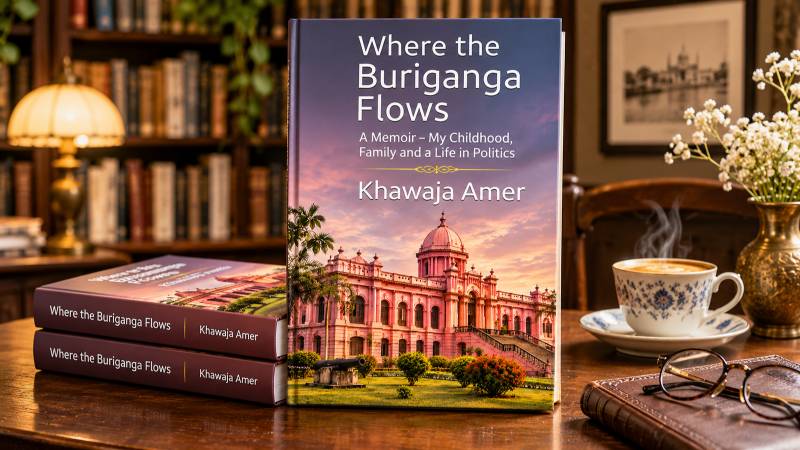
Khawaja Amer’s memoir, Where the Buriganga Flows, is a personal and historical account of childhood, family life and growing up in Dhaka between 1953 and 1966. Set against a period of significant political and social change in East Pakistan, the memoir offers more than a glimpse into family traditions, cultural heritage and everyday life. It takes readers back to an important era in the history of the region, when political developments, changing social attitudes and the growing sense of Bengali identity were shaping the lives of ordinary people. Through his book, the author captures the relationship between family, culture, education, spirituality and the wider political environment. In doing so, he brings to life a world that has largely disappeared, while preserving a valuable record of both his family’s heritage and a defining period in the history of East Pakistan, before the advent of Bangladesh.
The book revolves around 15 Ahsanullah Road, popularly known as Ahsan Manzil, the ancestral home, where the author spent his formative years. Yet this is much more than a story about a family home. It is a journey into the past, introducing readers to the people, places and experiences that shaped the author's outlook on life. One of the most touching aspects of the memoir is the tribute to three important women in his childhood; his grandmother, Shahzadi Khanum (Nano), his mother, Farhadi Khanum (Ammi), and his aunt, Hasina Begum (Mumani Jan). Each played a special role in the family. Nano is remembered as a strong, dignified and wise woman who combined authority with affection. Mumani Jan is recalled for her kindness, patience and dedication to the household, while the memories of Ammi are particularly moving, reflecting her devotion to her family, her faith and her love of cooking. These recollections give the book much of its warmth and emotional depth.
The chapters about Khawaja Khairuddin, affectionately known as Mamma, add an important political dimension to the memoir. His patriotism, political beliefs and commitment to public service had a lasting influence on the author. Family discussions about Quaid-e-Azam Muhammad Ali Jinnah, the Pakistan Movement and the principles of Unity, Faith and Discipline helped shape his early understanding of national responsibility. One of the most interesting episodes is Mamma's role in persuading Mohtarma Fatima Jinnah, popularly known as Madar-i-Millat (Mother of the Nation), to enter the 1965 presidential election against Field Marshal Ayub Khan. Having largely stayed away from active politics since her brother's death, her decision to challenge a serving president came as a surprise to many. However, Mamma believed that the circumstances demanded her involvement and that she could unite the opposition against Ayub Khan.
The memoir reminds readers that history is not shaped exclusively by celebrated personalities and defining political events, but also by families, teachers, neighbours and ordinary experiences that preserve the cultural and emotional fabric of a society.
The author recalls that Mamma announced Fatima Jinnah's candidature in a press statement while in Karachi, even before the Combined Opposition Parties (COP) had formally declared her as their candidate. The Urdu daily Hurriyat criticised his announcement in an editorial, dismissing it as unrealistic. When the author showed Mamma the newspaper cutting, he simply smiled and told him to "wait and see". About a week later, the COP officially announced Fatima Jinnah as its presidential candidate. This episode reveals Mamma's powers of persuasion, political foresight and confidence in his convictions.
The memoir reminds readers that history is not shaped exclusively by celebrated personalities and defining political events, but also by families, teachers, neighbours and ordinary experiences that preserve the cultural and emotional fabric of a society. The memoir also describes Mamma's work as Fatima Jinnah's chief election campaigner in Dhaka. He devoted himself to organising meetings, mobilising political workers and bringing opposition leaders together. Although she lost the national contest to Ayub Khan, Fatima Jinnah secured a clear victory in Dhaka city. This account offers a valuable personal insight into an important moment in Pakistan's political history and highlights Mamma's contribution to the campaign.
Another memorable feature is the description of the wider family and social life surrounding Ahsan Manzil. The author recalls relatives, friends, teachers and household members with warmth and affection. Memories of the family paandan, traditional hospitality, gatherings and everyday conversations paint a fascinating picture of a way of life that has gradually disappeared.
The account of Najmu Mamma's Khanqah is particularly interesting. Descriptions of Zikr, Qawwali, Sama, the annual Urs, Chadar Poshi and Langar introduce readers to its spiritual atmosphere and highlight values such as humility, generosity, equality and service to humanity. The incident in which Najmu Mamma accepts a public reprimand from an elder with complete humility is especially memorable. The lighter side of childhood is equally engaging. The open field in front of the house, where children played football, cricket and badminton, brings back memories of simpler times. The badminton tournament organised by Mumani Jan, the Independence Day celebrations arranged by Yousuf Jan Sir, literary gatherings at Khaloo Baba's house, Urdu poetry discussions and the family library all add colour to the narrative. The excitement of listening to cricket commentary on the radio is another reminder of how entertainment and family life were closely connected.
One of the book's greatest strengths is its attention to detail. The author does not simply mention people and events; he recreates their atmosphere. Readers can almost picture the family gatherings, hear the conversations and share the excitement of childhood activities. His affectionate writing makes the people and places he describes feel familiar. The memoir is also a valuable record of family and social history. It preserves the traditions, political connections and cultural contributions of a prominent Dhaka family. More importantly, it reminds us that history is not shaped only by famous personalities and major political events, but also by families, teachers, neighbours and everyday experiences.
The later chapters place these memories against the wider political changes in East Pakistan. The growing demand for provincial autonomy, Sheikh Mujibur Rahman's Six-Point Programme in 1966, the political unrest that led to Ayub Khan's departure in 1969 and the events culminating in the creation of Bangladesh in 1971 provide a broader historical setting. Mamma's eventual move to Karachi is described as a painful experience, as he had to leave behind his ancestral home, political life and the city to which he was deeply attached.
The writing is warm, descriptive and easy to follow, and the author's personal involvement makes the narrative sincere. However, some additional historical background would also have helped readers unfamiliar with the period. Overall, A Journey Through Memories is a charming and meaningful memoir. It takes readers back to a world in which family was at the centre of life, elders were respected, hospitality was a tradition, books and poetry were valued, and spirituality was part of everyday experience. It also offers an interesting glimpse into the social and political life of Dhaka before 1971.
The book reminds us that our childhood is shaped not only by the places, where we grow up but also by the people around us and the values they pass on. By recording these memories, Khawaja Amer has preserved a world that might otherwise have been lost with time. The book will appeal particularly to readers interested in the Dhaka Nawab Family, the history and social life of pre-1971 Dhaka, and the traditions of an earlier generation. It will also resonate with anyone who values family memories and the importance of passing them on to future generations. A heartfelt tribute to a family, a home and a bygone era, this memoir is not only about remembering the past; it is about keeping its spirit alive.