

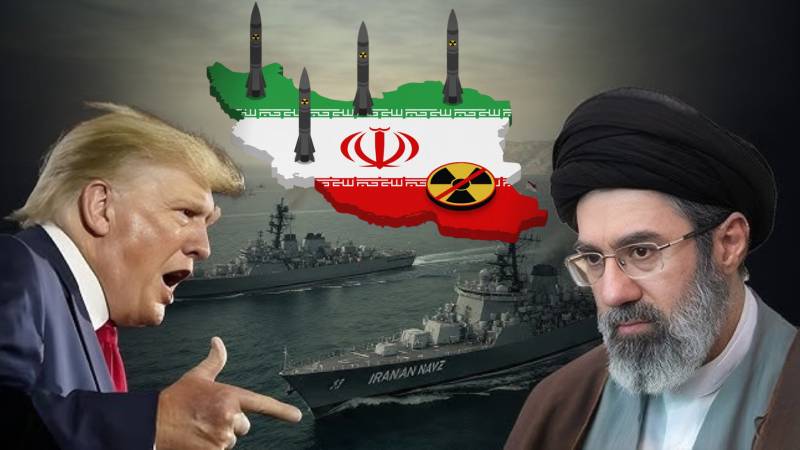
The recently held talks between the high-powered U.S. and Iranian delegations in Islamabad reflected that the two sides lacked flexibility and political will to reach an agreement. According to American Vice-President J.D. Vance, the Iranian delegation in Islamabad lacked the authority to reach an agreement with the U.S., and that is the reason the talks remained inconclusive.
Iran argued that the talks failed to yield positive results because the United States refused to honour its trust towards Iran. Whereas the U.S. made it clear that Iran failed to realise that America had red lines, namely not to accept, by any means, Iranian nuclear ambitions. Enrichment of uranium by Iran above 60% is sufficient to proceed towards manufacturing a nuclear device.
That type of concern forced the U.S. to seek a categorical commitment from Iran that it would not use its enriched uranium for manufacturing nuclear weapons. Since Iran failed to give such an assurance, the U.S. delegation decided to leave the negotiating table.
For a variety of reasons, Iran argues that there is a serious trust deficit with the United States because, on several occasions, it has let down Tehran. In June 2025 and February 2026, when talks on the nuclear issue were going on between the United States and Iran in Geneva, America attacked Iran.
How can Tehran now trust the United States when, in the past, it failed to honour talks? Otherwise, on other issues like the lifting of sanctions and regime change, the U.S. pursued a flexible approach. But the real bone of contention which has emerged in the recent past is related to the Strait of Hormuz, its closure and blockade.
After the inconclusive nature of U.S.-Iran talks, American President Donald Trump announced the imposition of a naval blockade of Iranian ports, making it clear that its navy would not allow the exit or entrance of any ship at the Strait of Hormuz. Is the U.S. Navy capable of pursuing that difficult and gigantic task, particularly when Iran has made it clear that it will not allow any act which seeks to blockade its coast? It seems the Iran-U.S. conflict will remain unresolved unless the two parties adopt meaningful confidence-building measures to establish trust so that whatever is agreed upon is implemented in letter and spirit.
What sort of trust-building measures can Iran and the United States adopt to take their talks to a logical conclusion? How will the U.S. prevent Israel from sabotaging American-Iranian talks, and how are the threats of President Donald Trump of obliterating the Iranian military and destroying its civilisation a major impediment to restoring trust between the two countries?
There is a silver lining emerging from the Islamabad talks—that the two sides will certainly avoid another phase of armed conflict and will use Track-I diplomacy to manage and resolve their issues
Since the outbreak of the Islamic Revolution in Iran in February 1979 and the hostage crisis from November 1979 till January 1981, there has been enormous hostility between Tehran and Washington. America tried, through Iraq, to destabilise Iran during the eight-year Iran-Iraq War (1980–88), imposed sanctions, supported anti-regime elements, and has now conducted direct attacks on Iran, but it has failed to destabilise the Iranian regime.
Six weeks of U.S.-Iran war led to global losses of 200 billion dollars, the elimination of top Iranian civilian and military leadership, and massive destruction of its infrastructure. The U.S.-Israeli attack also caused losses to the Iranian Air Force, navy, and its military assets. Yet Iran refused to capitulate because of its resilience and motivation.
Before February 28, the Iranian regime had become highly unpopular because of massive demonstrations and the killing of thousands of protesters by security forces. But the U.S.-Israeli attack on Iran augmented patriotism to combat foreign aggression. The Iranian leadership, despite weeks of bombings, is confident in dealing with the naval blockade of the United States and has made it clear that it will not compromise on its sovereignty and security.
Trust-building or the trust deficit in U.S.-Iran relations needs to be examined from three sides. First, the reality of the U.S. failure to topple the Iranian regime, but its repeated actions with Israel to destabilise Iran, cannot be ignored. Such a situation has augmented the lack of trust between the U.S. and Iran. Most importantly, the manner in which America shattered Iran’s trust when nuclear talks were going on in Geneva led to the rupture of the Islamabad talks. By imposing a naval blockade of Iranian ports, the U.S. has further aggravated the situation.
When mistrust in Iran-U.S. relations is inbuilt, and there are forces on both sides that do not want to mend fences based on political will, determination, and a win-win situation, it is not possible to proceed with confidence-building measures. Second, a foremost requirement in trust-building is to launch Track-II and Track-III initiatives in Iran-U.S. relations. Presently, Track-I diplomacy in the form of government-to-government talks between Tehran and Washington is ongoing.
But one needs to understand that merely through official or Track-I dialogue, one cannot expect a breakthrough in the decades-old schism in Iran-U.S. relations. Therefore, it is imperative that, in order to facilitate Track-I dialogue, efforts for Track-II and Track-III diplomacy should also be given serious consideration.
When the People’s Republic of China and the United States could engage in ping-pong diplomacy during the 1960s and subsequently normalise their relations, Iran and America could also follow that model. The history of Track-I, Track-II, and Track-III diplomacy for the management and resolution of conflicts is quite old. India and Pakistan, for decades, have used Track-II and Track-III diplomacy when Track-I was stagnant. Track-I diplomacy is between the officials of two adversaries. In contrast, Track-II is between non-officials with the support of respective governments, and Track-III is exclusively private and non-official.
Finally, confidence-building measures require the cessation of hostile propaganda against each other and the creation of an environment that is not hostile. It also means vibrancy in economic, political, and cultural relations, which is not the case in Iran-U.S. ties. Since 1979, the United States and Iran have had no diplomatic relations, a situation aggravated by the hostage crisis and the imposition of sanctions by America against Iran. Five decades of hostility, ill will, paranoia, and mistrust between the U.S. and Iran cannot be replaced with friendly relations merely through the holding of high-level direct talks in Islamabad.
There is no shortcut to establishing trust or mitigating ill will and suspicion between Tehran and Washington. But one thing has been proved in the recent war: neither has the U.S. been able to defeat Iran, nor has Iran been able to mitigate American power. Yet there is a silver lining emerging from the Islamabad talks—that the two sides will certainly avoid another phase of armed conflict and will use Track-I diplomacy to manage and resolve their issues.
Once Track-I diplomacy yields positive results and the two sides establish mutual trust, efforts should be made to initiate Track-II and Track-III diplomacy, which will help diminish the trust deficit. The United States, having failed to defeat Iran, change the regime in Tehran, and dismantle its missile and nuclear programme, should now focus on pursuing a policy of non-interference and non-intervention in the affairs of Iran.
If peace is in the interest of Iran and the United States, it is also in the interest of Gulf and Middle Eastern countries to support the peace process. However, the only villain obstructing peace between Iran and the United States is Israel. It would be better if American leadership prevents Israel from again destabilising the situation in the Gulf and the Middle East.