

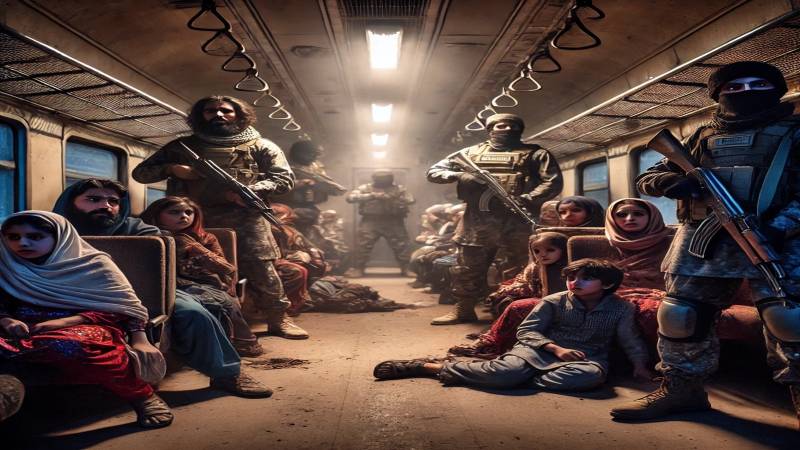
In the afternoon hours of Tuesday 11 March, the Jaffar Express train – nine carriages traveling on the train’s usual route departing from Quetta at 9 am local time to cover its 30-hour journey to Peshawar – was ambushed by Baloch Liberation Army (BLA) guerilla fighters near the Mashkaf Railway Tunnels, some 160 kilometres from Quetta in an area between Pehro Kunri and Mushkaf railway stations. The train was carrying between 440 and 450 passengers, including reportedly more than a hundred off-duty security forces personnel. The train tracks in this area had already been sabotaged, and a video of the attack released by BLA’s Hakkal Media shows the train being brought to a halt in an open area, with explosives detonating on the tracks and BLA fighters firing bullets and rocket propelled grenades (RPGs) at the train to disable it completely.
It was initially reported that BLA militants had hijacked the train inside Tunnel No. 8 of the Mashkaf Railway Tunnels complex through which the Rohri-Chaman Railway Line passes. However, it ultimately became clear that the train was not in any tunnel or enclosed space when it was attacked and halted. The BLA quickly issued a claim of responsibility and announced that it would free noncombatant hostages (women and children) but still hold anywhere between 144 and 214 hostages, many of whom they claimed to be Pakistani security forces personnel. As to the identity of these hostages, one source claimed that the hostages included 37 soldiers, 28 naiks (corporals), 23 lance naiks (lance corporals), 15 havaldars (sergeants), 4 signalmen, 8 sappers, 4 non-commissioned officers, 2 bombardiers, 1 gunner, 3 naib subedars (warrant officers), 4 lower havaldars (junior sergeants) and several other personnel, including officers of the rank of major and captain. Thus began the hijacking of the Jaffar Express, which ended with a “clearance operation” that ran through Tuesday night well into Wednesday.
In the end, the ISPR confirmed on Wednesday night that 33 of the terrorist hijackers, including suicide bombers, had been neutralised, while the hijackers had killed 21 hostages before the operation began. In his press conference on Friday 14 March, DG ISPR Lt Gen Ahmed Sharif Chaudhry confirmed that the total number of hostages killed by militants had risen to 26, of whom 18 belonged to the Pakistan Army and the paramilitary Frontier Corps. 4 security forces’ personnel made the ultimate sacrifice during the course of the security operation to retake the Jaffar Express. One security personnel deputed on the train was also killed, bringing the total “operational casualties” to 5.
A total of 346 hostages were rescued, of whom 37 were wounded. A “sanitization operation” was also launched in the area, which continued over 72 hours after the incident took place. Meanwhile, BLA kept releasing statements to the media throughout the hijacking, and even after the operation, claiming that it still retained some number of hostages, who had been sequestered with suicide bombers who would detonate their explosives if the security forces launched any further operations. Many of these statements kept being immediately reported as breaking news by several Indian news media outlets. The BLA christened this attack “Operation Mashkaf”.
Since the entire incident lasted over 24 hours, there was widespread misinformation and disinformation regarding the hijacking. But in an environment where the mainstream media is controlled, the news media ecosystem itself will naturally have no objective mechanism for checks and balances that could allow them to sift between true and false, between authentic and fake. Constant attempts by the Pakistani military establishment to try and control the flow of information shows that the focus continues to be on the wrong priorities: manipulation of narratives is easily detectable, whether you do it or your opponent does it, and in the final analysis, imposing controls on information flows is essentially futile in today’s day and age. Doing both results in a loss of credibility that states and credible organisations can hardly afford.
Sources report that the Balochistan counter terrorism department (CTD) had issued a threat alert on Friday 7 March about a “planned attack” by the outlawed BLA, but the alert did not include specifics such as the location and target of this planned attack. And as the hostages kept making it to safety, they described harrowing scenes of wanton firing by the militants, the hostages being separated into groups, and executions of hostages, to the international media. One eyewitness report stated that some of the hostages attempted to escape at around 10 pm on Tuesday night: they were mowed down by gunfire from the BLA militants.
The hijacking of the Jaffar Express occurred on Tuesday afternoon, and Pakistani special forces’ complex operation to wrest control and rescue all the hostages continued well into Wednesday
In the aftermath of the hijacking, DG ISPR Lt Gen Ahmed Sharif Chaudhry said that “the rules of the game have changed”, signalling that the military establishment has the intention to deal with these internal security and terror threats more forcefully and coherently. What these steps are, and which of these steps that the civil-military leadership, and the state institutions they run, will actually take, all remains to be seen: these very officials instituted a “zero tolerance policy” against terrorism and extremism way back in January 2023, but here we are today.
On 1 March, the Baloch separatist militant alliance “Baloch Raaji Aajoi Sangar” (BRAS) announced the formation of a new “National Army of Balochistan”, heralding a new “intensive phase” of the Balochistan insurgency. However, the outlawed BLA planning and executing a ‘solo operation’ after this announcement, given that it is one of the strongest components of BRAS, raises more than just a few eyebrows. Perhaps the BLA wished to show its operational capabilities to all and sundry, or perhaps this was a spur-of-the-moment attack, to which non-BLA and non-Baloch elements also allegedly gravitated, to play their part and create as much trouble and embarrassment for Pakistan’s security establishment as they possibly could. In his press conference flanked by the chief minister of Balochistan, DG ISPR Lt Gen Ahmed Sharif Chaudhry asserted that the suicide bombers taking part in the hijacking of the Jaffar Express were “all Afghans”.
The BLA’s suicide bomber wing, the Majeed Brigade, is increasingly accused of having close operational linkages with the banned Tehreek-e-Taliban Pakistan (TTP), and of training on militant bases in Afghanistan. This seems very implausible to those who know that the TTP is a religiously motivated extremist movement, whereas the BLA has a secular underpinning to its separatist ideology. There have also been reports that, like the TTP, BLA has also been receiving support from the Afghan Taliban for a few years now. Some have accused the deputy director of the Afghan Taliban’s intelligence agency GDI, Tajmeer Jawad, of being in command of military facilities that were being used for training BLA militants and bombers of the Majeed Brigade.
This would appear to confirm the assessment made in the 35th report of the Monitoring Team answerable to the UN Security Council's 1267 Committee, where it noted in point 96 that two member states (presumed to be Pakistan and China) had shared intelligence inputs regarding close collaboration between Al Qaeda, TTP, BLA, and BLA’s Majeed Brigade. In essence, if such an operational synergy does actually exist, it would not be rooted in an ideological alliance: the interests of these violent non-state actors (VNSAs) converge and coincide when it comes to their fight against the Pakistani state, and their target is the same even if their agenda and goals are not. This makes two things eminently clear: one, that the sub-conventional security threat to Pakistan in its western provinces continues to intensify and metastasise; and two, that it does not behove a nuclear power to even tolerate and allow, much less project and promote, sub-conventional proxy militias operating on its soil, because sooner or later the deep state’s control of such groups will evaporate.
BRAS announced plans for stronger blockades on Balochistan’s national highways to step up the tempo of the insurgency, but such a coordinated and prolonged attack on the railways system is a much bigger signal: it indicates that even newer and more advanced railways systems, potentially to be constructed by China sometime in the future to link Kashgar to Gwadar, would be kept under threat by separatist militants unless the insurgency subsides, or unless the rights of the Baloch people are returned to them so that they can themselves reject separatism, provided that ship has not yet sailed.
No contact could be established with hostages in the early stages of the hijacking on Tuesday evening, but intelligence surveillance of signals frequencies operational in the area revealed that the hijackers were in contact with their handlers: Pakistani security sources claim these handlers are based in Afghanistan and operate with backing from India. It was hoped that conversations between attackers and their masterminds would be shared with the mainstream media in the DG ISPR’s press conference. However, the Pakistan Army’s official spokesman shared a number of audiovisual media clips which showed how the Pakistani military, most likely the Pakistan Air Force, was employing UAVs (unmanned aerial vehicles, or drones) for monitoring and surveillance of the hijacked train and the proximate areas.
The hostages were rescued in three waves, with the last one being the hostage rescue and clearance operation launched by the Pakistan Army Special Service Group’s (SSG) Zarrar Company, the military’s premier counterterrorism warfighters, at midday on Wednesday 12 March. And the special forces took immense precautions to ensure the safe recovery of all hostages, a mission that was complicated by the presence of suicide bombers who could have detonated their explosives the moment they discovered any rescue operation being initiated by the Pakistani military.
BRAS, a separatist militant umbrella of which BLA is a part, announced a new ‘national army’; that the BLA conducted a ‘solo mission’ after this announcement raises more than just a few eyebrows
Pakistani prime minister Shehbaz Sharif visited Quetta on Thursday 13 March and delivered emotional remarks at a meeting of top-ranked provincial and federal officials. He noted that terrorism had been dealt a severe blow through countless sacrifices rendered under the auspices of Operation Zarb-e-Azb from 2014 to 2018, and proceeded to criticise his incarcerated predecessor’s administration for supporting the Afghan Taliban “breaking their shackles of slavery”, for releasing hundreds of captured TTP militants from Pakistani jails, and for resettling scores of TTP militants and their families back from Afghanistan into Pakistan’s tribal districts.
“I’m not here for any political point scoring, I am here as a Pakistani and nothing else”, prime minister Shehbaz Sharif exclaimed, adding that, “if Pakistan exists only then we exist, we are all because of Pakistan”. The prime minister also called on the nation to consider this terror attack another APS moment. “If we do not eliminate the scourge of terrorism, then… there will be a danger to the very existence of Pakistan,” the premier acknowledged in the presence of COAS General Syed Asim Munir. The prime minister concluded his public statement to the high-powered meeting by revealing that he had told the army chief on 12 March that the federal government will provide all the resources that are needed to uproot the resurging menace of terrorism, separatism, and insecurity.
It is high time that Pakistan’s security establishment refocus itself from political helmsmanship and dedicate their time and resources to the resolution of national security threats and internal security problems that Pakistan has been facing since the Fall of Kabul in August 2021. Merely relabelling the terrorists as “Khawarij” (which means “seceders” and denotes certain groups and individuals who played an extremely controversial and destabilising role in early Islamic history) to expropriate the religious and moral high ground will not at all suffice: these “Khawarij” have themselves always been engaged in what they call a “holy war” against the Pakistani “infidel” army. The Taliban regime in Afghanistan – who were brought to power by the covert backing of the Pakistani military establishment, and whose ascension was celebrated by then-prime minister Imran Khan – has also turned out to be as hostile to Pakistan as their republican predecessors, if not more.
And it is way too late for Pakistan’s incumbent civil-military rulers to play the blame game and concentrate on the past, when the real focus should be on the present and the future. Imran Khan cannot cause any damage to Pakistan’s national security from Adiala jail, and neither can PTI supporters coordinate and execute terrorist attacks from their safe havens on Twitter/X and outside Pakistan. The commanders of Pakistan’s security apparatus should be wholly and solely focused on the actual threats posed by cells of terrorists and militants in terms of ground realities of the local environment of Pakistan’s western provinces, and give little heed or credence to social media cacophony, to misguided, unconstructive and utterly erroneous viewpoints, and to blatant anti-state propaganda. The ideological war cannot be fought on the electronic platforms of discussion and discourse while the ground war is being lost in attack after terror attack.
If diplomacy, economic pressure and forced repatriation of Afghan refugees fails to impress upon the Taliban the urgency of Pakistan’s legitimate security concerns, then it should naturally follow that Pakistan will have no choice but to engage militarily with the Afghan Taliban, overtly and/or covertly. While the possibility of such a ‘war’ has been predicted since late 2022 and even before, it will not be easy for Pakistan to fight: the Taliban know little about governance but everything about warfare and insurgency, while Pakistan is less worried about a two-front sub-conventional war with the TTP and BLA escalating into a direct confrontation with Afghan Taliban forces armed with NATO-grade weapons, and more concerned with detractors, dissenters and highly disenchanted cohorts of “potential traitors”, namely those who have espoused a specific political viewpoint since April 2022, living within the midst of Pakistan’s citizenry.
And those who blame Pakistan's traditional adversary India for its presumed or actual support of anti-Pakistani terror groups - now operating from Afghanistan whose incumbent Taliban regime was protected and sheltered from NATO-ISAF by the Pakistani deep state for two decades - must try to convince the international community with incontrovertible evidence of such activities going on right now. Repeated reference to incarcerated R&AW agent Kulbhushan Yadav, which was again made in the DG ISPR’s Friday press conference, is of no use in this regard. And if India is actually supporting these groups against Pakistan, then suffice it to say that India is taking a leaf out of Pakistan’s book, specifically the chapters on ‘strategic depth’ and on ‘bleeding the enemy with a thousand cuts’. Indian hawks on Pakistan are celebrating the attacks on Pakistani security forces, calling on Pakistan to introspect and fix its own internal governance failures. One Indian commentator has even called on the Pakistani state to end its “strategic reliance on propaganda and deception”, and urges the Pakistani people, especially Pakistan’s Baloch citizens, to rise up and “break free from the web of deceit” imposed on them by Pakistan’s ruling elites who want to maintain their “empire of lies”.
There is a time to talk, and then there is a time to fight. The Pakistani state definitely has the means to fight, but does it have the will or the motivation to do so? Most importantly, does Pakistan have an overarching plan that clearly outlines tactical and strategic objectives to achieve in any fight that escalates from counterterrorism operations against the TTP and BLA to a full-fledged conventional war with the Afghan Taliban? Will Pakistan continue to treat the Afghan Taliban with strongly worded diplomatic statements that achieve nothing, or will Pakistan impose some tangible diplomatic and military pressure on the interim Afghan government to disincentivise their continued support of anti-Pakistan militant groups? As the saying goes, “if you want peace, prepare for war”.