

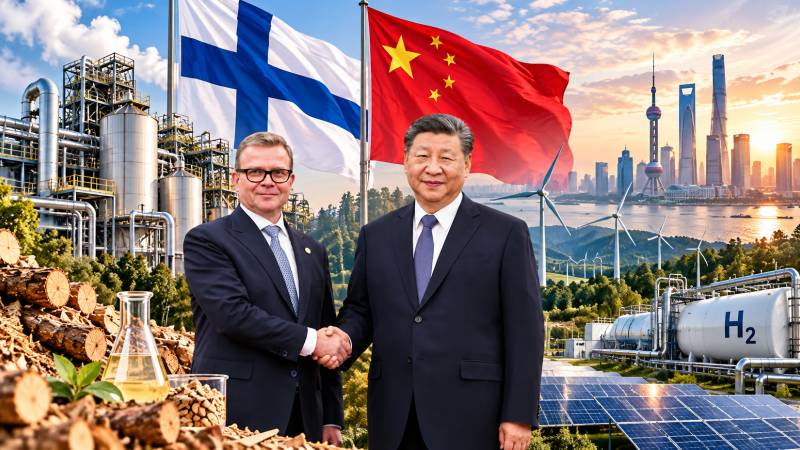
What began in Suzhou in October 2025 as three specialised Finland–China energy demonstration proposals, covering cellulosic ethanol, district-heating optimisation and advanced carbon technologies has gained wider significance. With bilateral energy cooperation renewed, China’s electricity demand and renewable expansion accelerating, and Finnish technologies moving closer to industrial use, the partnership illustrates how Finland can contribute to China’s energy transition through specialised engineering, optimisation and process expertise rather than scale.
The institutional framework behind this cooperation has strengthened. On January 27, 2026, during Finnish Prime Minister Petteri Orpo’s visit to China, the two countries signed a new memorandum of understanding on energy cooperation in Beijing. The agreement identified clean energy, smart energy systems and energy innovation as central areas for future collaboration, covering biomass, waste-to-energy, distributed generation, storage, hydrogen, clean heating and cooling, carbon capture, clean electricity, grid flexibility and digitalisation.
The agreement also aims to create greater opportunities for Finnish clean-energy technology exports, with demonstration projects identified as a practical instrument of cooperation. This continuity matters because technologies require feasibility studies, local adaptation, engineering, financing, regulatory approvals and operational evidence before they can be replicated commercially.
The timing is particularly important because China’s energy transition is becoming more complex. China remains heavily dependent on fossil fuels, especially coal, while simultaneously expanding renewable capacity on a scale unmatched elsewhere. According to the International Energy Agency, China added nearly 500 gigawatts of renewable capacity in 2025, representing more than 60 per cent of global renewable-capacity growth. Around 370 GW of solar photovoltaic capacity and 117 GW of wind capacity were commissioned in a single year.
Yet China’s transition is far from complete. Net electricity demand exceeded 9,500 terawatt-hours in 2025, rising by more than five per cent, with further growth expected from manufacturing, electric vehicles, digital infrastructure, air conditioning and wider electrification. China is therefore attempting to decarbonise one of the world’s largest energy systems while that system continues to expand. The challenge is no longer simply adding renewable capacity, but integrating it into an increasingly electrified economy efficiently and flexibly. This is where the three Finnish technologies become relevant.
Valmet’s proposal addresses biomass and the production of cellulosic ethanol through steam-explosion pretreatment. Unlike conventional bioethanol, cellulosic ethanol can be produced from lignocellulosic materials such as agricultural residues, forestry waste, straw, bagasse and bamboo. These materials are abundant but technically difficult to process because cellulose is embedded within structures containing lignin and hemicellulose. Steam explosion exposes biomass to high-pressure steam before rapidly depressurising it, disrupting the fibres and making cellulose more accessible for subsequent enzymatic and fermentation processes.
The relationship is therefore not simply about Finland helping China or China adopting Finnish technology. It is about bringing together two very different strengths—innovation developed in a small, technologically advanced economy and deployment attempted inside one of the largest energy transformations in history.
The attraction is that materials with limited economic value could potentially be transformed into fuels, chemicals and other useful products. However, advanced biofuels face persistent questions over feedstock logistics, process costs, energy balance and scalability. Demonstration projects therefore matter because proving a process under controlled conditions is very different from operating continuously with local raw materials at an acceptable cost.
By 2026, Valmet continued promoting its BioTrac continuous steam-explosion pretreatment technology in China’s bio-based industrial sector. The technology is presented as a platform for processing non-food biomass into fermentable sugars and ultimately into cellulosic ethanol, bio-based chemicals and other products.
Its significance extends beyond ethanol. The global energy transition cannot rely entirely on direct electrification. Aviation fuels, chemicals, certain industrial materials and some forms of heavy transport still require carbon-containing molecules. Sustainable biomass can provide renewable carbon, but its environmental value depends heavily on feedstock selection and lifecycle emissions.
Planora’s proposal addresses another part of the energy system: district heating. Although it receives less attention than solar, wind or electric vehicles, heating represents a major share of energy consumption in cold climates and dense urban areas. District-heating systems can be highly efficient because thermal energy can be produced centrally or recovered from industrial processes, data centres and other sources before being distributed to buildings. But a network does not automatically guarantee efficiency. Demand changes with weather, occupancy and behaviour, while different heat sources have different costs and emissions. Pumps consume electricity, pipeline losses vary and thermal storage can shift heat production over time.
Planora’s proposed use of dynamic optimisation and digital-twin technology reflects a wider shift towards combining energy infrastructure with intelligence. A digital twin can receive data from a real system, model its behaviour and simulate different operational choices. Operators can use it to forecast demand, lower network temperatures, identify bottlenecks, optimise pumps, select heat sources and integrate waste heat more efficiently.
These improvements may be less visible than a huge wind farm, but they can generate savings across entire cities. Finland has considerable experience in this field because district heating is deeply integrated into its urban energy systems, alongside expertise in heat pumps, thermal storage, waste-heat recovery and network optimisation.
The Planora project also illustrates why the next phase of the energy transition will increasingly depend on software, forecasting and system integration. Solar and wind fluctuate with weather; electric vehicles create new loads while potentially offering flexibility; heat pumps connect electricity and heating; and data centres consume electricity while producing potentially useful waste heat. The energy system is therefore becoming a network of interacting sectors. Digital tools can coordinate these interactions, creating an opportunity for Finland because its competitive strength lies less in scale than in technological sophistication.
ROTOBOOST addresses another major challenge: industrial decarbonisation and carbon management. Its technology uses thermo-catalytic decomposition of methane, or methane pyrolysis, to separate methane into hydrogen and solid carbon rather than producing carbon dioxide through conventional combustion. The approach could provide hydrogen for industrial use while producing solid carbon that may have commercial applications. By 2026, ROTOBOOST had entered more visible cooperation with China Baowu, the world’s largest steelmaker, focusing on how the technology might contribute to industrial decarbonisation.
Steel is among the hardest sectors to decarbonise. Coal and coke are used not only for energy but also as chemical reducing agents. Hydrogen has emerged as one possible alternative, particularly in direct-reduced-iron processes, but its environmental value depends on how the hydrogen is produced.
Methane pyrolysis offers another pathway. By splitting methane into hydrogen and solid carbon, it avoids direct carbon-dioxide formation during the core reaction. Its overall climate performance, however, depends on methane leakage, the energy used in the process and the eventual treatment of the solid carbon. It should therefore be considered potentially low-carbon rather than automatically carbon-free.
Cooperation with Baowu is significant because industrial credibility requires testing in real production environments. Baowu provides scale and operating conditions that a laboratory cannot reproduce, while ROTOBOOST contributes specialised technology. Their cooperation captures a central feature of Finland–China energy relations: innovation from a small technological economy meeting deployment capacity in a vast industrial one.
Taken together, the three projects reveal the diversity of the modern energy transition. One concerns biomass and renewable fuels, another urban heating and digital optimisation, and the third industrial hydrogen and carbon materials. Climate change will not be solved by a single technology. Solar and wind will remain central, but they require storage, grid flexibility and demand management. Electrification will expand, but not every process can be directly electrified. Heating must become cleaner and more efficient, while heavy industry will require new fuels, processes and carbon-management technologies. Data and digital control will increasingly determine how these technologies interact.
This is where Finland’s economic strategy becomes clearer. Finland cannot realistically compete with China in the mass manufacture of solar modules, batteries or electric vehicles. Its advantage lies in specialised know-how developed through experience in forestry, process engineering, automation, district heating, energy efficiency and demanding climatic conditions. A Finnish company does not need to dominate an entire market to become important. It can provide a technology that improves the performance of a much larger industrial system.
China offers the opposite advantage: scale. Its cities, steel mills, power systems, supply chains and industrial clusters are so large that even small percentage improvements can generate enormous absolute benefits. At the same time, scale creates pressure. Technologies that succeed in demonstration environments may encounter supply-chain constraints, maintenance problems or unfavourable cost structures when deployed industrially. China can therefore function both as an opportunity and as a test.
The relationship should nevertheless not be romanticised. European cooperation with China takes place within a complicated geopolitical and industrial environment. European governments have concerns about strategic dependencies, intellectual-property protection, industrial subsidies and competition from Chinese clean-technology manufacturers.
Finnish companies therefore face both opportunity and risk. Access to one of the world’s largest industrial markets comes alongside powerful domestic competitors and the need to protect proprietary technologies. Successful cooperation requires clear commercial arrangements, trusted partners, intellectual-property safeguards and technologies that offer measurable advantages. There is also a broader lesson: technologies should not be considered environmentally beneficial simply because they are labelled green. Bioenergy must be assessed according to feedstock and lifecycle emissions. Hydrogen must be judged according to how it is produced. Carbon-management projects must demonstrate genuine emissions reductions, while digital optimisation systems must show measurable energy savings.
Demonstration projects are valuable precisely because they provide a bridge between claims and evidence. Their purpose should not be public relations but verification. A successful pilot should answer questions about performance, reliability, cost, emissions and scalability.
China’s changing electricity market makes this verification increasingly important. As renewable generation expands, technologies for balancing, storage, flexible demand, heating integration and digital control become more valuable. The first phase of the renewable transition focused largely on proving that solar and wind could be deployed cheaply and at scale. The next phase is about operating entire economies in which these resources provide an increasingly large share of energy.
That requires flexible grids, industrial consumers capable of shifting demand, cities able to use waste heat and storage, and digital systems capable of anticipating operational problems. The renewed Finland–China memorandum’s emphasis on smart energy systems, hydrogen, storage, clean heating, balancing and carbon capture reflects this changing reality.
The broader lesson is that the energy transition will not be delivered by one spectacular breakthrough. It will emerge through thousands of improvements: heating networks operating more efficiently, waste heat being recovered rather than discarded, biomass converted into higher-value products, industrial gas streams turned into hydrogen and solid carbon, and digital systems predicting demand before operators need to react.
That is why the Finland–China partnership deserves attention. Finland will never match China in market size, manufacturing volume or energy consumption, while China does not need Finland to teach it how to manufacture solar panels or batteries. The value lies elsewhere: combining Finland’s specialised engineering with China’s ability to test and replicate technologies at industrial scale.
By September 2026, the Suzhou proposals were beginning to move from concept towards application: Valmet remained active in China’s bio-based sector, ROTOBOOST had entered visible cooperation with Baowu, while Planora’s district-heating technology remained relevant but less publicly deployed. The key challenge now is scaling successful pilots into wider use. Pilots prove feasibility, but scale proves significance.