

Sir, I need to have a word after the class, responded a young undergrad upon inquiring about his absence in previous classes. It was nothing unusual for youngsters to share their issues, knowing there is an empathetic set of ears for consolation. However, what stunned me was not only unusual but ringing an alarm bell.
The incident— the seemingly fragile student from the interior of Balochistan said one fine evening he was returning from supper at a makeshift restaurant with a bunch of university fellows, they were intercepted at a security checkpoint in the capital. Upon identity card check the accompanying boys were allowed to proceed except the two Baloch students. After a thorough body search the coppers insisted on taking them to the police station for further investigation. The victims told me they were not only scolded but insulted with bad words, and the security personnel in a sweeping statement alleged that the “Baloch are terrorists”. Ultimately, after an hour-long humiliation in the hold-up, they were finally released.
The very next day, as I was told, four stout Baloch men visited that particular checkpoint and thoroughly disciplined the security personnel into the norms of decency allegedly guilty of humiliating their comrades earlier. What had happened has frequently been reported from various conflict zones, and is just a leaf from the fat book of denial, disgruntle, and despair. It’s not only the 3-D in words but it represents the 3-dimensional picture of what has generally been happening in the conflict zones of Pakistan, particularly, the southwest province of Balochistan. It’s the largest geographical but least developed high-priority geostrategic region in the country.
What’s precious to Baloch— a common belief suggests that no self-respecting Baloch can ever tolerate humiliation. Balochistan is home to primitive tribalism where it is still intact in its original form. In a society where self-esteem is more precious than life for Baloch who are known for their elephant memory, they never forget to avenge the insult.
As soon as the news of hundreds of passengers taken hostage in the train in Balochistan on Tuesday, the mudslinging on the security forces' capability and intelligence ability began, as a usual easy way out
The bone-of-contention— Balochistan is home to China’s over 50 billion dollar project the China-Pakistan Economic Corridor (CPEC), a flagship project of the Belt and Road Initiative (BRI), and its success is equally important for Pakistan’s economic development. It houses the crucial natural deep sea port of Gwadar developed by China as part of its [Sting of Pearls] ports project that runs through the South China Sea, the Indian Ocean, and to the coasts of Africa. The situation has intensified the region’s vulnerabilities in the shadow of the confluence of mega powers' interests, particularly the convergence of the interests of the United States, United Arab Emirates (UAE), and India where Afghanistan playing stooges to the highest bidder, and all rivaling in the multi-polarity of the contemporary international system.
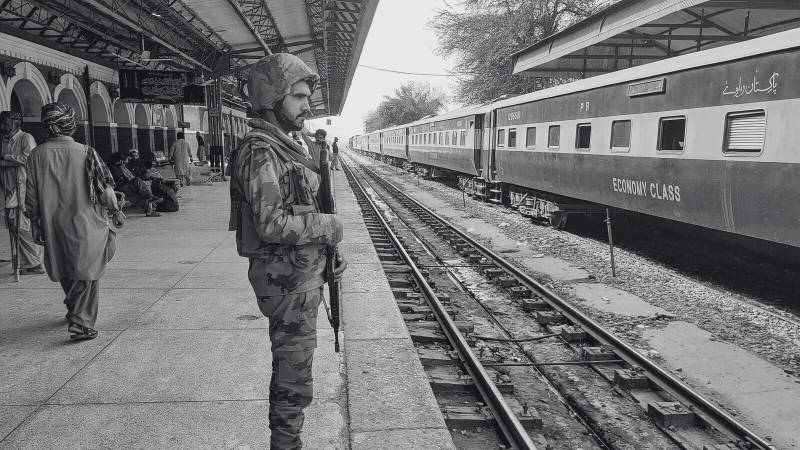
Dilating Aura of the insurgency— holding hundreds of passengers hostage in the Jaffer Express train in Balochistan during the 30 hours episode that claims loss of precious lives in several dozen on both sides, as the official statistic is still awaited while the battle of supremacy continues in the rugged mountainous terrain till our going to the press. This incident did not occur in isolation, nor is it something new, nor the last, yet it demonstrated a shift and an escalation in the volume and intensity of the operational mode of the insurgents. In a recent regrouping, the conglomerate of the separatists led by the Balochistan Liberation Army (BLA) which had been responsible for a wide range of terrorist activities including suicide bombing, has been joined by a host of disgruntled banned entities like the Tehrik-e-Taliban Pakistan (TTP), radical Sindhi elements and various splinter groups under a single flag.
Diagnosis— such stories as one told by the young Baloch students, have been echoing around in all conflict zones across the country. Whether it's seven decades of continuing strife in Balochistan, 80s Sindhi nationalists, the 2000s northwest, or even in the interior of eastern Punjab province, it's similar resentment against the administrative blunders and injustices done. It all has ultimately led the victims to fall into the trap of the enemy’s extremist agenda. If you suppress anything, it would pop out elsewhere more intensely, and it is the administrative blunders that ultimately lead a socio-political mobilization or agitation into a terrorist organization. Unfortunately, an effective political system is almost non-existent in Balochistan where the masses and opposition are left out to fall prey to any appealing sloganeering.
One cannot expect the security forces, particularly the counterterrorism operatives, to prolong their stay in a conflict zone after the job is done
The case of Sri Lanka is before us whereas the Muttahida Qaumi Movement (MQM), an urban Sindh ethnic movement barely saved from turning into a terrorist organization, as it still maintains its status as the mainstream political party. What is required is the recognition of realities on the ground and work towards an effective remedial solution, rather than blunt administrative repression, which is counterproductive. The case of mainstreaming Maoist separatist insurgents in the mainstream political discourse of Nepal in the recent past presents a success story model. However, it is essential to differentiate between counterterrorism and counterinsurgency; the two different phenomena require different approaches.
The responsibility factor— As soon as the news of hundreds of passengers taken hostage in the train in Balochistan on Tuesday, the mudslinging on the security forces' capability and intelligence ability began, as a usual easy way out. Neither has the security apparatus been dismantled in Pakistan nor the capability of our security forces has been compromised as alleged by many hasty commentators shooting in the dark. They all have been delivering their best within the given constraints. The executive [Babus] in Pakistan’s elite bureaucracies and the political elites need to come out of their comfort zone of the state of denial and fill in for their responsibilities. The divide-and-rule was the legacy of British colonialists to rule the colonial subjects while Pakistan was a free nation.
One cannot expect the security forces particularly the counterterrorism operatives to prolong their stay in a conflict zone after the job is done. If they do, as in case of Balochistan or the other conflict zones in the Khyber Pakhtunkhwa in the past, it’s because of the failure of the political and civil administration to take over once the imminent threat is removed and begin installing development sector relief.
Remedy— unlike the need-based kinetic approach of counterterrorism, counterinsurgency is required to resolve the nagging issues that essentially mean long overdue socio-economic reforms. Those who are thrown out of the political system in Balochistan still have their political presence. They cannot be ignored, because their grievances also add to the rogue narrative which is being encashed by unhappy external factors. The solution lies not in intensifying the firepower or intelligence network but rests in the hands of an unholy nexus of policy and decision-makers in Pakistan’s bureaucracies and political offices. Lip singing and retailing of plugging holes with superficial quick fixes for optics and gaining political mileage isn’t the required solution. The house needs to be in order by rising above the petty interests.