

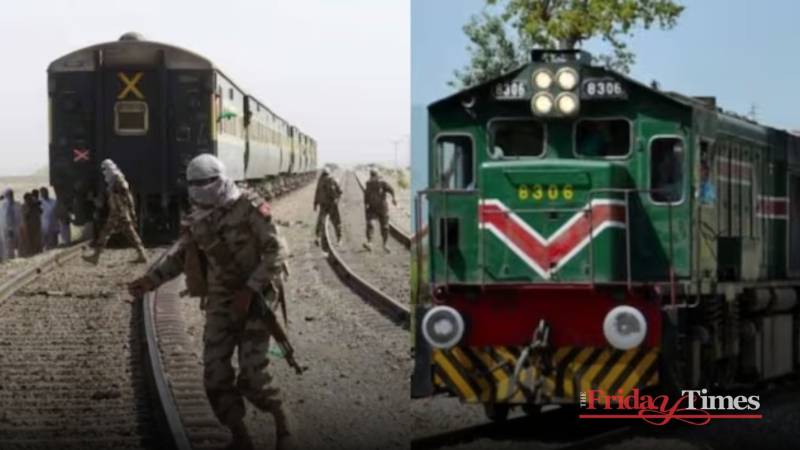
On March 12, 2025, militants launched a well-coordinated assault on the Jaffar Express near Mushkaf Tunnel in Bolan Pass, Balochistan. The train, carrying 440 passengers, including 200 security personnel, came under heavy rocket and gunfire. During the attack, insurgents killed 21 hostages before security forces eliminated all 33 assailants and successfully rescued the remaining passengers.
This incident is unprecedented in Pakistan’s history, as it marks the first large-scale hijacking of a train by a separatist group. Unlike past attacks by Tehreek-e-Taliban Pakistan (TTP) or Islamic State Khorasan Province (ISKP), which primarily targeted military outposts and convoys, this attack demonstrates an alarming shift in insurgent tactics. The ongoing security operation has yet to uncover all details, but this event highlights the growing threat posed by separatist groups, their tactical evolution, and the critical weaknesses in Pakistan’s security preparedness.
Security forces faced significant challenges in neutralising the militants due to the difficult terrain and their use of human shields. The Balochistan government had declared a state of emergency in hospitals, and additional security personnel have been deployed to assist in the operation. Balochistan government spokesperson Shahid Rind has emphasised that forces are exercising extreme caution to prevent civilian casualties. Railway authorities sent relief trains to aid in the evacuation of rescued passengers.
The Baloch Liberation Army (BLA) has claimed responsibility for the attack, with reports suggesting that the militants were in direct communication with handlers in Afghanistan. Given the attack’s proximity to the Afghan border, concerns have arisen over the involvement of external elements. The sophisticated weaponry used by the insurgents has also raised alarms, as intelligence reports suggest these may be arms left behind by US forces in Afghanistan, providing the militants with a technological advantage over Pakistani security personnel.
This attack is part of a broader escalation in separatist violence in 2025. The BLA alone has claimed 13 attacks this year, resulting in 35 fatalities, the majority being security personnel. Among these, three were suicide attacks using explosives-laden vehicles, while one attack was carried out by a female suicide bomber, claimed by BLA’s splinter faction, BLA-Azad. The Baloch Liberation Front (BLF) has also been active, claiming responsibility for four attacks that resulted in the deaths of five security personnel and one Punjabi bus passenger.
The Mangochar attack on February 1, 2025, provides further evidence of this escalation. In that incident, 70 to 80 armed militants ambushed a vehicle carrying unarmed border troops, killing 18 paramilitary personnel before security forces retaliated, eliminating 12 attackers. The BLA later claimed responsibility for the attack. The growing frequency and scale of these incidents point to a highly organised insurgency with increasingly sophisticated tactics.
The timing of this attack is particularly notable, coinciding with key political and insurgent developments. Just a day earlier, JUI lawmaker Mir Zafar Zehri had claimed in the Balochistan Assembly that insurgents were more powerful than the state
The presence of 200 security personnel on Jaffar Express raises serious questions about Pakistan’s security preparedness. The fact that they were unable to prevent the hijacking suggests critical intelligence failures, operational missteps, and a lack of adequate countermeasures. If the personnel were under-armed or poorly coordinated, their ability to resist would have been significantly compromised. There are also unverified reports that senior military officers were among the hostages, including at least one army major. While Pakistani authorities have not confirmed this, the attackers have accessed the passengers’ list after taking the train under their control. Based on the list, they claim that over 100 military personnel were onboard the train. If true, this raises serious concerns about security lapses and the state’s ability to anticipate and counter such threats.
While this is an unprecedented incident of insurgent attack, the past trajectory of the BLA attacks indicates a persistent tendency of their attacks that was bound to culminate into such a daring attack. In the past, they always targeted convoys, checkpoints, and railway stations, but this attack represents a new level of insurgent capability and coordination. Railway infrastructure has increasingly become a target, as seen in the November 2024 Quetta railway station bombing, which signaled an emerging trend of attacks on transportation networks. Separatists have also frequently targeted buses, where passengers’ identities were checked before executing security personnel or members of specific ethnic groups. The Khuzdar-Rawalpindi bus bombing on January 27, 2025, serves as another example, where a car bomb explosion killed two passengers and injured seven, with BLA later claiming that the victims were security personnel.
The timing of this attack is particularly notable, coinciding with key political and insurgent developments. Just a day earlier, JUI lawmaker Mir Zafar Zehri had claimed in the Balochistan Assembly that insurgents were more powerful than the state. Around the same time, former TTP spokesperson Ehsanullah Ehsan accused Pakistan of using ISIS to pressure the Afghan Taliban, while Pakistan’s UN envoy warned that TTP was evolving into an umbrella group for regional militants. PTI leader Omar Ayub also alleged that separatist movements were active in six districts of Balochistan, a claim strongly denied by Balochistan CM Sarfaraz Bugti. The convergence of these statements suggests an evolving insurgent narrative, potentially influenced by external actors or geopolitical maneuvering.
Adding to the crisis, a parallel information warfare campaign has emerged. Indian media and anti-state elements have been particularly active in spreading misinformation and amplifying separatist rhetoric. Social media accounts linked to Baloch insurgents have echoed Indian media’s narratives, featuring self-exiled Baloch leaders engaging in anti-Pakistan discourse. Authorities have urged caution against misinformation and emphasised the need to rely on verified sources for updates. Meanwhile, families of hostages remain in distress, anxiously awaiting news about their loved ones.
The growing nexus between Baloch insurgents and external actors, particularly with suspected support from Afghan-based elements, presents a formidable challenge for national security
As the military operation ends, reports indicate that 33 militants have been killed and 155 hostages have been rescued. The BLA has issued a 48-hour ultimatum, threatening to execute hostages unless the Pakistani government releases Baloch political prisoners and missing persons. The rescue mission was particularly complex, as BLA militants wearing suicide vests are reportedly sitting among hostages, making any direct assault highly risky. The militants also strategically trapped the locomotive inside the tunnel, making access even more challenging for security forces.
This attack raises critical security concerns that Pakistan’s authorities must urgently address. The inability to anticipate and counteract insurgent attacks highlights serious intelligence weaknesses. A key question remains: How do separatists manage to find out about the movement of security personnel and intercept the buses and trains having security personnel on board? Frequently targeting security forces using passenger transport routes suggests a major intelligence leak or surveillance gap.
Pakistan’s counterinsurgency strategies must adapt to separatist groups' rapidly evolving tactics. The growing nexus between Baloch insurgents and external actors, particularly with suspected support from Afghan-based elements, presents a formidable challenge for national security. Unless security forces improve intelligence gathering, operational coordination, and counterinsurgency tactics, similar large-scale attacks could continue, posing a serious threat to Pakistan’s internal stability.
This incident underscores the urgent need for Pakistan to reassess its counterinsurgency policies and broader approach to militancy, as continued instability has severely damaged the country's global image. While Pakistan attributes its internal unrest to covert support from Afghanistan and India, both nations levy similar accusations against Pakistan, deepening regional tensions. Over the years, Pakistan has missed critical opportunities to mend ties with India, and now, the Afghan Taliban—once considered strategic allies—have shifted from partners to adversaries thanks to the policies adopted in the past.
With two hostile neighbors and escalating internal threats, Pakistan cannot afford to remain in a reactive mode. A proactive, intelligence-driven strategy is essential to counter both external interference and domestic insurgency. The question remains: Can Pakistan rise to these challenges before the situation spirals beyond control?