

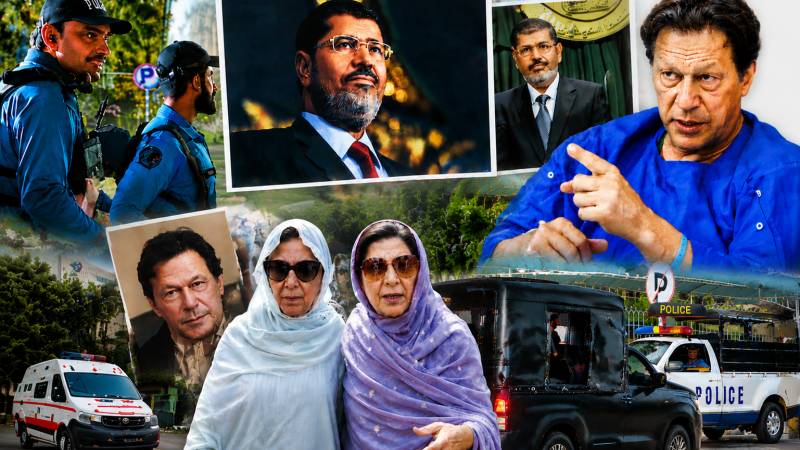
“They will kill me like Morsi”. This is not merely a political statement. It is a sentence loaded with fear; fear of death, fear of deteriorating health, fear of helplessness, and perhaps, above all, fear of losing control over what happens to one’s own body. Imran Khan, according to his sister, has said that solitary confinement is aggravating his anxiety and blood pressure. He has then invoked the fate of Egypt’s former president Mohamed Morsi, who died in custody in 2019 after collapsing during a court hearing.
Whether Khan’s fear is medically justified, psychologically amplified, politically motivated, or some combination of all three cannot be determined by political argument. It requires evidence. And that is precisely why the statement deserves to be taken seriously; not necessarily believed as an allegation, and not dismissed as political theatre, but investigated. The health of a prisoner is ultimately a responsibility of the state. Political disagreement does not suspend that responsibility. Nor does imprisonment erase a person's right to appropriate medical care, human dignity, and reasonable protection from preventable harm.
The central question, therefore, is not simply whether Imran Khan is right when he says, “They will kill me like Morsi.” The more important question is: What should a responsible state do when a prisoner says he believes his health and life may be in danger?The answer should be neither political denial nor political outrage. It should be independent medical evidence. It is easy to imagine solitary confinement as simply a person being placed alone in a room. Psychologically, however, isolation is far more complicated.
Human beings are profoundly social creatures. Our sense of time, identity, security and emotional stability is continuously shaped by interaction with other people and the environment around us. Conversation, faces, movement, routine, natural light and ordinary human contact all provide cues through which the mind organizes reality.
When those cues are severely restricted for prolonged periods, the psychological consequences can become significant. Time may begin to feel distorted. Sleep can deteriorate. Concentration may weaken. Minor physical sensations can acquire enormous significance. Thoughts may become repetitive. Anxiety can intensify. A person may become increasingly preoccupied with health, danger and the future.
This does not mean that every person subjected to isolation will develop a psychiatric disorder. Nor does it mean that every symptom experienced in isolation is caused by confinement. But prolonged and harsh isolation is a recognized psychological stressor, and research has associated it with anxiety, depression, sleep disturbance, impaired concentration, emotional distress and other adverse psychological outcomes. That distinction matters. We should neither exaggerate the medical consequences of solitary confinement nor trivialize them. The most important mistake in discussions of anxiety and blood pressure is to treat the mind and body as separate systems. They are not.
Fear and prolonged stress can activate the body's stress response. Heart rate can increase. Blood vessels can constrict. Blood pressure can rise temporarily. If stress is persistent or repeatedly triggered, the physiological effects can become part of a self-reinforcing cycle. Isolation can produce anxiety. Anxiety can produce physical sensations. Those sensations can create fear of illness. That fear can intensify anxiety. And the cycle continues. This does not mean that every rise in blood pressure is caused by anxiety. Hypertension has many causes, and only clinical evaluation can establish what is happening in a particular individual.
But if a prisoner is reporting persistent anxiety alongside repeated elevations in blood pressure, it is medically irresponsible to dismiss the combination simply as political rhetoric. It is equally irresponsible to declare that the combination proves an imminent threat to life. Both conclusions require evidence. Hypertension is not dangerous merely because the word sounds alarming. Its significance depends on the actual readings, how persistently they remain elevated, the individual's medical history, medications, and whether there are signs of acute organ injury.
Persistently uncontrolled hypertension can increase the long-term risk of stroke, heart disease, kidney disease and other complications. Extremely high blood pressure can become an emergency when accompanied by symptoms suggesting acute damage, for example, chest pain, severe shortness of breath, neurological weakness, changes in vision, confusion or difficulty speaking. But the distinction is crucial: a high blood-pressure reading is not, by itself, proof that someone is dying. Likewise, calling the symptoms “just anxiety” is not a medical assessment.
The appropriate response is measurement, monitoring and clinical judgment. If there are concerns about Khan's health, independent physicians should have access to his medical history and conduct whatever cardiovascular, neurological and laboratory assessments they consider clinically appropriate.
The argument should end where the medical evidence begins. The reference to Mohamed Morsi is perhaps the most psychologically revealing part of Khan's statement. Morsi's death has become a powerful symbol of political imprisonment and deteriorating health in custody. For someone currently imprisoned, the sequence may appear hauntingly familiar: a political leader, imprisonment, isolation, health concerns, uncertainty and then death. Whether that comparison is objectively justified is one question. But psychologically, the comparison itself matters.
But the distinction is crucial: a high blood pressure reading is not, by itself, proof that someone is dying. Likewise, calling the symptoms ‘just anxiety’ is not a medical assessment.
If a prisoner begins to interpret his own circumstances through the story of another political leader who died in custody, every physical symptom may acquire a new meaning. A headache is no longer simply a headache. A rise in blood pressure is no longer simply a medical reading. A sleepless night becomes another sign of deterioration. A delay in medical attention becomes evidence of danger. The mind begins connecting separate events into a single narrative.
Psychologists describe related patterns as catastrophic thinking anticipating the worst possible outcome and interpreting subsequent experiences through the lens of that anticipated catastrophe. But there is an important qualification. To say that a person's fear may contain elements of catastrophic thinking is not to say that the danger is imaginary.
A fear can be psychologically amplified and still contain a legitimate concern. That is precisely why independent assessment is necessary. “They will kill me like Morsi” may contain several different psychological meanings. The first is fear of death. A prisoner may fear that if his health deteriorates and adequate treatment is not available, he could die in custody. The second is loss of control. Perhaps the deepest psychological burden of imprisonment is not simply confinement but the feeling that important decisions about one's body, movement, medical access and environment are being made by others. The third is perceived threat. The prisoner may believe that the conditions in which he is being held are not merely unpleasant but potentially dangerous, or even deliberately so. These possibilities cannot be distinguished through political commentary.
A doctor cannot determine the truth of a political conspiracy simply by taking a blood-pressure reading. A politician cannot diagnose anxiety from a public statement. And a journalist cannot convert a prisoner's fear into established fact merely by repeating it. Each question requires its own evidence. There is a dangerous tendency in polarized politics to diagnose opponents from a distance. If a political leader makes a frightening claim, supporters may regard it as undeniable truth while opponents immediately label it manipulation, paranoia or drama. Both responses are intellectually lazy.
Fear should be taken seriously without automatically accepting the explanation attached to it. If the fear has a medical basis, it requires medical attention. If psychological distress is contributing to it, that distress requires assessment and care. If there is credible evidence of an external threat, that evidence requires investigation. And if the fear is not supported by evidence, an independent process should be capable of demonstrating that too.
The point is not to decide in advance which explanation is correct. The point is to create a system in which the truth can actually be established. There is another principle that must not be lost. The statement “They will kill me like Morsi” is an expression of fear. It is not, by itself, proof of a murder conspiracy. This distinction is particularly important in journalism. A journalist's responsibility is not to amplify fear into fact. Nor is it to suppress fear because it is politically inconvenient.
The responsible approach is to ask: What is the medical record? What are the actual blood-pressure readings? How long have they been elevated? What treatment is being provided? Has the prisoner been independently examined? What does his medical history show? How severe is the isolation? How much human contact is available? Are there documented psychological symptoms? And are there any objective facts suggesting that his health is being deliberately endangered?
Those questions are far more powerful than either a government denial or a political accusation. If the state is confident that Imran Khan is medically stable, it should have little reason to fear an independent medical examination. If an independent medical team finds that his condition is stable, that finding should be made public. If it identifies hypertension, anxiety, cardiovascular concerns, sleep problems or other issues requiring attention, appropriate treatment should follow. If the environment itself is contributing to deterioration, that should also be assessed.
Transparency would serve everyone. It would reassure those genuinely concerned about Khan's health. It would deprive political propagandists of the information vacuum in which speculation flourishes. And it would strengthen the credibility of the state. A defensive statement saying “there is no danger” is weaker than evidence demonstrating that there is no danger. There is a broader principle here that goes beyond Imran Khan.
A prisoner may lose freedom of movement. He may lose political power. He may lose access to public life. But imprisonment should not mean the loss of human dignity. Nor should punishment mean the suspension of medical care. This principle must apply irrespective of political identity. If a state protects the health of a political opponent only when he is popular, it is not protecting a principle. It is responding to pressure.
The real test is whether the same standard applies to everyone including the person the state finds most difficult to tolerate. That is why the issue should not be framed simply as: “Is Imran Khan telling the truth?” It should also be framed as: “What standard of treatment should a democratic state guarantee to every prisoner?” There is another dimension to Khan's situation that should be considered carefully. He spent decades at the center of public life: an international cricket star, a political leader, a former prime minister, and a figure accustomed to constant public attention and interaction. But it would be wrong to conclude that fame automatically makes solitary confinement more damaging.
The psychological issue is not celebrity. It is identity and agency. A person who has spent much of his life making decisions, commanding attention, addressing crowds and exercising considerable influence may experience the sudden collapse of that environment as a profound disruption of identity.
The world outside continues to move. Inside, time narrows. The public figure becomes a solitary individual. The person accustomed to speaking to millions is left with very few people to speak to. The person accustomed to making decisions suddenly has very little control over the conditions of his own existence. That contrast can be psychologically powerful. And it is the loss of agency not fame itself that deserves attention.
Perhaps the most responsible way to approach the question is through three interconnected layers. The first is physical health: What are the blood-pressure readings? How frequently are they elevated? What is his cardiovascular condition? What medications is he taking? Are there signs of acute organ involvement? The second is mental health: Is there persistent anxiety? How is he sleeping? Is he experiencing panic, intrusive thoughts, hopelessness or excessive fear? Is his perception of threat proportionate to the available evidence? Is his psychological condition deteriorating? The third is the environment: How extensive is the isolation? How much human contact is permitted? How much natural light and physical activity are available? How readily can he access medical care? How often can independent doctors examine him?
Only by examining all three layers can a credible picture emerge. There is a simple principle that could resolve much of this controversy: Let the evidence speak. If Khan's health is stable, demonstrate it. If it is not, treat it. If isolation is harmless in his particular circumstances, establish that through professional assessment. If it is causing deterioration, modify the conditions. If there is no evidence of deliberate harm, an independent assessment can establish that. And if there is evidence of negligence or deliberate endangerment, it must be addressed regardless of political consequences. This is not a concession to Imran Khan. It is an assertion of the state's own institutional confidence.
A secure democratic state does not need to fear independent doctors. There is also a lesson for Khan's supporters. Health concerns should not become another battlefield in Pakistan's already polarized politics. A genuine medical concern loses credibility when every symptom is immediately presented as proof of a conspiracy. Nor should every government medical statement automatically be dismissed because it comes from the state.
The appropriate response to both is the same: Independent verification. That is the only language both sides should be willing to accept. This is perhaps the most important point. If tomorrow another political leader whether from the Pakistan Muslim League, Pakistan Peoples Party, Pakistan Tehreek-e-Insaf, or any other political force is imprisoned and reports deteriorating health, the standard should remain unchanged. No one should have to be politically popular to deserve medical attention. No one should have to be politically powerful to deserve human dignity. And no prisoner should have to turn his health into a political argument merely to secure appropriate medical care.
That is what makes this issue larger than Imran Khan. It is about the character of the state. The phrase “They will kill me like Morsi” does not prove a murder conspiracy. But neither should it be laughed away. It is the expression of a person who says he fears that isolation, deteriorating health and circumstances beyond his control may place his life at risk. That fear may be justified. It may be exaggerated. It may contain both psychological distress and legitimate medical concern.
Only independent evidence can tell us which. And this is where the political argument should stop. The doctor should speak. The independent medical examination should speak. The medical record should speak. The evidence should speak. Because if the state truly believes that Imran Khan is safe, the most convincing answer is not a denial. It is transparency. And if the state discovers that he is not safe, the answer is not another statement. It is action.
The strength of a democratic state is not demonstrated by its ability to silence an opponent. It is demonstrated by its ability to protect that opponent's life and dignity even while disagreeing with everything he represents. Imprisonment may take away freedom. It must never become a licence to compromise health. Political conflict may divide a nation. It should never divide us over the basic principle that a human life has value. And perhaps that is the deeper meaning hidden inside those five words:
“They will kill me like Morsi.” The responsible response is neither belief nor disbelief. It is investigation. Neither propaganda nor denial. It is evidence. Neither political theatre nor silence. It is transparency. Because when a prisoner says he fears that he may die in custody, the first duty of a democratic state is not to win the argument. It is to make absolutely certain that the prisoner survives it.