

I met Muhammad Yunus in a registration queue. He was walking toward a pre-event dinner, and when I stepped forward, he did not wait for me to extend my hand. He extended his first, smiling the way a man smiles when he has nothing left to prove. I have read about Grameen Bank in economics textbooks. I did not expect its founder, a Nobel laureate who restructured how the world thinks about poverty, to greet an eighteen-year-old from Lahore as though we were equals. That handshake told me more about social business than any keynote could have.
The 16th Social Business Day, held June 27 to 28 at the Samajik Convention Centre in Zirabo, Savar, was never going to be an ordinary conference. It arrived at a rare confluence: fifty years of Grameen Bank, twenty years since the Nobel Peace Prize recognised it, and a theme, Social Business: The Language of Peace in a Fractured World, that felt less like branding and more like a diagnosis. Keynotes, plenaries, breakout sessions, and regional forums filled two days, flanked by the Academia Dialogue and the 3ZERO Club Convention, built around Yunus's vision of zero net carbon, zero wealth concentration, and zero unemployment. But the architecture of the event mattered less than what happened inside it: entrepreneurs, academics, and media personalities from across the world, packed into one building, arguing, listening, and occasionally sitting in stunned silence together.

Pakistan sent the second largest delegation. Team Rizq and Team Dream3 sat among people I will not forget. Masarrat Misbah, who has spent years restoring dignity to acid attack survivors through Depilex, spoke with the exactness of someone who has seen the worst of humanity and refused to let it define her work. Dr. Faiz Shah carried economic theory the way most people carry conversation, effortlessly, and in the country forum said something I have not stopped thinking about: that Pakistani parents need to let their children fail, that a culture allergic to mistakes cannot manufacture risk-takers, and that our national deficit in entrepreneurship is, underneath everything, a deficit of permission. Ibrahim Murad, president of UMT, Musa Aamir and Qasim of the Rizq Foundation, Shahid Lone of Allah Wale Foundation, each one a case study in learning that never stops, regardless of how far they had already come.

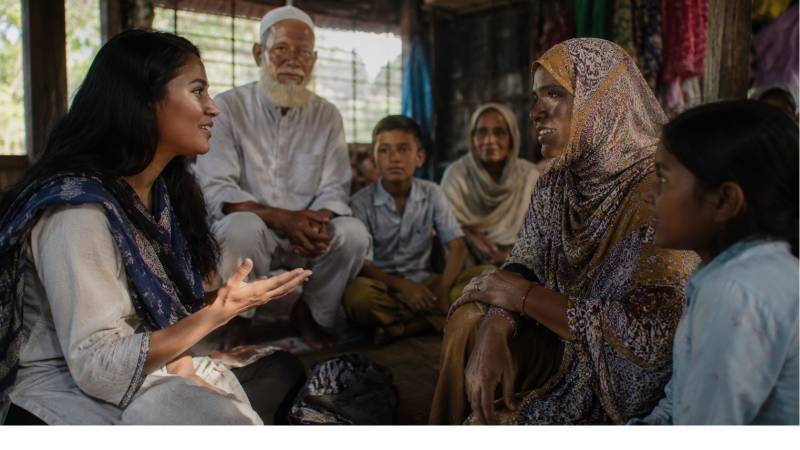
Then there was the Grameen Bank branch itself, 2 hour and forty minutes down a punishing, bumpy road into Savar's suffocating humidity. Numbers rarely move me. These did. 6500 hundred branches. 96% repayment. Two managers from this branch say that it lends 21 crore and holds 36 crore in deposits, entirely self-sustained, sending its surplus back to headquarters rather than asking anything of a central bank. Pori Manno borrowed three thousand taka in 1988 after a flood, to buy a single cow. She is now the centre head, carrying a fifty-thousand-taka loan of her own. Another woman turned a thirty-thousand-taka loan for sari equipment into an enterprise worth 360,000. When someone in our group asked whether an interest-free model would serve them better, the room laughed, warmly, because the answer was obvious to everyone except the one asking.
It was the peace of a system where no one's dignity depends on someone else's permission.
What stayed with me longest was Grameen Shikkha, whose growth curve was not linear but exponential, proof that education financed like an investment rather than a charity compounds the way capital does. I did not leave Savar wanting a job. I left understanding that wanting one, ever, would now feel like a small betrayal. Sitting among entrepreneurs who had turned scarcity into infrastructure, and academics who studied that transformation with real rigour, I recognised a peace that had nothing to do with the absence of conflict. It was the peace of a system where no one's dignity depends on someone else's permission. Two days inside a room built around that idea convinced me the only honest response was to go and build one myself.