

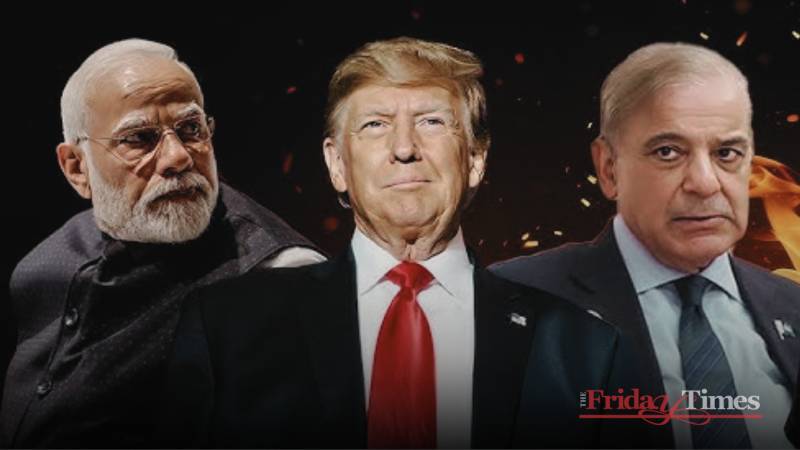
Barely a couple of days have passed since the US-mediated ceasefire in 5th Indo Pakistan war of May 2025 has come into effect. I do not claim to know the precise conversations that went on behind the scenes that resulted in the announcement of the ceasefire directly by President Trump around 3pm on May 10, 2025.
What has been reported in local and International Media (such as CNN, etc.) points to a complex set of actions that began well before India attacked Pakistan on the night of May 6/7 and that accelerated tremendously after Pakistan responded on the early morning of May 10. There is a discussion of a critical piece of intelligence that was acquired (or leaked) to the US. Sect. Rubio briefed Pres. Trump then called PM Modi to ask him to consider ceasing hostilities.
Pakistani accounts (as well as CNN) also seem to suggest that the ceasefire discussions were initiated on PM Modi's behest and several mediators and friends - such as US, Saudi Arabia, and Turkey - were engaged to apply pressure on the Pakistanis to accept a ceasefire. This aligns well with the facts on the ground faced by the Indian Army (unable to mobilise), Airforce (afraid to fly), and Air defense (S400 and Harup drones being effectively neutralised).
Having received a significant beating all morning, and facing massive losses if the Pakistani action continued, India would have had no alternative but to cease and fight another day.
Indian accounts of what led to the ceasefire - as related by their Foreign Sect. Vikram Misri and major newspapers - paint a totally different story. The Indian version suggests that Pakistan requested ceasefire, that they were winning the war, and that the crucial intelligence that was relayed to Sect. Rubio was regarding Pakistan mobilising its nuclear assets.
This, however, does not align with facts on the ground. First, at the time of the ceasefire discussion, Pakistan was winning the "war" with complete air superiority over India and attacking Indian assets with impunity. Second, in a situation where Pakistan was potentially doing considerably more damage by conventional weapons alone, there was no point in deploying nuclear assets. This is contrary to Pakistan's declared nuclear doctrine. In fact, after the NCA Meeting on the 10th morning, the Defense Minister had categorically taken the nuclear option off the table - in contrast to what he had been saying earlier.
Why did Pakistan accept the ceasefire?
Then why did Pakistan accept the ceasefire in the first place? Especially when Pakistan had an upper hand in the battle and enjoyed uncontested air superiority?
Without knowing about - or considering - the kind of pressure that may have been applied by the US (and, perhaps, other friendly countries) to accept the ceasefire there could be three possible explanations for this:
First, Pakistan's ultimate objective (perceived best outcome) in all of this episode was to get powers, such as the United States, to convince India not to attack. This clearly comes from a position of perceived weakness - military, economic, numerical, or otherwise. We have always believed that we cannot sustain a long war with India and that while we may perform well in a short battle, particularly an air battle (as Feb 2019 demonstrated) but a long protracted war is beyond us. Our first reaction, therefore, always is to not seek a fight or invite intervention of superpowers or powerful friends to dissuade India from attacking. So when the opportunity to ceasefire was offered, Pakistan took it, instantly.
Second, Pakistan's war posture, right from the beginning, was a bit defensive in nature. When India first attacked, Pakistan gave a somewhat cautious response to make sure that only those fighter aircrafts that had offloaded weapons on Pakistan were targeted. Several government officials, including DG ISPR, said that we could have downed 10 aircrafts but decided to only kill 5. In doing so, Pakistan sought to maintain a moral high-ground - i.e. we're only defending, not attacking, and even our attack is a proportional response, etc. - with a view that this might become crucial later on. With this limited view of the war, our planners may have thought that they have achieved enough by afternoon of May 10 to make a point and avoided prolonging the war which would have certainly caused greater losses on both sides.
Third, Pakistan accepted the ceasefire as a strategic and diplomatic coup d'etat forcing the India Pakistan Kashmir issue into the international domain. India has not accepted any third party intervention on Kashmir since the Simla Accords and have not substantively engaged Pakistan bilaterally as well for over a decade now. The Foreign Office may have thought of the ceasefire as a golden opportunity to force a third set of actors in our stalled bilateral affairs. Indeed, this seems to be the most logical of the three possibilities as the next day Pres. Trump even expressed the desire to help solve the Kashmir issue - perhaps music to some Pakistani foreign policy leaders and, equally, and anathema to Indians.
Let's explore each of these possible explanations one at a time - starting with the diplomatic masterstroke argument first.
A diplomatic masterstroke
Unable to wrest Kashmir out of India's occupation, and especially since India abbrograted its special status, Pakistan has always sought to internationalise the Kashmir dispute. The May 6-10 War gave Pakistan the perfect opportunity to make that happen. Clearly, the announcement made it clear that the two parties were to resume bilateral negotiations on a broad set of issues - including the terms of ceasefire itself - at a "neutral third venue." Pres. Trump praised both Sharif and Modi for their wisdom. Shahbaz Sharif immediately praised the American intervention. The next day Pres. Trump jumped in with his desire to help solve the Kashmir issue.
Ever since the eve of the ceasefire, however, there has been a climb down on the bilateral talks from the Indian side. As soon as the ceasefire was announced, Indian media reported Modi saying that India did not agree to any pre-conditions such as the requirement of bilateral talks. On May 11, the Indian media reported Modi as saying that talks with Pakistan will only happen if "Pakistan returned AJK and punished the terrorists." Another Indian media source went on to say that the ceasefire was not an "agreement" only an "understanding."
It is possible that this is only for domestic consumption since Indian media - and leaders - are desperately trying to spin the ceasefire in various ways to make it look like India has ended the conflict in control. Will India come to the negotiating table with Pakistan? We would know in a couple of days (or a week) how India responds to the pressure / obligation to hold these bilateral talks.
My reading (and prediction) is that this is not the case. While that tracking back may be designed for the domestic audience, initially, India does not intend to make good on the implied commitment to have bilateral talks with Pakistan. Over a decade or two of Indian foreign policy towards Pakistan has been to not engage, diplomatically isolate, economically hurt, and militarily weaken Pakistan. It has done anything in its power - from the cricket fields, to FAFT, to IMF - to make Pakistan a pariah state and that policy isn't going to change overnight.
I am also cautiously pessimistic of the prospect of engaging America - particularly Pres. Trump - as a mediator between India and Pakistan. If Modi can be credited for his consistency in trying to ostracise Pakistan, Trump can be credited with being totally inconsistent - often temperamental - in doing anything he seeks to do. Take Gaza and Israel, or Russia and Ukraine for example. After getting elected - with a massive majority of Muslim vote - on the promise of being anti-war, Trump ended up being the most pro-Israeli leader in recent American history. On Russia and Ukraine as well, Trump has been somewhat inconsistent. The bottomline is: it is quite hard to predict which side he will be on, and how long before he switches.
Pres. Trump also is driven, mostly, by economic profit or desire for an ego boost and in both these matters India may be able to play a better game than Pakistan.
There is one caveat, however, that may work in Pakistan's favor. Trump has recently demonstrated his disdain for people trying to "manipulate" him. He recently decided to cancel Bibi Netanyahu because he felt being "manipulated" by the latter. In this, Pakistan's Sharif who has no capacity to manipulate anyone might be able to do a better job with Trump than Modi.
However, all said and done, I am not willing to give the diplomatic masterstroke more than 1 in 6 chance of working for Pakistan. It's a toss of dice with only one possibility of working in our favor and 5 possibilities of working against us. We will know very soon if we're in the right territory for that.
So if it is not a diplomatic masterstroke, notwithstanding the naive aspirations of our foreign policy leaders, could it be a strategic blunder for Pakistan to have accepted a ceasefire when they were on the top and so soon?
A strategic miscalculation?
Possibilities 1 and 2 (above) could very possibly convert this ceasefire into a strategic blunder of sorts. Let me explain.
If we rule out possibility 3 i.e. successfully forcing India onto a negotiating table to discuss Kashmir, Terrorism (both ours and theirs), the Indus Water Treaty, and other issues (including cricket) then what purpose does the ceasefire serve? Practically none.
We may have accepted the ceasefire because mentally we had given up on us being able to win a battle against India or inflict so much damage on India to force its hand. Our objective may have been simply to avoid the confrontation or keep it as short as possible. If that's the case, then we may have achieved our short-term (limited) objective, but the long-term (ultimate) objectives of IWT or Kashmir are practically lost. We simply underestimated our potential and did not play our hand well.
The second possibility of accepting the ceasefire having achieved our limited military objectives - while playing fair, and nice, and proportionate - again makes little sense. We're trying to play fair with an adversary which has never played fair with us? To what end? How does being fair and nice help us achieve our ultimate objectives?
Shouldn't it be part of the military planning that if you see an opening in the enemies defenses and strategy, you take advantage of it and strike harder.
On the afternoon of May 10th, it was clear that Pakistan had an upper hand in the war. Our massive response earlier in the day had taken India by a surprise. And that we had unchallenged air superiority not just in our skies but over northwestern India as well. IAF was nowhere to be seen and the only credible threat that remained was the BrahMos - their cruise missile - which was yet to be used in large numbers. Karachi was preparing for a BrahMos attack from INS Vikrant in the sea.
Having an unchallenged air superiority is a beautiful thing and we should have used it as a precious commodity. Nothing like this had ever happened to Pakistan before and is not likely to happen again. The JF-17/JC10 combination took not just India but the whole world by surprise. In this moment of surprise, India lost its battle plan. But we can rest assured India will come better prepared next time around.
So what might have this ceasefire done for India? The ceasefire may have provided India with a strategic pause to re-group, re-plenish, and re-strategise. India will not let Pakistan finish this fifth war on a high. It has already begun to reshape the narrative to claim victory but sooner, or later, it will come back to try to convert its defeat on the ground into a victory too.
Some analysts / observers are giving the possibility of resumption of hostilities from two weeks to three months. What will 2 weeks or 3 months do to India's war calculus?
Rafale's failure and the destruction of S-400 basically threw India's battleplan out of the window. Facing further destruction, they panicked and ran to their friends to intervene. In 2 weeks, India may come back with a better strategy and may replenish its lost hardware. We should keep a close eye on what India does in the next weeks and months to get a clearer sense of its strategy going forward.
At the very minimum, India may resume hostilities in a couple weeks, or less, citing Pakistan's violation of the ceasefire. IAF has already stated that Operation Sindoor isn't yet over. We should get a hint.
In 3 months time, India will have the possibility of backing up its air / missile offensive with a ground invasion. With PAF's edge over IAF, this is where India's numerical superiority makes the most difference. With the hot summer gone, India can open several fronts on the ground to teach Pakistan a lesson.
Although a ground invasion will be difficult to run without IAF cover, India could surely get some support from its allies - American F35s or Israeli fighters - in due course to neutralise PAF's advantage.
Even if India doesn't attack in 3 months time frame, we haven't seen the end of conflict between India and Pakistan. There will be another war in a year, 3 years, or 5 years. Plenty of opportunities for India to convert an incident into an excuse to go to war with Pakistan. And one can be sure that given what has transpired this last week, India will use all its financial and economic muscle to come back better prepared.
A ceasefire too soon?
This then begs the question, when Pakistan had a military advantage over India, and we had them by their jugular, why did we rush to take the offer of the ceasefire? Could we have not prolonged this by a day or two and maybe exact greater damage on India's war and economic machine? or maybe even waited long enough to properly negotiate the terms of the ceasefire and secure iron clad guarantees on Kashmir and IWT? Could the ceasefire negotiations not taken place while Pakistan was pounding Indian targets.
India has a long history of running to its interlocutors for a ceasefire when it faced challenging conditions on the battlefield (1965, 1999, 2019, etc.) and opting to fight another day. Pakistan has never been able to convert a ceasefire into something that brings it closer to its objectives. Could this ceasefire, also, turn into a strategic miscalculation for Pakistan?
Finally, if Pakistan's ultimate strategic objectives (IWT, Kashmir) are not achieved, will Pakistan be willing to be the first to attack India next time?
The next few days and weeks will help clarify many questions - particularly about India's intent and seriousness - but if the past is any indicator of what is to come, Pakistan needs to think hard about the possibilities identified above and convert a lost opportunity into enduring success with whatever initiative is left with it.