

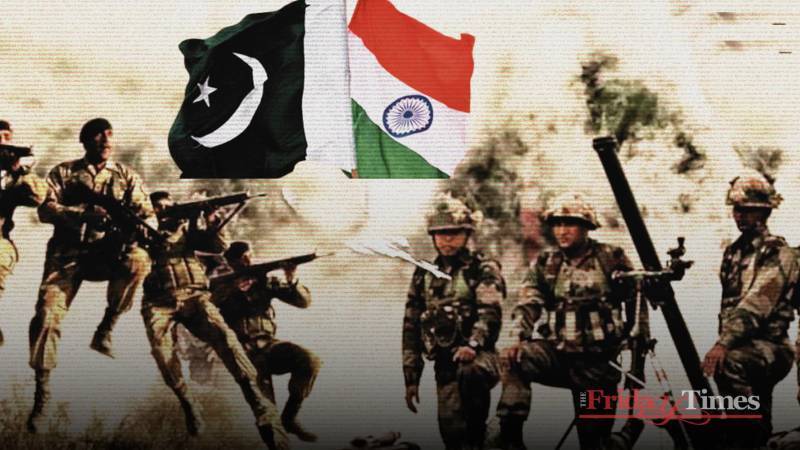
Can what happened between midnight on May 7th-- the time when India launched military strikes deep inside Pakistani territory and late afternoon May 10--the day when US President Trump announced a ceasefire through a Tweet-- be described as the breakdown of nuclear deterrence in South Asia? Nuclear deterrence is generally believed to explain the period of peace, or absence of full-scale war, between Pakistan and India since 1987--the year war was narrowly averted when the Indian military held large-scale military exercises close to Pakistani borders and the Pakistani military counter-mobilised. There have been many tense moments in Pak-India military relations in the last 38 years.
Pakistani and Indian militaries fought a conflict in Kashmir at Kargil in 1999, but the militaries of the two countries didn’t cross international borders. In 2019, India did carry out airstrikes targeting desolate places in Balakot, deep inside Pakistani territory, but it was considered a minor incident as no damage was done to Pakistani military installations or civilian infrastructure, or population. Contrary to all these, Indian military strikes on Pakistani cities on the night between May 6 and May 7, 2025 first significant targeting of targets deep inside Pakistani territory--not in Azad Kashmir, which, constitutionally speaking, is not part of Pakistani territory--since the 1971 war. Pakistani officialdom believed India had since been prevented from attacking mainland Pakistan by Pakistan’s nuclear deterrent--the possession of nuclear bombs and varied types of delivery systems that can be used to deliver these weapons. This was how Pakistanis believed India’s conventional superiority was neutralised. And this understanding was reinforced by the events between 1987 and May 2025--during this period, India didn’t launch any conventional military attack across the international borders. What changed on midnight May 7, 2025, that India launched conventional military strikes across international borders.
On six major sites, which Indians claimed were terrorist camps and which Pakistanis said were civilian buildings and infrastructure. Can we say nuclear deterrent is now irrelevant in Pak-India military relations? Attacks against military and civilian targets across international borders have become a new normal in South Asia, despite the fact that the two sides are still in possession of nuclear weapons and their delivery systems. On the following day, on May 8, India accused Pakistan of violating its airspace by sending hundreds of military drones across the international border. India said it responded by sending military drones of its own into Pakistani airspace. This was followed by missile strikes on Pakistani air bases across Pakistan. On the morning of May 10, the Pakistan military targeted Indian military bases across Northern India along the length of the International border from Kashmir to Sir Creek. This was a full-fledged military conflict. Neither side mobilised its land forces. At least neither side reported that it had.
US diplomacy has been actively engaged in preventing a war between Pakistan and India since the time these two South Asian nations embarked on the path of weaponisation of their nuclear program
Paradoxically speaking, what Indians did on the night of May 7, 2025, was expected and shocking at the same time. It was expected that Indians would launch military strikes in response to what they alleged to be Pakistan-sponsored terrorism in the territory under their control. It was shocking because Indian missile strikes were a clear departure from patterns of India’s past behavior, through which they used to honor Pakistan’s nuclear deterrence.
Deterrence has conflicting explanations in Pakistan-India military relations. Pakistan, used to India’s conventional superiority, was neutralised by Pakistan’s nuclear weapons. India used to say that Pakistan was using its possession of nuclear weapons to launch cross-border terrorism into Indian territory. During the past 38 years, India has repeatedly threatened to launch conventional attacks across international borders to one or another type of alleged provocation. But every time, war was averted because of international intervention led by Washington. US diplomacy has been actively engaged in preventing a war between Pakistan and India since the time these two South Asian nations embarked on the path of weaponisation of their nuclear program. American, French, and British diplomats had to do a lot of shuttle diplomacy in 2002 to avert a war between Pakistan and India in the wake of the terrorist attack on the Indian parliament building in December 2001. Theories abound as to whether it was Western diplomacy or the Pakistani nuclear deterrent that averted the war eventually. Pakistani nuclear enthusiasts argue that Pakistan’s nuclear deterrent prevented the Indian military from attacking Pakistan during the twin peak crisis that brought massive deployment of Indian land forces on our borders. Indian narration credits General Musharraf’s actions to ban and crack down on militant groups inside Pakistani territory, and corresponding Western diplomacy as the source of averting a war.
Since 1986, South Asia has witnessed at least one military crisis between Pakistan and India in every decade that has passed till now. In 1986-87, we witnessed the brass tacks military crisis when India's ambitious political and military leaders brought massive land forces deployment close to the Pakistani border. In 1990, we witnessed another large-scale Indian tank deployment in reaction to the uprising in Kashmir. In 1999, we had the Kargil military conflict in response to Pakistani intrusion into the Indian side of the LOC. In 2002, there was a massive Indian deployment in response to a terror attack on the Indian parliament. In 2008, we had military tensions after the Mumbai terrorist attack. In 2019, there were military tensions following a suicide attack on a military convoy in Pulwama, Kashmir. Every time, US diplomacy was active in defusing the crisis.
The US role in influencing military outcomes in South Asia is more complex than what meets the eye. This time, it appeared that Americans didn’t put pressure on Pakistan to absorb Indian military strikes without retaliating to keep the military situation in South Asia stable. This, however, was not the crux of US diplomacy in 2016 at the time of the Uri suicide attack--when Indians launched cross-border raids--and at the time of the Pulwama attacks--when Indian launched air strikes on Balakot. On both these occasions, the US clearly sided with India and impressed upon Pakistan not to retaliate in response to Indian strikes. On one of these occasions, the US Secretary Mike Pompeo even refused to receive a panic call from Pakistani Foreign Minister Shah Mehmood Qureshi while Indian air strikes were underway. On both occasions Pakistani military and government didn’t respond adequately and tried to underplay the Indian raids across the LOC.
Pakistani experts believe that these were the moments when Indians started to harbour wrong notions about their superiority and Pakistani timidity. Even this time, Washington's aim didn’t seem to be to prevent the initial strikes or counterstrikes. They activated diplomatic channels at the highest levels only after receiving alarming intelligence about military or possibly nuclear developments in the region. It is not clear on the basis of available evidence whether it was American diplomacy or nuclear weapons that have prevented war between Pakistan and India. The two developments were taking place simultaneously--Pakistan was activating its nuclear command mechanism, and the US Vice President was activating diplomatic channels with Prime Minister Modi and Prime Minister Sharif in New Delhi and Islamabad, respectively, which ultimately led to a ceasefire agreement. This was the time when nuclear-capable surface-to-surface and cruise missiles started to fly across international borders. Both FATEH-II and Brahmos cruise missiles are nuclear-capable.
Indian strikes this time were clearly aimed at undermining how Pakistanis perceive the military situation between the two countries, specifically, the notion that Pakistan’s nuclear weapons neutralise India’s conventional military superiority
Pakistani experts believe that the Indian military started testing Pakistani resolve to respond to Indian incursions across the de facto borders in 2016 and 2019--on both occasions, Pakistanis, instead of responding forcefully, tried to underplay the event. In any case, Pakistanis could not have responded to minor incursions with nuclear weapons in their possession. But then this laid-back approach the Pakistani government adopted didn’t match the desperation with which Pakistani political leaders sometimes defined their attitude towards the utility of their nuclear deterrent. Pakistan has never officially defined its nuclear doctrine; on occasions, however, some of its officials have tried to define its red lines as far as nuclear weapons are concerned.
Indian strikes this time were clearly aimed at undermining how Pakistanis perceive the military situation between the two countries, specifically, the notion that Pakistan’s nuclear weapons neutralise India’s conventional military superiority. In response, Pakistan didn’t signal that it was contemplating the activation of its nuclear assets. The only signal it did omit was when, immediately after launching multiple strikes on Indian bases in Northern India, it convened a meeting of its National Command Authority--the highest decision-making body with command over Pakistani nuclear weapons. Perhaps by then, the situation didn’t reach a point where Pakistan’s territorial integrity was at stake--one of the red lines as defined by Pakistani officials. If India’s response to Pakistani counter-strikes had resulted in the destruction of significant parts of Pakistani military assets--another Pakistani red line--could this have led to the activation of nuclear assets? We don’t have any answers.
However, the Pakistani claim that when Pakistan responded to Indian strikes, the nuclear deterrent had been reestablished is of doubtful authenticity. This is what Pakistani experts and former military officials close to military leadership have been saying throughout the three days of crisis. For instance, Lt General ® Nasir Junjua, former National Security Advisor (NCA), told an interviewer less than an hour before Pakistan launched counterstrikes, “We have to re-establish a nuclear deterrent,” he said. The facts on the ground tell you a different story. It did launch conventional strikes despite the existence of Pakistan’s nuclear deterrent. Pakistan responded to the first Indian strikes with conventional strikes of its own. This only proves the Indian point of view that limited conventional war between the two countries is possible despite the fact that they possess nuclear weapons. We don’t know when, during this conventional conflict, nuclear weapons will become relevant. But does this mean the breakdown of nuclear deterrence? I don’t think so. During the crisis, I was reading an analytical piece by a retired Indian military official, in which he claimed that India did observe some discipline while launching strikes--it didn’t hit military targets, it didn’t hit major cities, and its aircraft didn’t intrude into Pakistani airspace. These facts may go unnoticed by the general public, but will definitely be perceived by military men. So, in my opinion, the deterrent is still holding. All Pakistanis did on May 10 was to respond to conventional strikes with counter-conventional strikes of their own. How long it would have continued to hold in case Washington had not intervened is difficult to answer.
Will India strike again? Not very difficult to answer. Indians reached this point after the Mumbai attacks, when a consensus developed in the Indian strategic community that the Indian state would have to raise the military cost for Pakistan in response to terror attacks inside Pakistan. This general consensus was prevailing in India when Narendra Modi was elected Prime Minister in 2014, and with his election, this point of view received official approval. Narendra Modi's beliefs were reinforced when the American political establishment and security apparatus supported this viewpoint to punish Pakistan for what was happening inside India. It appears that this was the first time Washington did not openly support India in launching a conventional strike against Pakistan. Instead, it coaxed the two sides to talk directly to each other. I think there is no need for Pakistanis to be complacent at this point in time. Sometimes, ensuring the security of your enemy becomes the cornerstone of your own security architecture. It is imperative that we see to it that no terrorist incident takes place inside India.
Obviously, we cannot ensure this on our own. We have to assure India that we want to help them in this regard. We sincerely want to help. For this, we should reorient our security apparatus, if there is a need. For India, I would say making Pakistan insecure will only make you more insecure. It will not improve your security situation. If Pakistan’s nuclear weapons cannot prevent a conventional attack on Pakistan, how can you even think that your conventional superiority will make you secure against Pakistani conventional and sub-conventional attacks? You are not living on Mars. The military logic India employed in striking Pakistan and the late Pakistani employed in launching counterstrikes would only plunge this region into a horrendous war. We need political management of the problem of terrorism.