

In my latest article, The Radcliffe Award: Facts and Fantasies’ (Friday Times, 2 June 2025) I had not explained why Viceroy Wavell had in his 7 February 1946 Demarcation Plan deviated from the general principle that the district should be the cut-off point for the allocation of territory in Punjab and Bengal if the British were forced to leave India quickly because of mounting unrest when he gave the Muslim-majority district of Gurdaspur to India.
It may be noted that I explained that the arguments of the Congress counsel Mr Setalvad and Sikh counsel Harnam Singh that ‘other factors’ in the terms of reference for the Boundary Commission for Punjab should be equally important as contiguous Muslim and non-Muslim areas for allocating territory to Pakistan and India. They asserted that economic investments, ownership of business and industries, land holdings, and revenue payments of Hindus and Sikhs, their services in the development of Punjab including in the educational field as well as the Sikh religion’s organic relationship to places in Punjab should be considered equally important. On such a basis, they had claimed Sialkot, Gujranwala, Sheikhupura, Lahore, Montgomery (Sahiwal), and Lyallpur (Faisalabad) districts for India.
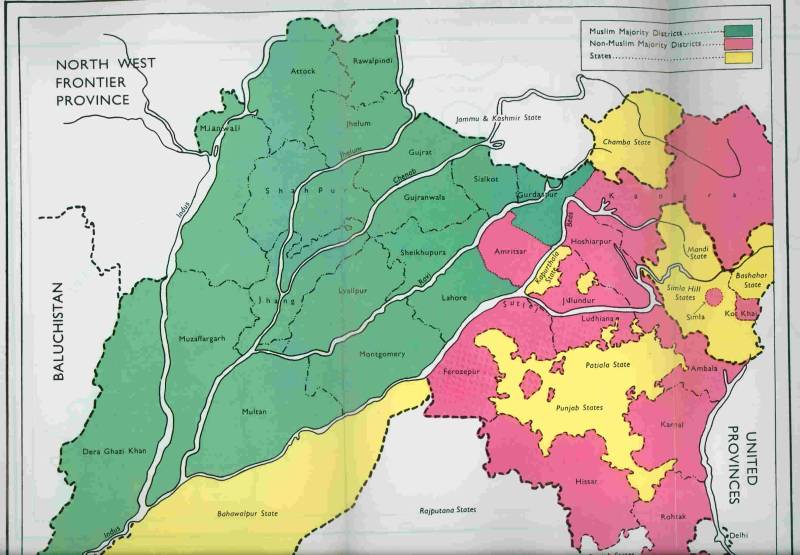
Radcliffe rejected such arguments and the arguments of Sir Zafrulla that contiguous Muslim and non-Muslim areas should be separated and given to Pakistan and India had prevailed, except in the case of the Muslim-majority Gurdaspur district. The final award was virtually identical to Wavell’s 7 February 1946 Demarcation Plan.
The public did not know until the morning of 17 August 1947 what parts of Punjab went to India and Pakistan
In Pakistan a tempting conspiracy theory that Mountbatten intervened in behalf of India to get Gurdaspur so that a link to the Jammu and Kashmir State could be provided to India. Now, Mountbatten and Nehru’s rapport was well-known. In contrast, the viceroy and Mohammad Ali Jinnah’s relationship was formal, even cold. A salacious angle to this conspiracy theory is added that Nehru and Lady Mountbatten were involved in a passionate amorous relationship and Lady Mountbatten exercised considerable influence on her husband. Therefore, the Gurdaspur district had gone to India.
Such a conspiracy theory rests on the ignorance of the 7 February 1946 Wavell’s Demarcation Plan. But then, the appeal of conspiracy theories is that they preclude any serious and responsible effort to research relevant source material and feed the imagination instead with fantastic images of behind-the-scenes bedroom happenings and manoeuvrings.
Lord Wavell had explained the deviation from the district as the cut-off point because of geographical, rather than security reasons. Gurdaspur had a very thin Muslim majority of only 1% according to the 1941 Punjab Census Report. In the 1931 census report, Gurdaspur was a Hindu-Sikh majority district and the statistics for 1941 were disputed by Setalvad and Harnam Singh who blamed Muslim officers for fabricating a Muslim majority. It may also be noted that the 1% Muslim majority of the Gurdaspur district included followers of the Ahmadi faith.
If Gurdaspur were granted to Pakistan, Amritsar which had a 53% Hindu-Sikh majority would be surrounded by Pakistan from all sides except from the east. Gurdaspur on the north, Sialkot north-west, Sheikhupura opposite it, and Lahore district would be south of Amritsar. Simply, Amritsar would be perilously jutting into Pakistan and would be indefensible. Also, two more important factors need to be taken into consideration.
- The 570 princely states were not part of the 3 June 1947 Partition Plan or the 18 July 1947 Indian Independence Act. They could, in principle, remain independent. Therefore, providing a road to Kashmir to India we know that the Maharaja of Kashmir wanted to remain in India presumptuous. Had Pakistan not sent irregulars and tribals into Kashmir on the 21-22 October 1947 night the Maharaja would not have acceded to India even when both India and Pakistan had their supporters in Kashmir trying to convince the Maharaja to accede to one of them.
- Perhaps even more interestingly, Sir Zafrulla had argued that instead of the district the tehsil should be used as the basis for determining contiguous Muslim and non-Muslim parts of Punjab. If Radcliffe had accepted that as the basis for the allocation of territory to either Pakistan or India, Pakistan may have reached Jalandhar or even Ludhiana, in the Gurdaspur district Pathankot tehsil through which the road to Kashmir went, was 60% Hindu-Sikh majority. It would have been given to India.
Justice Munir had mentioned that the Sikhs tried to bribe him to agree to Lahore being given to India. Some stories suggest that the tehsils of Ferozepur and Zira where a munition factory existed were to be given to Pakistan in the original allocations by Radcliffe, but Mountbatten prevailed on the chairman to give them to India. However, Ferozepur district’s five tehsils together as a whole had a Hindu-Sikh majority and Wavell had placed Ferozepur district in India.
Sir Christopher Beaumont who was private secretary to Sir Cyril suggested in 1992 that Mountbatten influenced Radcliffe to alter the award in favour of India. He has referred to the daily changing maps which were being discussed by Radcliffe from about 8 August onwards. What we know for a fact is that in the end Radcliffe awarded 3 tehsils Gurdaspur, Batala, and Pathankot of the Gurdaspur district to India and Shakargarh tehsil of Gurdaspur district, which was on the western bank of the Ravi was given to Pakistan. Beaumont may have had a memory lapse after so many years or Radcliffe the final award secret even from him, or Mountbatten’s influence somehow coincided with Wavell’s Demarcation Plan.
However, the public did not know until the morning of 17 August 1947 what parts of Punjab went to India and Pakistan. Pakistan and India celebrated independence on 14 and 15 August. For 2 days the Pakistan flag flew at the Gurdaspur district headquarters and Mushtaq Ahmed Cheema PCS was Pakistan’s Deputy Commissioner in Gurdaspur. Then all hell broke loose, and the Muslims had to flee to Pakistan in great haste. I have dealt with these details in my book, The Punjab Bloodied, Partitioned and Cleansed.