

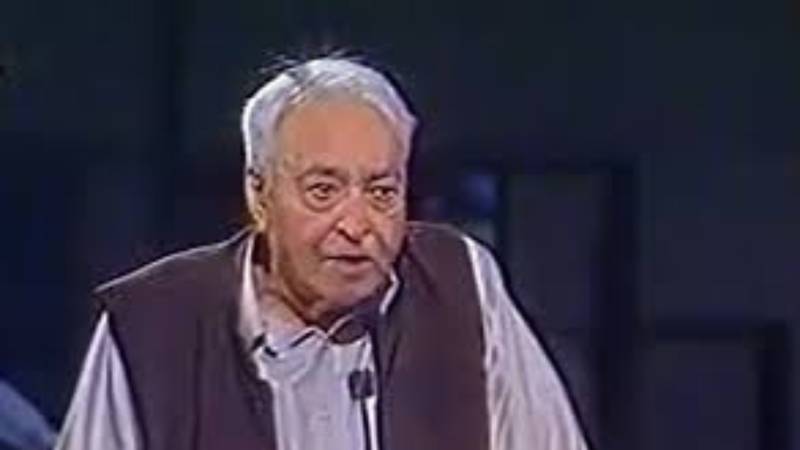
Among twentieth-century Urdu poets of the subcontinent, Munir Niazi occupies an oddly luminous solitude. He does not belong to a school or manifesto; he inherits no tradition in a conventional sense, nor does he act as the mouthpiece of an ideology. His arrival in literature resembles the entry of a solitary traveller emerging from the oblique angles of language, a figure half-dreamer, half-sage, carrying the fragrance of estrangement and the shimmer of visions poised uncertainly between revelation and rumour. His uniqueness, rather than a cultivated rebellion against tradition, seems a natural outgrowth of temperament: the sense that he was born slightly askew from the known world, seeing it not directly but refracted through moods, memories, and metaphysical breezes that others could barely feel.
This sense of strangeness is not cultivated performance; it rises from the grain of his life: displacement, austerity, an abiding metaphysical restlessness, and a poverty of early years that heightened rather than dimmed his receptivity. He famously insisted that he never moved towards poetry; poetry moved towards him, demanding not composition but surrender. His poems thus feel “received” rather than “made”: acts of visitation rather than construction. It is as though his imagination served as a kind of threshold through which images, intuitions, and apprehensions passed, never fully his, never fully foreign, but suspended in the space between sensation and symbol.
This quality is crucial to understanding why his contemporaries felt in him both the familiarity of a lost homeland and the aura of someone newly expelled from Eden. Munir’s voice holds the murmur of mortality, the shimmer of evening, the unease of twilight: moods that critics tried to name but could never quite domesticate. His poetry seems both ancient and startlingly modern, echoing archetypes but also inventing new tonalities of solitary feeling.
In the poem Husn meñ gunāh kī ḵẖvāhiš, the world appears as a tension between fire and snow:
Ḥusn to bas do ṭaraḥ kā ḵhūb lagtā hai mujhē
Āg meñ jaltā huā
Yā barf meñ soya huā;
Darmiyāñ meñ kuch nahīñ…
(Beauty pleases me only in two forms: burning in fire, or sleeping in the snow; nothing exists in between…)
The refusal of the middle is the refusal of the ordinary. Munir steps into poetry from a slightly slanted plane of perception, where experience is either incandescent or frozen, never merely present. It is this refusal of the middling texture of reality that makes him indispensable in our own era of flattening sensation. In a cultural moment that rewards the average, the uninflected, the algorithmically predictable, Munir insists on extremity: on beauty that wounds or dazzles, on emotion that unsettles rather than reassures.
Munir’s creative process was not one of deliberate craft but of being touched by something outside the self
The Geography of a Restless Self
Munir’s personality, emerging through interviews and recollections and ultimately crystallised in his poems, reveals a being shaped by inner mobility: an emotional nomad who experienced beauty with acute intensity precisely because it was scarce around him. His temperament oscillated between solitude and visibility; he claimed indifference to fame while quietly accepting its inevitability. Those who knew him recall a man who could sit silently for hours yet suddenly erupt with remarks that felt like dispatches from another dimension of experience.
This inner restlessness also structured his verse. What later critics described as his philosophical moods, alienation, hesitation, longing, were not positions, but atmospheres. His emotions moved in tides; certainties dissolved; meanings shimmered and retreated. The instability of perception became the condition of his art.
There is a striking resonance here with his nazm Sapnā āge jātā kaise:
Chhoṭā sā ik gāṅv thā jis meñ
Diye the kam aur bahut andherā…
(There was a small village in which lamps were few and darkness abundant…)
The poem’s landscape, dim lamps, thick shadows, and an ancient loneliness mirror Munir’s own psychic topography. The final question of the poem, “Sapnā āge jātā kaise?” (“How could the dream move forward?”) articulates the existential limit he repeatedly encountered: the dreamer is always held back by the architecture of his own fear, memory, or fate. Such limits shape his entire poetic universe. They also frame a paradox: that yearning, not arrival, is the true condition of poetic life. Munir inhabits that yearning as though it were a homeland.
The Poetic Imagination as Visitation
Munir’s creative process was not one of deliberate craft but of being touched by something outside the self. His recollection of a woman’s momentary glance in Canada, a fleeting event that lived within him for decades, reveals the metaphysical dimension of his memory. What another person would have forgotten instantly became, for Munir, a symbol, an omen. His memory did not store events; it stored essences.
His poems feel older than their historical moment, as though fragments of forgotten epics drift through them
This is why his poetry feels dream-cinematic: images advance not by logic but by metaphysical association. The visual dissolves into the archetypal. Critics such as Majid Amjad saw in his lines the rippling of secret emotional pulses. Munir’s poems are not narratives but apparitions.
Consider the poem Nigār ḵẖāna:
Kisī kī sharbati naz̤ar / koī mehkhtā pairahan…
(Someone’s sherbet-coloured gaze, a fragrant garment…)
The scene accumulates sensory intensities, colour, fragrance, and motion, yet it never settles into a narrative. It hovers, much like the woman’s gaze in Canada, half-present, half-symbolic. The metaphysics of visitation is embedded in every line. And perhaps this is why his poetry so often resembles memory dreaming of itself: the world seen not as it is, but as it trembles just before meaning.
Cities of Light, Cities of Shadow
Urban modernity in Urdu poetry often appears as a social metaphor; in Munir’s work, the city becomes elemental, a psychological and moral terrain. His most famous refrain captures this condition:
Us bewafā kā shahr hai aur hum haiñ dosto.
Ashk-e-rawāñ kī nehr hai aur hum haiñ dosto.
(The city of that treacherous, faithless beloved, and here we stand, my friends;
A canal of flowing tears, and here we stand, my friends.)
This bewafā kā shahr is not merely a place but an emotional cosmos structured around absence. It is the beloved’s city, not because she dwells in it, but because her unreliability imbues its very air. The city becomes treacherous not through its walls or roads but through the beloved’s spectral presence, which haunts the sidewalks as palpably as wind. Munir’s vision of the modern metropolis is therefore an intimate one: an architecture built of longing, where even the ordinary light of afternoon seems tilted by desire.
Evening in this city becomes an instrument of memory:
Ā ga’ī yād shām ḍhalte hī…
(Memory returned the moment evening descended…)
In Chhe raṅgeñ darwāze, Munir returns to the motif of portals:
Chhe raṅgoñ ke phūl khile haiñ / mere ghar ke āge…
(Six-coloured flowers have bloomed before my house…)
Each door opens into multiplicity: cities behind cities, possibilities behind possibilities. One senses that Munir is less interested in the destination than in the shimmer of thresholds themselves: the promise of what might lie beyond, or what might be lost the instant one crosses.
A couplet intensifies this urban dislocation:
Gali ke bāhar tamām manzar badal ga’e the,
Jo sāyah-e kū-e yār utra to maine dekha.
(All the scenes outside the lane had changed when the shadow of the beloved’s quarter descended, then I saw.)
Here, the city shifts the moment longing darkens its periphery; architecture rearranges itself under the pressure of desire. Munir’s city is thus a theatre of metamorphosis, where memory alters buildings and dusk redrafts the streets. It is not urban space but emotional weather that governs the map: a place where one can never be entirely sure whether one is walking through a city, or through the aftermath of a feeling.
Myth, Fragrance, and the Atmospheric Mind
Munir does not invoke myth directly; yet myth breathes through his imagery. His poems feel older than their historical moment, as though fragments of forgotten epics drift through them. The wanderer, unable to return home, the beloved who arrives like fate, the evening that becomes a presence: all these archetypes populate his verse without fanfare.
Munir Niazi’s poetry is not merely literature. It is a way of looking, a discipline of feeling, a reclaiming of wonder in an era that has traded wonder for speed
Nature, too, becomes mythic. Wind is never meteorological; it carries existential news. His scent-laden imagery also intensifies this mythic atmosphere:
Woh jo mere pāas se ho kar kisī ke ghar gayā,
Reshmī malbūs kī ḵẖushbū se jādū kar gayā.
(She who passed by me on her way to someone else’s house enchanted me with the fragrance of her silken garment.)
Fragrance becomes enchantment; the moment becomes myth.
There is an evening in Munir’s poetry that does not merely descend; it approaches, as if aware of who waits for it. It carries with it the rustle of unkept promises, the footsteps of those who never returned, and the slight metallic tang of a city about to rain. One feels, reading him, that dusk is a sentient thing: it watches, listens, and occasionally answers. We are accustomed to thinking that we remember evenings; Munir reverses the direction. It is the evening, in his world, that remembers us and names us in the dimming light.
This quality gives his atmosphere an almost mythic autonomy: time becomes character, fragrance becomes omen, and silence becomes prophecy.
The Metaphysics of Time and the Tragedy of Delay
Time is the gravitational centre of Munir’s imagination. Not time in abstraction, but delay, the human condition in which awareness arrives too late to alter events. His classic nazm Hameśā der kar detā hū̃ maĩ crystallises this vision: the confession of a man who always comes after the decisive moment has passed.
This is not moral weakness; it is existential architecture. In Munir’s world, mornings feel incomplete, evenings linger, and nights are thick with myth. Time has viscosity; it slows around decision and accelerates around regret. Delay is not an accident, it is a metaphysical law.
A couplet reflects this belated self-wounding:
Apnī hī taigh-e adā se āp ghāyl ho gayā,
Chāñd ne pānī meñ dekhā aur pāgal ho gayā.
(By the elegance of its own blade, the moon wounded itself;
It gazed into the water and went mad.)
Even the moon succumbs to the tragedy of realisation arriving too late. That is Munir’s gift and wound: the capacity to feel the moment as it slips just past reach.
The Last Rooms of Silence
As Munir aged, the inner combustion that once powered his poems began to dim. He admitted this without embarrassment: the emotional reservoirs from which he had written were slowly receding. This honesty did not diminish him; it completed him. He had always written from visitation; when the visitor ceased to arrive, he accepted the silence.
His later life acquired the aura of a myth in itself. He lived in a room without a door, letting visitors enter through a window. The gesture, half-eccentric and half-symbolic, preserved his lifelong preference for reality entering obliquely. Even in domestic routine, he sought the slanted angle of perception.
When he died, his contemporaries felt not merely the loss of a poet but the disappearance of an atmosphere. They remembered not events, but the silence after his sentences. His absence seemed to hollow out the very air he once populated.
Why We Still Need Him
The question of why Munir Niazi’s poetry is still needed today is inseparable from the spiritual crises of our age: the erosion of wonder, the exhaustion of attention, the collapse of inwardness beneath accelerating demands. Munir’s poetry becomes necessary in a world that has forgotten to pause, forgotten to doubt, forgotten to perceive. His art restores mystery to reality, shading the world again with ambiguity where algorithms now insist on certainty.
His couplets continue to echo because they awaken the dormant capacities of the self. In the shimmering music of lines such as:
Āwāz de ke dekh lo shāyad woh mil hī jā’e…
(Call out and try, perhaps she might yet return…)
There is both longing and courage: a recognition that human desire continues to reach beyond probability. Another couplet reminds us that perception itself is transformative:
Chaman meñ rang-e bahār utra to maine dekha…
(When the colour of spring settled in the garden, then I saw…)
Only a heart prepared for recognition can perceive renewal.
Munir allows us to inhabit our estrangement rather than flee it. He protects ambiguity, that fragile space where meaning begins to form. He teaches us to walk into the evening slowly, vulnerably, attentively, seeing not just what is present, but what trembles at the edge of presence.
Munir Niazi’s poetry is not merely literature. It is a way of looking, a discipline of feeling, a reclaiming of wonder in an era that has traded wonder for speed. Even now, his lines ask us, quietly, insistently, whether we have forgotten how to perceive. In answering them, we discover why we still need him, and why we always will.