

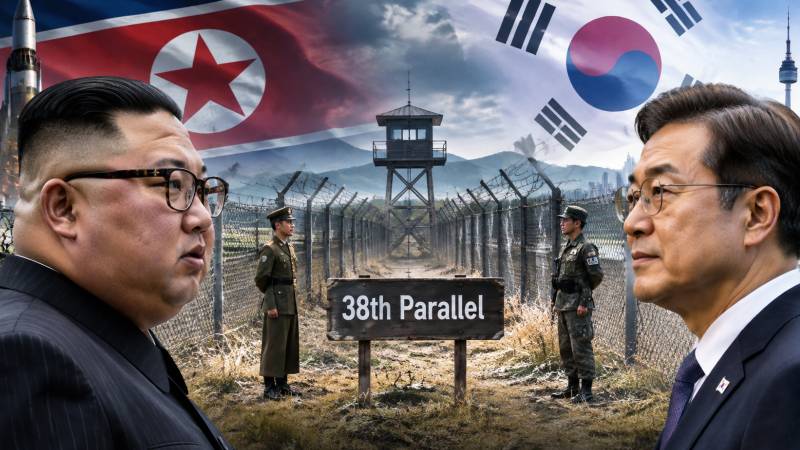
Korean peninsula is the only prevailing case study of division of one nation into two separate entities. Unlike East and West Germany, North and South Yemen which were unified, Korea is the only example in the post-Second World War period which reflects splitting of a nation in two separate countries. Since the outbreak of the Korean War in 1950, 38th parallel is a dividing line between the two Koreas and hence is a de facto border.
Despite common ethnic, lingual, historical and geographical characteristics of the Korean Peninsula what is preventing the unification of Korea? Why the regime of North Korea is adamant in not supporting unification with its southern counterpart? How Korean Peninsula emerged as a nuclear flashpoint in North East Asia and how its militarization is a major impediment for the unification of the two Koreas? These are the questions which are raised while examining the case of Korean unification.
Tracing the historical evolution of the division of two Koreas, Ambassador Syed Hasan Habib in his illuminating book entitled, North Korea Never Ending Tragedy published in 2026 states that: “After the end of WWII (1945), the country was divided into a northern area, protected by the Soviets, and a southern area protected primarily by the United States. In 1948, when these powers failed to agree on the formation of a single government, this partition became the modern states of North and South Korea. The peninsula was divided along the 38th Parallel: the "Republic of Korea" was created in the south with the backing of the US and Western Europe, and the "Democratic People's Republic of Korea" in the north with the backing of the Soviets and China.
The new premier of North Korea, Kim Il-sung, launched the Korean War in 1950 in an attempt to reunify the country under Communist rule. After a bloody war, the conflict ended with a cease-fire in 1953, but the two nations officially remain at war because a peace treaty was never signed. Both states were accepted into the United Nations in 1991.” Since 1953, the division of Korean Peninsula along 38th parallel is accepted as a fait accompli with a long standing desire particularly in a segment of South Korean population for unification with their northern counterparts. Whereas, given dictatorial nature of North Korean regime, there is no measure to gauge how people in the north of 38th parallel think about uniting with their southern counterparts?
76 years of separation of the two Koreas is an interesting phenomenon because it reflects how aspirations for the unification of the two Koreas are crushed. It was the drive of North Korean leader Kim Il-sung who wanted to unify the two Koreas under communist system but his attack on non-communist southern part of Korea leading to the outbreak of war in 1950 failed to materialize his ambition. Now, there is a realization in South Korea that in view of North Korean nuclear and militaristic threats and the inability of impoverished people of North Korea to rise against the authoritarian regime, there is no point in having ambitions for unification of the two Koreas.
According to Mitch Shin in his article, “The Unification Paradox: Why South Korea Must Embrace a Two-State Reality” published in The Diplomat issue of January 29, 2026: “Over the past decades, the official North Star of South Korean foreign policy has been the peaceful unification of the Korean Peninsula. Rooted in a post-war ethos and a shared ethno-national identity, this objective has been treated as a sacred national mission by successive governments. However, the cold realities of the 21st century demand a reckoning: this goal is no longer a noble aspiration, but a strategic delusion. South Korea must formally and permanently abandon its “unification-first” doctrine. To secure long-term stability and a lasting peace, Seoul must pivot toward a pragmatic strategy of managed coexistence based on a permanent two-state system”. It means the goal of Korean unification is now an aberration and majority people of South Korea realize that unifying with their northern counterparts will not be possible particularly in the near future. Since North Korea went nuclear its confidence in maintaining its sovereignty is now a reality. It is the prevailing stance of North Korean regime of boosting its nuclear arsenal and threatening the U.S with long range nuclear missiles that prevents any drive for the unification of Korea.
The 76-year division of the Korean Peninsula reflects how aspirations for unification have been crushed by geopolitical rivalries, authoritarian rule and the growing militarisation of the region.
When people of North Korea don’t matter for the regime of Kim un Jong and there is no plausible hope that people of that part of Korea will rise and topple the communist regime, unification of Korea would remain elusive. Nevertheless, what prevent the unification of Korea needs to be analyzed from three standpoints. First, while unification may be a distant ambition, what is required to deal with issues engulfing North and South Korea is to unleash the process of dialogue and diplomacy. In 1994 in the last days of North Korean leader Kim Kim Il-Sung, talks were held between the two Koreas for unification with U.S President Bill Clinton for urging Pyongyang to freeze its nuclear program in return for the lifting of sanctions. But, following the death of Kim Il-Sung dialogue process between the two Koreas and U.S and North Korea got stalled. The U.S President Donald Trump had a meeting with the North Korean leader Kim un Jung in February 2019 in Hanoi but there was no breakthrough for mending of U.S-North Korean relations. In the second term of President Trump talks for a meeting between Trump and Kim un Jung in China also remained inconclusive.
Knowing that North Korea will not be receptive to unification of the two Koreas and will not denuclearize, the only viable option left for peace and stability in the Korean Peninsula is to unleash the process of dialogue. This would require softening of 38th parallel and allowing movement of people, goods and services between North and South Korea. Second, North Korean regime must realize the fact that its adamant position for not resuming normal relations with Seoul is counterproductive and will further impoverish its people. For that purpose, the onus is on the side of Pyongyang because nuclearization and militarization will be at the expense of its economy and further deepen poverty at its end. Furthermore, Russia and China as strategic allies of North Korea also need to play a pivotal role for dialogue and diplomacy between North and South Korea instead of supporting militaristic and nuclear ambitions of Pyongyang,
It is certain that North Korea is confident to deal with U.S/U.N sanctions by seeking support from Moscow and Beijing. Therefore, international community needs to exert pressure over Russia and China not to promote nuclear and militaristic ambitions of North Korea and compel Pyongyang to be receptive for the holding of dialogue with the United States and South Korea. But, it seems North Korea is adamant by threatening the U.S, South Korea and Japan of consequences if there is any military action against Pyongyang. It means, the world needs to accept the nuclear status of North Korea and the permanent division of the Korean Peninsula. Finally, South Korea and the United States should examine North Korean demand for the withdrawal of U.S forces from South Korea. Pyongyang argues that it is because of American military presence in South Korea and the U.S nuclear shield to Seoul that was compelled to carry out its nuclear and militarization program.
It is yet to be seen if there can be any solution to North Korean demand from the U.S and South Korea. There is also trust deficit among the three parties to the Korean conflict: the United States, North and South Korea. Only by pursuing military and non-military confidence-building measures by the two Koreas an environment of trust can be established leading to peace and stability in the Korean Peninsula. Russia and China as stakeholders of the Korean Peninsula must also play their role in this regard. The task is difficult but not impossible.