

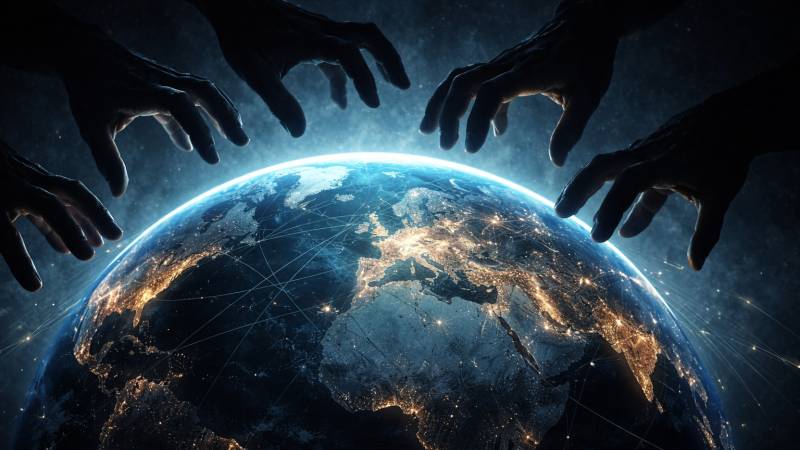
“Have you ever paused to examine the process through which you came to believe the things you believe?”
Let us recall what Pat Robertson wrote in his book The New World Order, published shortly after the collapse of the Soviet Union in 1991. Robertson’s outline of the New World Order has, in many respects, stood the test of time: “It must eliminate national sovereignty. There must be a world government, a world police force, world courts, a world banking system and currency, and a world elite in charge of it all.” What many celebrated as the Global Village at the turn of the twenty-first century, with the widespread arrival of the internet, was in fact a manifestation of this order, a world increasingly interconnected and interdependent, and therefore more open to surveillance, where every individual, every bank transaction, and every movement could be monitored.
This world order has systematically eroded individuality, privacy, and independence.
Before the First World War, the world was structured around empires: French, British, Ottoman, Prussian, Austro-Hungarian, and Tsarist Russian. The interwar period was one of dissolution, eventually consolidating into two opposing blocs, the Soviet and the American, composed of newly founded nation-states after the Second World War, including India and Pakistan. Competition between these two powers revolved around spheres of influence, territory, military strength, and resources.
The Middle East, with its newly discovered oil wealth, drew the attention of both superpowers, each exerting influence through a mixture of persuasion and coercion. If we attempt to connect the dots between key events, assassinations, alliances, and wars in the Middle East and South Asia during the Cold War period (1945–1988), it becomes increasingly persuasive that these events did not occur by chance, but by design.
It is impossible to summarise all of them here, so let us focus on the 1970s.
In 1973, King Faisal of Saudi Arabia imposed the oil embargo, sending shockwaves through the West. That same year, Mohammad Daoud Khan overthrew his cousin, King Mohammad Zahir Shah, ending Afghanistan’s constitutional monarchy and declaring a republic. In the same year, Pakistan adopted its first constitution with an Islamic identity under Zulfikar Ali Bhutto’s martial law. Simultaneously, the oil boom transformed Iranian society under Mohammad Reza Shah Pahlavi, who maintained close relations with both Washington and Moscow.
Following the extraction of Venezuelan President Nicolás Maduro from his palace, President Trump has reminded the world that international law now means whatever the United States decides it means, guided by his own moral judgment alone
What followed is striking. King Faisal was assassinated in 1975; Daoud Khan was killed in 1978; the Shah of Iran was exiled in 1979; and Zulfikar Ali Bhutto was hanged in the same year.
Does this appear to be a mere coincidence, or a carefully designed reordering of the world?
With moderates eliminated across Eurasia, the Soviet Union was drawn into Afghanistan, previously a relatively stable country under King Zahir Shah, where Daoud Khan had already opened the door to American and Saudi involvement. Saudi Arabia, newly radicalised after the loss of the progressive King Faisal, poured money into Islamist movements. With the Western-oriented Shah gone and the comparatively progressive Bhutto executed, the stage was set for the conclusion of Act One: the Afghan jihad and the Iran–Iraq War, followed by the fall of the Berlin Wall in 1988 and the collapse of the Soviet Union in 1991.
Act Two unfolded with Operation Desert Storm in Iraq in August 1990, the consolidation of control over oil resources, and the proliferation of jihadist organisations such as al-Qaeda, alongside the Afghan Taliban. This created the conditions for Act Three, which began with 9/11 in 2001. United Nations Security Council Resolution 678 enabled the United States and its allies, including NATO, to wage war in Afghanistan, even as NATO continued to expand eastwards, much to Russia’s growing alarm.
Under Vladimir Putin, Russia sought reconciliation with the West, while China, having liberalised its economy after 1991, quietly built an immense industrial base with Western investment. It was perhaps a grave miscalculation by the United States and its allies, particularly Britain under Margaret Thatcher and the United States under Ronald Reagan, to shift their economies from production to commerce. Rising living standards and labour costs drove this change. Russia inherited a formidable industrial base, while China was allowed to create one.
The first major challenge to Western dominance emerged in 2014–15, when Russia annexed Crimea, and China launched the One Belt One Road initiative, later renamed the Belt and Road Initiative. One was overtly aggressive; the other appeared benign. The COVID-19 pandemic of 2019–20 accelerated these shifts. When the world reopened, China’s economic momentum seemed unstoppable. Russia’s invasion of Ukraine in February 2022 returned global attention to Eastern Europe, the cradle of two previous world wars.
Three years later, with Donald Trump’s return to the presidency in 2025, we entered Act Four.
His tariff wars, his acceptance of Russia’s territorial gains in Ukraine, and China’s dominance in manufacturing and technology were reflected in Vice-President J.D. Vance’s speech at the Munich Conference of 14–16 February 2025, where he castigated Europe’s immigration policies and blamed them for Europe’s decline. Trump further stunned his NATO allies by expressing his desire to make Canada the 51st state of the United States and to acquire Greenland.
In this new American vision, India no longer enjoys the privileged status it held after 9/11, apparently due to disappointment over its military performance against Pakistan in May 2025. As NATO weakens, the United States Secretary of State has redefined the American concept of the West, no longer a community of shared values such as democracy and the rule of law, but a geopolitical sphere of United States dominance in the Western Hemisphere.
Finally, following the extraction of Venezuelan President Nicolás Maduro from his palace, President Trump has reminded the world that international law now means whatever the United States decides it means, guided by his own moral judgment alone. This is not the end of the New World Order that began in 1988. It is merely a reminder of who owns it.
This is the beginning of Act Four—a time to reflect and examine our beliefs. Perhaps we were too quick to conclude that the United States had lost its status as a superpower with the rise of China and the re-emergence of Russia on the battlefield.