

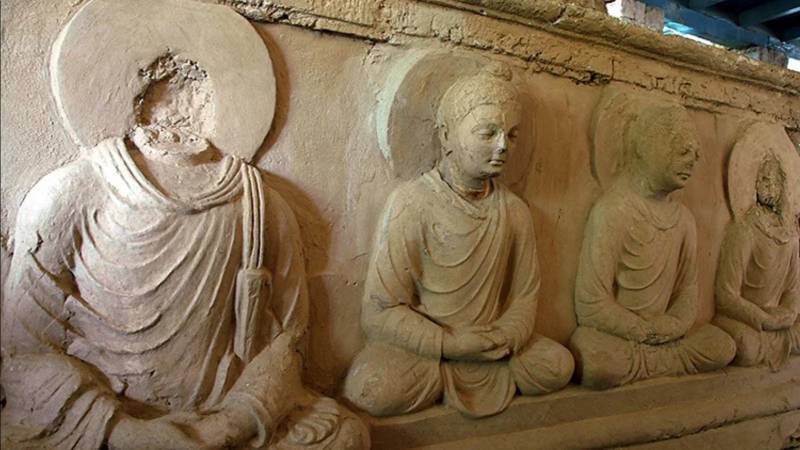
By any measure, the warning signs are now impossible to ignore. What began as a set of images, shared, circulated, and contested, has escalated into a full-fledged international concern. The ancient landscape of Taxila, long celebrated as one of South Asia’s most significant archaeological complexes, now stands at the edge of a reputational precipice: the possibility of being placed on UNESCO’s “List of World Heritage in Danger.”
The immediate trigger was a letter, part whistleblowing, part advocacy, sent to Pakistan’s Permanent Delegate to UNESCO in Paris. It flagged ongoing interventions at Mohra Moradu and Sirkap, two emblematic sites within the Taxila complex. The concern was not merely about repair, but about the nature of repair itself: walls allegedly demolished and rebuilt, heights altered, and materials, most controversially, cement, introduced into an archaeological fabric defined by its antiquity and fragility.
UNESCO, whose designation of Taxila in 1980 recognised not just its monuments but its layered civilisational history, responded in the only way it could: by asking questions. Those questions, in turn, triggered a chain of bureaucratic correspondence, federal inquiries, provincial defences, and technical reviews, now awaiting a final reply from Paris.
Yet behind this exchange lies a deeper, more troubling question: what does it mean to conserve heritage in the twenty-first century?
The federal Department of Archaeology and Museums (DOAM) has taken a firm stance. Its officials warn that the use of cement and the apparent reconstruction of original structures constitute serious violations of international conservation norms. The fear is not only technical but diplomatic. Pakistan, which has long struggled to expand its World Heritage footprint, risks undermining its own credibility. A site on the “danger list” does not merely signal decay; it signals mismanagement.
On the other side stands the Punjab Archaeology Department, equally resolute in its defence. Its leadership insists that the interventions were not acts of reckless rebuilding but necessary measures to prevent further deterioration. Faced with encroaching vegetation, water damage, and structural collapse, they argue, inaction was not an option. Conservation, in this telling, is not a purist exercise but a pragmatic one, requiring stabilisation, accessibility, and, crucially, relevance for contemporary audiences.
The stones of Sirkap and the monastic quiet of Mohra Moradu, once silent witnesses to centuries of history, have become the centre of a contemporary debate about authenticity, authority, and responsibility
This divergence is not new. It echoes a long-standing tension in global heritage practice: the line between conservation and reconstruction. International charters, from Venice to subsequent UNESCO guidelines, have consistently privileged minimal intervention and the preservation of original material. But these principles were formulated in contexts very different from today’s realities, contexts that did not always contend with mass tourism, climate stress, or the developmental aspirations of postcolonial states.
Taxila sits precisely at this intersection. It is not a frozen relic but a living heritage landscape, visited by pilgrims, tourists, and scholars alike. The push to build visitor facilities, restaurants, lodges, and interpretive spaces reflects a desire to integrate heritage into economic and cultural life. Yet such integration carries risks. When does facilitation become intrusion? When does restoration become reinvention?
The images that sparked this controversy capture that ambiguity. To some, they show necessary care: workers stabilising ancient walls, clearing invasive growth, reviving long-buried features like the sacred water well at Mohra Moradu. To others, they reveal something more unsettling: a gradual transformation of archaeological remains into something cleaner, higher, and perhaps less authentic than before.
UNESCO’s pending response will, no doubt, focus on compliance, on whether the interventions align with established conservation standards. But the real stakes are broader. This is not merely about two sites in Taxila; it is about the evolving philosophy of heritage management in countries where the past is both a cultural inheritance and a developmental resource.
Pakistan has faced this dilemma before. In 1998, Bhir Mound, another component of Taxila, was placed on the “danger list” after plans for a stadium threatened its integrity. Public outcry eventually halted the project, and the site was saved. That episode demonstrated the power of collective vigilance. Today’s situation, however, is more complex. The threat does not come from overt destruction but from well-intentioned intervention.
And that is precisely what makes it harder to resolve.
As the government’s response makes its way to UNESCO, and as the world body deliberates its reply, Taxila remains in a state of suspended judgment. The stones of Sirkap and the monastic quiet of Mohra Moradu, once silent witnesses to centuries of history, have become the centre of a contemporary debate about authenticity, authority, and responsibility.
If there is a lesson to be drawn, it is this: heritage is not only about preserving the past; it is about negotiating the present. And in that negotiation, the margin for error is vanishingly small. For now, the question lingers, posed not just by UNESCO, but by history itself: can we protect what we inherit without remaking it in our own image?