

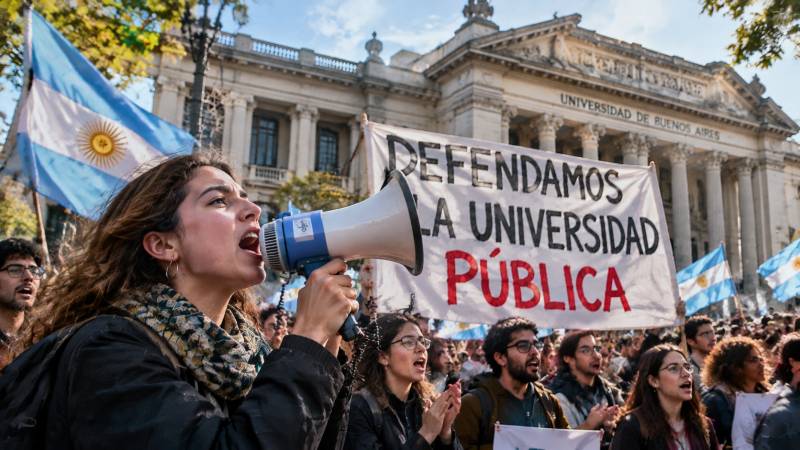
On 15 October 2026, the streets of Buenos Aires became an extension of Argentina’s university campuses. Students left classrooms, professors lecture halls and researchers laboratories to join the fifth Federal University March, demanding that President Javier Milei implement legislation intended to protect public university funding. By 3 November, a seven-day nationwide strike by university teachers had reached its scheduled final day, with further industrial action under consideration and the 2027 budget still in dispute. What began as a quarrel over allocations has become a test of democratic authority, constitutional obligations and the human cost of austerity. The central confrontation is not simply between demonstrators and the government, but between fiscal discipline and the insistence that a country cannot prosper by weakening the institutions that produce knowledge.
Argentina’s attachment to public education has unusually deep historical roots. In 1918, students in Córdoba initiated a university reform movement demanding academic autonomy, modern teaching, participation in governance and freedom from entrenched authority. Their ideas travelled across Latin America. In 1949, the Peronist government abolished tuition fees at national universities, making higher education an instrument of social mobility. A university degree became a route into professional and scientific careers. These traditions survived dictatorships and economic emergencies. Consequently, the current debate cannot be reduced to the size of an annual allocation. For many, defending universities means defending equal opportunity.
An additional dimension is geographical. For students outside Buenos Aires, publicly funded regional campuses reduce the need to relocate to the capital or abandon higher education altogether. A funding shock is therefore not distributed evenly: families with savings can improvise, while those already constrained by transport, accommodation and living expenses may simply withdraw. Educational austerity can quietly become geographical inequality. Milei came to power in December 2023 with a chainsaw as his political emblem. It signified his determination to dismantle wasteful spending, subsidies and bureaucratic structures that he believed had paralysed Argentina. His diagnosis was not entirely misplaced. Argentina endured fiscal deficits, currency crises, debt and inflation that devastated wages and savings. Traditional parties had failed to secure stability. Milei's program of spending restraint, deregulation and fiscal consolidation therefore appealed to citizens exhausted by economic disorder. Admirers regard him as a reformer courageous enough to confront entrenched interests; critics see an ideologue applying a blunt instrument to institutions that require careful repair. Both perspectives deserve examination.
Recent poverty figures reveal the fragility of the recovery. INDEC reported poverty rising to 32.3 per cent in the first half of 2026 from 28.2 per cent in the preceding half-year. This followed a substantial improvement from the severe crisis of early 2024, when poverty had approached 53 per cent. Milei helped tame inflation, but renewed poverty exposes the difficulty of turning stability into well-being. Unemployment reached 7.9 per cent in the second quarter of 2026. Reuters reported on 2 November that household consumption fell 2.7 per cent in the first nine months of 2026 compared with the same period a year earlier, while analysts anticipated a second consecutive quarterly contraction. Weakness in manufacturing, retail and construction contrasts with the stronger performance of some export-oriented sectors. A recession was not yet confirmed by the quarterly data, but the warning was unmistakable: improving macroeconomic indicators does not guarantee a recovery shared across households. When recovery is felt more readily in fiscal accounts than in family budgets, public patience becomes conditional.
Another difficulty is the lag between policy and perception. Budget savings are recorded immediately; improvements in employment, wages and productive investment may take years to emerge. This delay places an especially heavy burden on governments pursuing rapid adjustment. They must demonstrate not only that their calculations are sound, but that the transition is being managed with credible protections for vulnerable households.
Supporting fiscal responsibility does not require accepting the deterioration of universities. Indeed, if a reform program drives talented graduates abroad, it may squander precisely the human capital on which future productivity depends.
At issue is the University Financing Law passed in 2025. It called for adjustments to operating budgets, academic and non-academic salaries, and student scholarships following inflation. Milei vetoed it, arguing that additional spending lacked an adequate financing source. Congress overrode the veto, but an executive decree subsequently made implementation conditional upon identifying budgetary resources. Universities maintained that the government was frustrating a law that had completed the constitutional process. A budget dispute became a test of separation of powers. Fiscal prudence cannot exempt an executive from legal scrutiny; equally, legislators must take seriously the financial consequences of commitments they approve. Responsible democratic government requires both fiscal clarity and respect for enacted legislation.
The courts have made that tension more visible. On 6 October, federal judge Martín Cormick ruled against the decree blocking implementation of the financing law. The government appealed, and the appeal suspended that particular ruling, but an earlier obligation to update salaries and scholarships remained. The legal process therefore remains unsettled, and it would be misleading to portray the matter as a final judicial victory for either side. What is settled is the political damage created when universities, Congress and the executive become locked in an extended argument over whether an enacted law should take effect. Argentina must resolve constitutional disputes through law, not permanent confrontation.
By 3 November the movement had entered a sustained phase of industrial action. CONADU Histórica began a nationwide strike of university and pre-university teachers on 28 October, scheduled through 3 November, demanding implementation of the University Financing Law, recovery of lost salaries and adequate university funding. At the University of Buenos Aires, the AGD-UBA union announced participation in the week-long stoppage. The non-teaching federation FATUN held a 24-hour strike on 28 October and scheduled further stoppages for 3, 12 and 16 November, although participation differs across institutions. CONADU Histórica planned an extraordinary meeting for 6 November to determine the next steps. At the time of writing, the final outcome of the week-long strike and any new decisions had not yet been established. Its duration and its disruption of university life are already part of the political calculation.
Alongside the strikes, campus assemblies and protests have made the financial dispute visible beyond Congress. The interruption of classes presents a difficult paradox: those defending education are temporarily suspending the very activity they want to safeguard. Yet supporters argue that chronic underfunding is itself a quieter and longer-lasting interruption. A postponed experiment, an unfilled academic vacancy and a library with shortened hours seldom attract the attention that a national strike receives. University leaders and unions must nevertheless confront the educational costs of prolonged stoppages. Their achievement will ultimately be measured not by the number of days campuses close but by whether viable teaching, research and student support can be restored.
The 2027 budget has become the immediate parliamentary battleground. The National Inter-university Council is seeking approximately 11 trillion Argentine pesos for public universities, compared with roughly 7.7 trillion in the executive’s proposal—a gap of some 3.3 trillion pesos. On 28 October, the government failed to secure sufficient agreement with allied legislators to advance the planned committee report. By 1 November, negotiations were continuing with allied and centrist blocs, including discussions about university financing and other disputed provisions. Government negotiators were targeting a chamber debate on 18 November, or possibly 25 November. No settlement of university funding had been established by 3 November. The government maintains that commitments must remain compatible with its fiscal targets; universities argue that the proposed allocation would perpetuate financial deterioration. Transparent expenditure, phased salary recovery and independent assessment of university needs would be preferable to a contest of political endurance.
One practical path would be a multi-year compact between the treasury, university councils and Congress. It could link predictable operating grants to independently audited expenditure, transparent staffing data and protections for essential research. Salary restoration could be phased against explicit inflation benchmarks. Such a settlement would impose obligations on institutions as well as government, replacing annual brinkmanship with measurable commitments. The protests have also exposed a wider distributional question. Pensioners, public employees, disability-rights advocates and organized labour have raised grievances about reductions in support, changes to services and lost purchasing power. Their demands and loyalties differ. What unites many of them is uncertainty about who bears the costs of adjustment and who receives its benefits. A program that restores financial credibility but leaves large groups feeling excluded may achieve macroeconomic stability without securing social consent. Declarations cannot manufacture consent. Securing it requires citizens to see a credible connection between present sacrifice and an improved future.
Balanced accounts, credible monetary policy and lower inflation are indispensable foundations of recovery, but they are not the whole architecture of development. Public health, technological capability, education and labour productivity determine whether stabilization can become durable prosperity. Reforms gain support when burdens are fairly shared and institutions remain credible. Investors may respond favourably to fiscal restraint, but communities judge policy by whether their children can study, their parents can obtain care and their work can sustain a decent life. The comparison with Argentina's catastrophic crisis of 2001 may be politically tempting, but it should not be exaggerated. Conditions differ, institutions function and Milei retains support. The present protests do not establish that another national breakdown is imminent. They do, however, reveal how quickly a disagreement over allocations can become a struggle over dignity, constitutional legitimacy and national priorities. Democracy is tested by its ability to accommodate disagreement without treating opponents as enemies.
As of today, Argentina faces an unresolved university financing dispute at the close of a scheduled week-long teaching strike. Further non-teaching stoppages are planned for 12 and 16 November, university teachers are due to assess their next steps on 6 November, and negotiations over the 2027 budget remain open ahead of a possible parliamentary debate later in the month. Meanwhile, fresh reporting on weakening consumption and industrial activity has sharpened the economic question underlying the protests. Milei must show that fiscal stabilization can translate into broader prosperity and credible public services; opposition leaders must explain how their commitments would be financed; and university authorities must defend academic autonomy through accountable management as well as mobilization. As the country approaches its 2027 presidential election, the consequences extend far beyond campus gates. More than a century after Córdoba's students challenged academic authoritarianism, another generation is asking who should decide the future of knowledge. A nation may balance its books and still impoverish its future if, in the process, it neglects the classrooms and laboratories that make lasting progress possible.