

The Second World War is usually remembered through maps, generals, and diplomatic conferences. Histories of the Burma campaign discuss strategy, logistics, and imperial command. In South Asian nationalist histories, the war often appears merely as a prelude to independence and Partition. Lost between these narratives are the voices of ordinary colonial subjects who fought, suffered, and survived the war without ever controlling its purpose.
One such voice belongs to Mir Zaman, a rural Muslim from the Taxila region, whose memoir offers a rare account of the war from below. His story is not about Churchill, Roosevelt, or even Jinnah. It is about debt, hunger, interrupted schooling, military recruitment, malaria, artillery fire, and the fragile hope that a soldier’s salary might save a family from ruin. Read today, his recollections force us to rethink how the Second World War was experienced across colonial India.
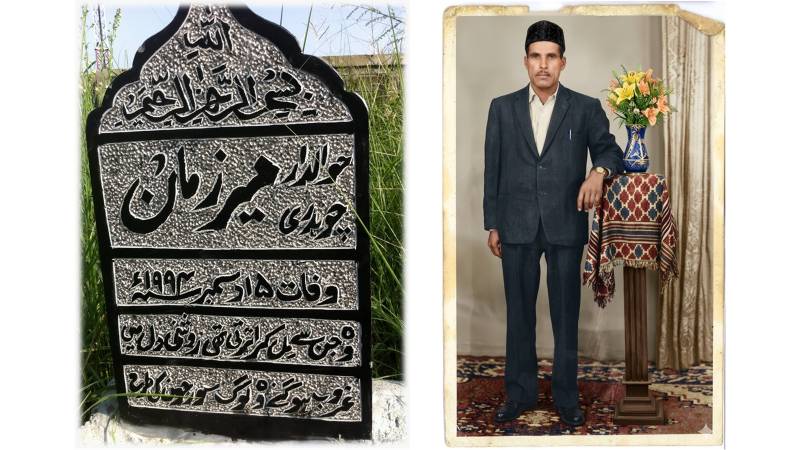
Today, Mir Zaman’s handwritten autobiography remains unpublished, preserved privately by his grandson Asif Farid in Taxila. A surviving studio portrait of Mir Zaman (Fig. 1) preserves the visual world of the rural Muslim working classes from which many colonial soldiers emerged. Formal yet modest, the photograph reflects the aspirational respectability associated with military service and state employment in late colonial Punjab. That such a document survives only within family custody is itself revealing. While the memoirs of generals, governors, and politicians are archived, edited, and celebrated, the memories of ordinary colonial soldiers remain fragile, vulnerable to disappearance, and largely absent from public history. With so much attention devoted to the voices of statesmen and military commanders, the small voice of history often drowns.
What emerges from the Burma front is not the glamour of war but its texture—jungle camps, malaria, collapsing bridges, hunger, exhaustion, and endless artillery fire
Mir Zaman was born around 1926 into an agrarian family near Taxila. His childhood unfolded within the precarious economy of rural Punjab under British rule. His father and uncles worked as cart drivers and cultivators. The family attempted to improve its fortunes by digging an irrigation well near Jandial, but the project became financially disastrous. Loans were taken from Hindu moneylenders, debts mounted, and land was mortgaged or sold. Court cases consumed whatever stability remained.
This is where the war story really begins.
Long before Mir Zaman reached the battlefield, imperial structures had already entered village life through debt, land pressure, and economic insecurity. The memoir reminds us that colonial military recruitment often relied not on patriotism but on desperation. Rural families joined the army because agriculture no longer sustained them.
One of the most striking parts of the memoir concerns education. Mir Zaman recalls that he excelled in school, stood first in class, and was even selected for a scholarship examination. Yet his father withdrew him from school because labour was needed at home after his brothers enlisted in the army. It is a small detail, but historically significant. For many colonised families, war closed off as many futures as it opened. The British Indian Army provided salaries and mobility, but it also absorbed the labour and aspirations of rural households.
His older brother Muhammad Ashraf’s story reveals the human cost of this system. Recruited into military service, Ashraf was sent through cantonments stretching from Allahabad to Burma and Iraq. Injured in an accident, hospitalised, and eventually afflicted with tuberculosis, he returned home dying. The family was too poor to arrange even basic funeral hospitality.
Yet the memoir does not narrate suffering in purely material terms. After Ashraf’s burial, the grave was reopened for repairs, and according to Mir Zaman, the body appeared intact, accompanied by fragrance and signs interpreted as spiritual blessing. To modern readers, the episode may sound miraculous or folkloric. But that reaction misses the point. Rural communities interpreted war, death, and sacrifice through moral and religious frameworks unavailable in official archives. These beliefs formed part of historical reality. The war was not only military and economic; it was spiritual and emotional.
Mir Zaman himself entered the army reluctantly. Initially he fled training and was later arrested for desertion. His account of imprisonment inside overcrowded military cells is particularly revealing. Colonial military discipline appears here not as heroic service but as coercion. Soldiers from different religious communities—Muslims, Sikhs, Hindus—shared filthy barracks and punishments together.
Eventually he trained as a wireless operator and was sent to the Burma front. Here the memoir becomes especially important for historians. Most official accounts of the Burma campaign focus on operational success: the defence of Imphal, the reconquest of Burma, the collapse of Japanese lines. Mir Zaman instead records the war through bodily experience.
He remembers jungle camps, air-raid sirens, malaria, collapsing bridges, hunger, exhaustion, and endless artillery fire. He writes about eating boiled gram with red chilies because supplies had run low. He recalls retreat routes marked on small maps in case soldiers were captured. He describes how artillery fragments tore through rock and flesh alike.
What emerges is not the glamour of war but its texture.
There are also moments of startling humanity. During one battle, a dying Muslim soldier requested burial beside the roadside where he fell. Mir Zaman and his comrades buried him there and marked the grave with wood. Elsewhere, local Burmese villagers welcomed Indian troops with white flags after suffering under Japanese occupation. Two local girls regularly brought milk to the soldiers, who shared rice pudding with them near the Irrawaddy River.
Such details matter because they restore individuality to people erased by large-scale military history. The war was fought not only through divisions and brigades but through improvised acts of care among frightened and exhausted people.
At the same time, the memoir complicates simplistic nationalist readings of colonial armies. Mir Zaman does not describe the British purely as oppressors, nor does he portray military service as imperial loyalty. His British officers appear mainly as immediate superiors enduring the same battlefield conditions. A Sikh instructor encourages him during technical training. Muslim relatives help him navigate military life. The army appears as a layered social world structured by race and empire but also by everyday cooperation.
This complexity is precisely what many nationalist histories flatten.
By the end of the war, Mir Zaman had travelled farther than most men from his village could ever imagine: Rawalpindi, Sialkot, Imphal, Mandalay, Rangoon, Madras, Ahmednagar, Malakand, Waziristan. Yet this mobility was never freedom. It was movement directed by empire.
Even the atomic bombing of Hiroshima and Nagasaki enters his memoir through rumour and radio broadcasts heard in cantonments. He understood the bomb primarily through death: “large numbers of people began dying.” The war ended not with celebration but exhaustion.
Then came Partition.
Communal violence, the creation of Pakistan, and the Kashmir conflict emerged immediately after demobilisation. Like many colonial soldiers, Mir Zaman moved seamlessly from imperial military service into the institutions of the new postcolonial state, eventually joining the police in Pakistan. The structures of empire did not disappear in 1947; they changed uniforms.
Mir Zaman died in 1994. Today, his memory survives not only through his handwritten memoir but also through material traces preserved within family history. His gravestone in the Taxila funerary landscape (Fig. 2) situates the life of an ordinary colonial soldier.
Why does this memoir matter today?
Because it reminds us that global events are lived locally. For rural South Asians, the Second World War was not an abstract conflict between fascism and democracy. It was a force that entered homes, reshaped families, interrupted education, mortgaged land, spread disease, and transformed peasants into soldiers.
Mir Zaman’s recollections challenge elite-centred histories of both empire and nationalism. He does not speak in the language of ideology. He speaks in the language of survival.
And perhaps that is the truest archive of war we have.