

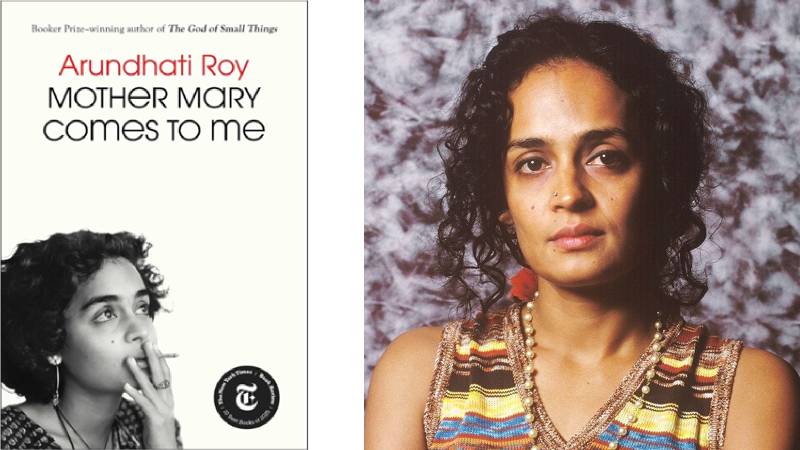
When I began to read Arundhati Roy’s memoir Mother Mary Comes to Me, I don’t know what I expected – excellent writing for sure, but this part autobiography, part biography of her mother blew me to smithereens. It was as if I was transported into another universe, Roy’s universe, and there, the love-hate relationship where ultimately love triumphs in the end left me captivated till the last word. As I kept reading the book, I kept discussing it with my father, and one day when I was all praise for it, he said, “Beta, after all she’s Arundhati Roy, she’s one in a billion.” And that sentence said it all.
No one on earth writes like Roy; no one has the command of the English language that she does, de-colonising the language and subverting it to suit her own tale in the most beautiful fashion. Mother Mary Comes to Me is a tale of Roy’s mother Mary’s resilience against the system in which she was born. With just a degree in education and being a single parent, she built an entire school that still stands. She was perhaps a little over-the-top, a little bizarre, and a little mad, but she was also passionate, fierce, and there for her students, orphans, and for women in need of shelter or help.
Title: Mother Mary Comes to Me
Author: Arundhati Roy
Publisher: Penguin Random House UK, 2025
The relationship between the mother and daughter was so fraught that Roy left home at the age of eighteen, just as she began her third year at the School of Planning and Architecture in Delhi, and cut ties with her mother, and did not return till many years later. She writes of their relationship and reunion:
“After our brittle, tentative reunion, I returned to her, visiting her regularly over the years as an independent adult, a qualified architect, a production designer, a writer, but most of all as a woman watching another with love and admiration – and a fair amount of disquiet – not just for her great qualities, but the opposite, too. In that conservative, stifling little South Indian town, where, in those days, women were only allowed the option of cloying virtue – or its affectation – my mother conducted herself with the edginess of a gangster.”
Roy even describes how she became a novelist because of her mother in some ways:
“In my effort to fathom my mother, to see things from her perspective, to accommodate her, to understand what hurt her, what made her do the things she did and to predict what she may or may not do next, I turned into a maze, a labyrinth of pathways that zigzag underground and surface in strange places, hoping to gain a vantage point for a perspective other than my own. Seeing her through lenses that were not entirely coloured by my own experience of her made me value her for the woman she was. It made me a writer. A novelist. Because that’s what novelists are – labyrinths. And now this labyrinth must make sense of its labyrinthine self without her.”
For me, one of the most interesting parts of the novel was when Roy describes what her mother did for her students as boys and girls. What she turned them into. She writes so beautifully when she says:
“Mrs Roy made it her mission to disabuse boys of their seemingly God-given sense of entitlement. She turned them into considerate, respectful men, the kind the town had rarely seen. In a way she liberated them, too. She freed them of the burden of being what society thought men ought to be. She raised generations of sweet men and sent them out into the world. What she did for her girl students, the spirit she instilled in them, was nothing short of revolutionary. She gave them spines, she gave them wings, she set them free. She bequeathed her unwavering attention and her stern love on them, and they shone back at her. That revolution, like all revolutions, came at a cost.”
Beyond her mother, Roy’s memoir delves into the creation of her famous novels, her unease with sudden wealth, and her enduring, spectacular battles alongside marginalised communities
Throughout the book, the love-hate relationship between the mother and daughter is revealed in Roy’s prose. At one place she writes:
“When it came to me, Mrs Roy taught me how to think, then raged against my thoughts. She taught me to be free and raged against my freedom. She taught me to write and resented the author I became.”
And she adds:
“It has taken me years to come to terms with the fact that I was a middle child, one of three siblings, not two. My older sibling was a boy, and my younger sibling was a school. There was never any doubt about who our mother’s favourite child was.”
Roy doesn’t just write about her mother; she writes about the process of writing The God of Small Things and The Ministry of Utmost Happiness. She writes about her unease with large sums of money and how she wanted to distribute her wealth. She also writes about her activism against the Narmada Dam Project. She states:
“Their fight against Big Dams in the Narmada Valley remains one of the world’s most spectacular battles. I was privileged to be a part of it. Though we lost, I would not, for anything, have wanted to be on the side of those who won – those who look at a river and want to stop it, tame it, own it, pour concrete and garbage and sewage into it. Kill it.”
She writes about Kashmir with even more emotion and range of anger she says:
“Every piece of news that comes out of the Kashmir Valley is censored or twisted around to suit the Indian government’s narrative. Every Kashmiri Muslim journalist is on notice. People are blackmailed, intimidated or bribed into spying on one another and becoming informers. There are double agents, triple agents, quadruple agents. A whole society schooled by experience not to trust itself. The system of incentives, rewards and promotions seemed only to enhance the brutality meted out by soldiers to Kashmiri civilians… But in Kashmir it had a different import altogether. Grief, loss, anger, fear, shame – families were drawn close by these threads of acute suffering. That closeness then brought upon itself further punishment. The security establishment often treated Kashmiri Muslim families as though their members were interchangeable. A brother could be arrested or killed in place of another. A father could be tortured till he gave up his son. A whole family could be punished in a variety of ways for what one of its members may or may not have done. All suffering in Kashmir was borne, chronicled, memorialised, quantified, calculated and assessed – by the perpetrators as well as their victims – along the grid and latticework of family relationships. Fortunately for me, Mrs Roy had a startlingly refreshing opinion about Kashmir. She had never been there. She knew just as much or as little as most Indians; she had been fed the same propaganda. But she didn’t buy it. ‘If they don’t want us, why are we forcing ourselves on them? It’s so vulgar.’”
The day Mary Roy died, Arundhati Roy’s friend sent her an Urdu couplet:
Aaj ki raat mein ghoomunga khuli sadakon par Aaj ki raat mujhe khwabon se fursat kuch hai
Tonight I will wander on open roads Tonight I have some time off, even from my dreams
Without her mother, she felt as if her world had changed completely, she says, because she was constantly used to her theatrics I feel. Roy is quite a woman herself to have withstood such a towering mother and made such a great career for herself. Mother Mary Comes to Me is a work of love that everyone should read, because it is simply put – magnificent.