

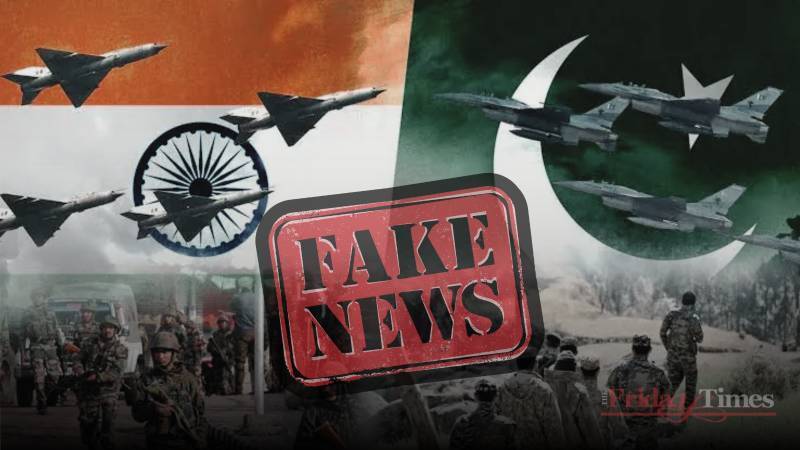
They say the first casualty when war comes is truth. We may not be at war anymore, but truth has certainly become a casualty of war. For a brief moment in time, May 7–10 to be exact, our fractured, polarised country came together to confront an external enemy. That crisis was the most significant one between the two nuclear-armed neighbours in several decades.
It saw extensive military action on the ground and in the skies and introduced Generation Z to a long-simmering conflict, which they had only read about in the history books. The four-day war brought the conflict straight onto their screens in real time. Social media exploded with memes, and there was a blurring of political and ideological divisions and internal fractures as we all waved the green flag and came together as one nation facing an enemy that clearly wanted to harm us.
Thankfully, the crisis that could have escalated into a full-blown war was defused by diplomatic engagement, primarily by the United States. It also resulted in unprecedented levels of misinformation and disinformation on both sides, but Pakistan came out of it euphoric – not only did we survive a vicious onslaught by a much bigger and richer rival, but we also gave it a bruising that led to our revival as a major regional military power.
Pakistan’s newfound respect in the world’s eyes has led the country to currently enjoy a favourable geopolitical environment. It also led to the promotion of the Field Marshal and his current active role in engaging with regional powers as a potential security provider, given Pakistan’s battle-tested military prowess. But the euphoria from the summer has died out, and the battle won on the ground and in the skies has not resulted in long-term gains for the country, as yet.
Social media accounts in Pakistan are back to their usual divisive, toxic self. What is true, what is not, who is peddling whose agenda, who knows? In the last 15 years, with the advent of digital technology, one can now produce all types of disinformation and distribute it at dizzying scale and speed.
We live in a conflict-prone neighbourhood; whatever military or diplomatic success comes our way will only improve our standing in the region
Whenever the Field Marshal undertakes an overseas visit to improve Pakistan’s standing in this tough region that we live in, a derogatory social media campaign invariably emerges back home, creating the impression that there is a deliberate attempt to undermine or obstruct his ongoing efforts in military diplomacy. Even vloggers and Twitter (X) handles who are presumably pro-establishment are found to be stirring controversies by speculating about future army appointments and promotions instead of reporting facts and covering the story about the visits!
Take the Field Marshal’s recent visit to war-torn Libya (literally divided in half by rival governments since the ouster of President Gaddafi in 2011) to strengthen defence ties with the eastern half of the country, led by Khalifa Haftar’s Libyan National Army. The Libyan conflict has already been shaped by several countries, including the United States, Egypt, France, Italy, Russia, and Turkey, among others, all looking after their own interests.
Pakistan is just the latest country to enter the fray. The circulation of a photograph from Libya featuring the Field Marshal – shared by certain journalists – triggered a wave of vlogs, tweets, commentary, and analysis on social media. These reactions have raised many serious questions. What are the motives behind these tweets, comments, and analyses? We are mired in a mess of underlying agendas, and truth is the casualty.
While there is an urgent need for a serious and responsible assessment of such matters, as well as for defining a clear framework of conduct regarding them, how will it be done and implemented in the current free-for-all social media climate? After all, it’s the most provocative and usually negative news that gets amplified. Algorithms work on clicks, and often fake news gets the most views. Currently, there are no regulations specific to social media companies requiring them to monitor and remove misinformation on their sites.
Clearly, Pakistan is the loser in all this. The Field Marshal’s strategic efforts undertaken in the national interest should not be undermined, as doing so serves no one’s interests in the country. Just recently, a leading US think tank, the Council on Foreign Relations, has warned that India and Pakistan could face the risk of renewed conflict in 2026 due to the disputed Kashmir region in its report entitled “Conflicts to Watch in 2026”. It pointed out that despite the ceasefire announced on May 10, both countries have significantly stepped up defence preparedness. We need to be ready for another crisis and back the Chief of Defence Forces as he tries to conduct military diplomacy.
We live in a conflict-prone neighbourhood; whatever military or diplomatic success comes our way will only improve our standing in the region. As a result of the war with India, we have elevated our strategic importance – it is important to consolidate these gains and translate them into bolstering the country’s defence and economy.