

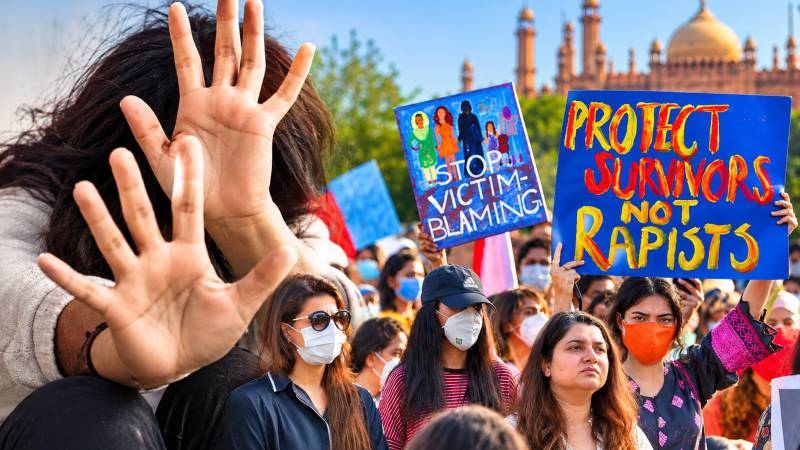
Two foreign women's cases in four months, one police station, and a pattern older than both: the complainant ends up under the microscope before the accused reach a courtroom.
On the night of 25 September, a 20-year-old woman from Azerbaijan went out to dinner in Lahore with two women. At a café, three men joined them and offered the group a ride. According to the FIR she later lodged at Defence C police station, she was taken to a rented flat in a private housing society near Raiwind, given a drink laced with something, and lost consciousness. She says the three men raped her through the night, locked her inside until 2 pm the next day, then drove her to Ghazi Interchange near the airport and left her there. They kept her phones and her luggage.
The case was registered under Section 375-A of the Pakistan Penal Code, the gang rape provision. By Sunday, police said they had identified all 3 suspects. They asked the federal government to put the names on the Provisional National Identification List because the men had left the city; they traced one of them to Sialkot, seized the car, and took 2 relatives and a domestic worker of one suspect into custody. A joint team drawn from the Crime Control Department, operations and investigation wings was formed. On Monday, she recorded her statement under Section 164 of the Code of Criminal Procedure before a judicial magistrate at the Cantonment Courts, in a courtroom cleared of everyone unconnected to the case. The same day, police announced the arrest of one of the main suspects.
Then a second kind of information began reaching the press. Police officials told reporters that inconsistencies had surfaced in her travel history and in some of her statements; nothing yet supported the reasons she had given for visiting Lahore 3 times or for her clothing business; and records showed she had been in touch with several people in the city. In the same reports, almost as a footnote, came the medical findings: pressure marks on her shoulder, an injury to her knee, DNA samples collected.
I want to be careful here, because the case is live. Investigators have to test every account, including the complainant's. The accused are entitled to the presumption of innocence and to a fair trial, and nothing in this piece assumes the guilt of any particular person. But checking a statement and briefing journalists about a woman's travel record and phone contacts 72 hours after she reported a gang rape are two very different things. One is investigation. The other tells the public what sort of woman she is, before a single witness has been examined. This is the second time since June that a foreign woman has alleged gang rape within the jurisdiction of the same police station.
In late June, a Dutch woman and her 40-year-old Venezuelan companion arrived in Pakistan on 26 June at the invitation of a man they had met at a cryptocurrency conference in Singapore. After a few days in Islamabad, they were brought to Lahore on 29 June for what they were told was a birthday party. According to their statements, they were held in a house in DHA for nearly 3 days, beaten, and sexually assaulted. Around $17,000 in cryptocurrency was allegedly moved out of the Dutch woman's accounts, and a ransom of $1.5 million was demanded. The operation to find them began only after her father called the Netherlands' police helpline 15. Safe City cameras helped trace the suspects, and among those arrested was a close relative of a senior political figure.
The police deserve credit for how that recovery went. What happened next deserves attention too. Officials said at the time that the women's travel documents had been completed so they could fly out as soon as possible. They did. By mid-July, the talk was of questioning them through video link, and of asking them to return if needed. I understand why a traumatized woman wants to leave. But a rape prosecution in Pakistan rests heavily on the complainant being present, examined and cross-examined. Once she is on the other side of the world, the case begins to thin, and every defense lawyer knows it. It would be easy to treat these as stories about foreigners. They are not. They are the visible end of a system whose numbers are already public.
Checking a statement and briefing journalists about a woman's travel record and phone contacts 72 hours after she reported a gang rape are two very different things. One is investigation. The other tells the public what sort of woman she is, before a single witness has been examined.
The Sustainable Social Development Organization, working from police data obtained under right-to-information laws, counted 5,339 rape cases registered across Pakistan in 2024. Punjab accounted for 4,641 of them. The national conviction rate was 0.5%. In Punjab, it was 0.4%, or roughly 4 convictions for every 1,000 cases registered. The smaller provinces were worse: Sindh recorded no convictions from 243 cases, Khyber Pakhtunkhwa 1 from 258, and Islamabad 7 from 176. In 2023, Punjab alone had registered 6,624 rape cases.
Set those figures beside the September case. Lahore police can identify 3 suspects in a day, request a national identification alert, seize a vehicle and arrest a prime suspect within 72 hours. Nobody doubts the capacity. What goes missing is everything between the FIR and the verdict: the forensic chain, witness protection, the prosecution's preparation, and, above all, the complainant's willingness to stay in the case for months or years while her life is discussed in public.
The Motorway case of September 2020 is the example everyone cites when they want to prove the system can work. DNA from the scene matched the accused, and an anti-terrorism court sentenced Abid Malhi and Shafqat Bagga to death on 20 March 2021, about 6 months after the crime. It is worth remembering the other half of that story. Within days of the attack, Lahore's then capital city police officer, Umar Sheikh, asked on television why the woman had set out at night and why she had not taken the GT Road instead. The outcry forced him to apologise. Six years on, the reflex he expressed has moved from television to anonymous briefings about a complainant's travel history.
We do not lack legislation. The Anti-Rape (Investigation and Trial) Act 2021 requires Special Sexual Offences Investigation Units in every district, in-camera trials, and verdicts preferably within 4 months, with no more than 2 adjournments during trial. It provides for anti-rape crisis cells where a woman can file an FIR, undergo a medico-legal examination and have an independent support person present under one roof. Punjab said in early 2025 that it was fielding 1,450 specially trained officers to run these units. Evidence suggests the structure helps when it is used. Maliha Zia of the Legal Aid Society has said that in Sindh districts where special courts under the anti-rape law are operating, the conviction rate rose from 5% in 2020 to 17% in 2025. That is still low. It is also more than 40 times Punjab's provincial figure.
Separately, Section 376-A of the Pakistan Penal Code already makes it an offence to disclose the identity of a rape complainant. In the September case, her first name, age, nationality, home city, business and travel pattern were all in print within 3 days. In a city where she knew only a handful of people, that is identity in every practical sense. There are serious objections to what I am saying, and they should be answered rather than waved away.
The first is that police have a duty to keep the public informed. They do. Announcing arrests, recoveries and the formation of investigation teams serves the public. Describing the complainant's phone contacts serves no one except the eventual defence.
The second, and I have already seen it in comment sections and WhatsApp forwards, is that foreign women should be more careful about whom they go out with. She went to dinner with two women she knew. If going to dinner is the lapse, then the offence has been redefined as a failure of etiquette, which is precisely what Umar Sheikh did on the motorway in 2020.
The third criticism is the strongest, and I partly agree. Foreign complainants get a DIG's press conference, a joint investigation team and a PNIL request within 48 hours, while a woman from Kasur or Sheikhupura waits days for her FIR to be registered at all. One reader under Dawn's report asked exactly this: if we build safe corridors for foreign visitors, what about everyone else? He is right about the unfairness. The answer is not to slow down foreign cases. It is to treat them as the benchmark. If Lahore can mobilise this quickly for one woman from Baku, the 4,641 women who registered cases in Punjab in 2024 are entitled to ask why the same machinery did not produce more than a handful of convictions.
The fourth objection concerns the country's image and the claim that coverage of such cases scares away visitors and investors. Impunity damages a country's image. A tourist or a businesswoman reading about these cases will not be reassured by silence. A verdict might reassure her.
The Inspector General of Punjab can issue a standing instruction that no officer briefs the media about a sexual violence complainant's character, movements, contacts or finances, and that any breach is treated as a disclosure under Section 376-A. That single step would cost nothing. In any case involving a foreign complainant, secure the trial evidence before she leaves the country. That means recording testimony early in a form the court can use, assigning a prosecutor from day one, and agreeing in writing to a video-link arrangement with her embassy rather than improvising weeks later.
The Punjab prosecution department should publish a public tracker for both the June and September cases: the date the challan is submitted, the date charges are framed, and the date of the verdict, measured against the 4-month standard the 2021 law sets. And the province should start judging its Special Sexual Offences Investigation Units by what happens in court, not by how quickly arrests are announced. The number that matters is not 72 hours. It is 0.4%.
I have written about gender-based violence in these pages before, and the uncomfortable truth is that the pattern repeats: a crime, a burst of efficiency, a quiet shift of suspicion onto the woman, and then silence until the next one. The woman from Azerbaijan came to Lahore 3 times on business. Whether she, or anyone like her, ever comes back will depend far less on what was said in a press briefing this week than on what a court says within 4 months. The same is true for every woman in Punjab whose case will never make the news.