

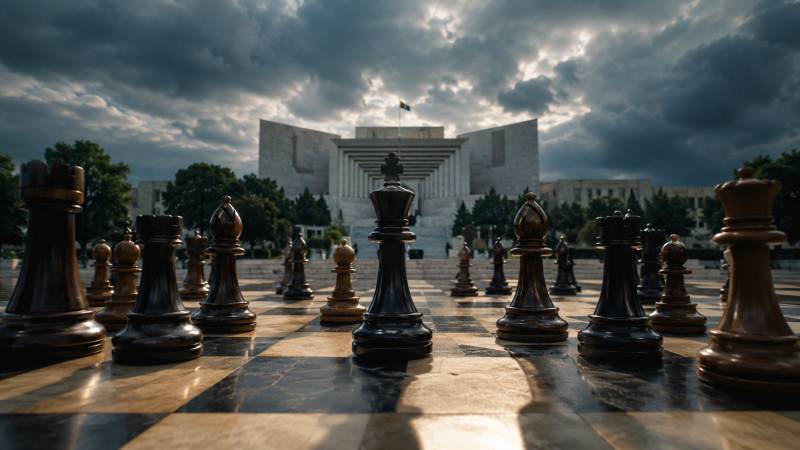
Power is an undeniable reality which can be used and misused. Unending power ambitions are rooted in human nature, which tends to cause destruction. Pakistan’s dilemma of unending power ambitions is as old as the history of the country. Since the early 1950s until today, power has been central to consolidating a nexus involving feudal, political, bureaucratic, military and clergy elites.
The failure of Pakistan to emerge as a democratic welfare state with political pluralism, good governance and the rule of law has much to do with the misuse of power by the elites governing the country. The dismemberment of Pakistan in December 1971 was also the result of denying power to the majority party, the Awami League, which had won the National Assembly elections. The demonstration of power by the West Pakistan-centric military through the launch of military action on 25 March 1971 reflected the arrogance of power, leading to the outbreak of civil war and the emergence of Bangladesh.
What is power, and how is it misused or used for the welfare and benefit of the people? Why, since the inception of Pakistan until today, have the ruling elites failed to understand the dynamics of power?
Hans J. Morgenthau, a renowned political scientist and author of the pioneering book Politics Among Nations, defined power as: “When we speak of power, we have in mind not man’s power over nature, or over an artistic medium, such as language, speech, sound, or colour, or over the means of production or consumption, or over himself in the sense of self-control. When we speak of power, we mean man’s control over the minds and actions of other men. By political power, we refer to the mutual relations of control among the holders of public authority and between the latter and the people at large.”
He further elaborates on the dynamics of power by arguing that “Domestic and international politics are but two different manifestations of the same phenomenon: the power struggle. Its manifestations differ in the two different spheres because different moral, political and social conditions prevail in each. All politics, domestic and international, reveal three basic patterns; that is, all political phenomena can be reduced to one of three basic types. A political policy seeks either to keep power, to increase power, or to demonstrate power.”
The failed use of power by the United States, from the outbreak of the Korean War in 1950 to its attack on Iran in February 2026, not only caused trillions of dollars in losses but also enormous human and material costs for America. The power ambitions of the United States diminished its influence and role in world affairs.
The same is the case with the Russian Federation, whose misuse of power against Ukraine by occupying Crimea in 2014 and parts of eastern Ukraine in 2022 led to its failure to accomplish its power ambitions. There are other examples of how the misuse of power becomes a cause of embarrassment and failure, and why states, despite knowing the adverse consequences of misusing power, are unable to change their policies in the right direction.
Unless those who matter in Pakistan reset their priorities regarding the use of power, the country will remain politically unstable, economically fragile and devoid of good governance and the rule of law
The price of unending power ambitions in Pakistan is colossal. One can categorise the cost of unending power ambitions as political, economic, societal and strategic. The political cost of the misuse of power is reflected in the emergence of Bangladesh, when the Punjab-centric military refused to grant the legitimate rights of the Bengali majority in the then East Pakistan. When the West Pakistan-dominated elites, particularly those representing the military, bureaucracy and a segment of the political elite, refused to accept the December 1970 election results and decided to use power to quell Bengali agitation, the die was cast, and Pakistan disintegrated.
The abuse of power in Balochistan in the 1960s, 1970s and the post-2000 era proved how the military, in connivance with a segment of the political elite, decided to crush Baloch nationalism, which today is witnessing a widespread insurgency. The misuse of power to deal with Sindhi and Mohajir nationalism by the state during the 1980s and 1990s also alienated a vast segment of society in Sindh province.
The use and misuse of power in the restive areas of Khyber Pakhtunkhwa, particularly the former Federally Administered Tribal Areas, is also evidence of how the state, instead of trusting the people, is more comfortable using force. The Swat and other military operations in Khyber Pakhtunkhwa destabilised a large part of the province. More recently, the use of power by the state to quell resistance by the banned Joint Awami Action Committee (JAAC) of Azad Jammu and Kashmir led to violence and instability in the region.
Why does the state of Pakistan, led by its military, tend to use power and force to quell non-conformist elements in Balochistan, Khyber Pakhtunkhwa, Sindh and Azad Jammu and Kashmir? How have political schisms and polarisation intensified following the crackdown on Pakistan Tehreek-e-Insaf and the incarceration of its founder, former Prime Minister Imran Khan? Why did the state use the powers of the Election Commission, the judiciary and the bureaucracy to deny Pakistan Tehreek-e-Insaf its role in Pakistan’s political process?
One needs to analyse the price of unending power ambitions in Pakistan from three angles. First, the ambitions of politicians and the military to hold and perpetuate power by all means. However, as a result of the 26th and 27th Constitutional Amendments, which can be termed constitutional engineering, the superior judiciary has been tamed, and the Chief of Defence Force (CDF) has been given enormous powers, including lifetime immunity. As a result, the military is not subservient to its civilian counterparts and is calling the shots. The military’s parity with, and indeed its dominance over, the civilian government is unprecedented and reflects the success of men in uniform in the domain of statehood.
When power is used to perpetuate authority and satisfy the ambitions of those occupying the highest offices, how can one expect the issues faced by ordinary people—such as poverty, underdevelopment, illiteracy, bad governance, lack of accountability and the absence of the rule of law—to be resolved? When power is used to silence the voices of non-conformist segments of society by compromising democratic principles, how can one expect Pakistan to uphold political pluralism and a free media?
Second, those wielding power are not interested in controlling corruption and nepotism. As a result, Pakistan is descending further into economic decline, with meagre foreign exchange reserves, low per capita income, declining exports and other indicators proving how indifferent Pakistan’s power elites are to pulling the country out of economic stagnation. The failure to pursue a policy of self-reliance by curbing imports, enhancing exports and relying on national resources instead of borrowing from the International Monetary Fund, the World Bank, the Asian Development Bank and other financial institutions, as well as seeking loans from friendly countries, means that power is not being used to achieve economic vibrancy and sovereignty.
When the power elites are more interested in sustaining their political clout than in overcoming economic stagnation, Pakistan will continue to compromise its sovereignty and deepen its fragility.
Finally, when the misuse of power becomes part of Pakistan’s political culture, the result is frustration, anger and antagonism, particularly among the youth. Why is power not used to control population growth, environmental degradation and climate change? Pakistan is now the world’s fifth-most populous country, with a population of around 250 million people who have almost lost hope for a better future.
Unless those who matter in Pakistan reset their priorities regarding the use of power, the country will remain politically unstable, economically fragile and devoid of good governance and the rule of law. Despite the claims made by those who wield real power, Pakistan is not moving in the right direction in terms of political pluralism, democracy, a free media, academia, good governance, the rule of law, economic vibrancy or addressing the issues of extremism, violence and terrorism. This is the price Pakistan is paying for the misuse of power by a leadership that lacks statesmanship and has failed to learn from successful models of the use of power in countries such as Japan, South Korea, the Association of Southeast Asian Nations member states and the Gulf countries.