

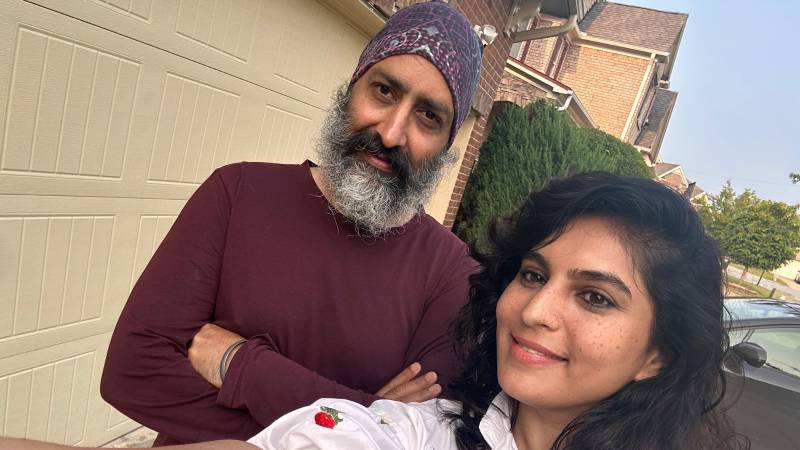
I had a two-hour window to meet Rabbi Shergill for the first time.
He is the musician.
I am the flailing writer.
Of course, I was going to make the deadline. Somehow.
He was in Swanee, and I was in across another part of Atlanta.
I went to Georgia from Islamabad only a few months ago.
Everything was new.
Rabbi was familiar.
Yes, I can be there.
I shared live location with him, wore my Sunday best and tucked my college kids under my arms and went off to impress them. Mama has friends in high places and all that Jazz.
“Why are you so excited?” my daughter asked.
“Have you ever seen me give a damn about celebrity. This is Rabbi, this is different,” I said.
When we finally made it to the suburbs, we all sort of shrieked at the sight of him at the front door.
He said: ajao. ajoo.
Surreal.
I said hi. I said thanks. I smiled.
He gestured for me and the family to sit.
An L-shaped leather sofa and a big houseplant sat between Rabbi and me.
Tucked my toes under me with an apology.
I’ve pulled my back, and the urgent care doctor diagnosed me with a herniated disc in my lower back. My prescription was bedrest and painkillers that were numbing enough for a gunshot wound to my tibia.
I found myself listening to Rabbi through a large-leafed green plant. Compelled to put my palm on my chin and nod obediently, fully aware of how awkward it must look.
“I didn’t take the painkillers today and everything hurts,” I said.
Yet here I am.
Still thinking of his casual ajao, and how I have known him all my life. Though his music, and to him I’m a cheering crowd of one.
I listen to the singer and in my head, I continue to think I know him. In my head.
Rabbi, the one whose songs helped me sing my way from one personal promise to another, one broken promise to another, until the promises dried up and only his songs remain. In the end, songs remain.
I am starstruck. This is no age. I often think celebrity is mediocre, mean or imposter-infested. Rabbi struck me, even before we met, as genuinely talented, personable and authentic. I must test those virtues against what’s in my head.
Still, my daughters are rolling their eyes at their mom’s fan girl moment so hard that their eyes may permanently get stuck at the back of their heads. I know, even for them, meeting a version of someone in their EarPods is a big deal.
“It is I who DMed your mom,” said the Rabbi to my daughters, 21 and 18.
My elder daughter nodded. She knew. She’s the one who was going through my Facebook ‘Other’ messenger to see how some men creepily harass her mom with unwanted advances. She found it mildly entertaining that desi men are so desperate.
Instead, there, among all that desperation, was Rabbi commending me for being a strong brown independent woman because of an article of mine in Dawn that he liked.
Rabbi walked into my DM long after I’d memorised all his lyrics.
“Mama! This is THE Rabbi Shergill. Accept his message.” She said.
I did with slight disbelief. Added him on Facebook as a friend. DMs from India are a thing. Mostly women from India have always appreciated my feminist content. Never a man though. Feminist, man, Indian, Sikh, Singer, Bulleh Shah reincarnated. Nope, never.
The article of mine that Rabbi liked was so corrosive.
It was a takedown piece of Pakistan’s terrible honour culture; the impunity that rapists have, and the systemic ways they are protected. A woman was raped in Islamabad’s central park equivalent, Fatima Jinnah Park. This incident hit home for me because this park was my everyday walking or running park, and this could have been me. The way a raped woman is talked of after the rape occurs is far more violating. Leaving the victim to find ways to de-criminalise herself socially and in some ways, legally. A legacy leading back to General Zia’s Hudood Laws.
Rabbi had reached out and said that it was a great piece of writing. That it was important work. That I must keep at it.
Rabbi, who shares his political angst and his solidarity. Across a warring world.
From behind the plant, the salt-and-pepper beard moving with his talking jaw, he reminds me: “We have a problem, both of us in the way we treat women.”
By us he means India, him, Pakistan, and me.
We meet in the territory of Trump’s America.
Trump unites us, our immigrant statuses shining like a neon sign.
The day I met Rabbi is the same day Sana Yusaf, the Pakistani influencer, was murdered by her stalker for rejecting his overtures. She was only 17.
Sana is younger than both my daughters.
We don’t to bring Sana up today, but we have her bitter murder in our mouths, like lead poisoning we swallow but can’t spit out.
We have another problem, him and I, we have to find ways to survive without being able to leave. Now we have left.
How do we survive the pieces of Pakistan and India in Swanee?
Rabbi, the person who mentioned Bilqis by name in his song.
Rabbi who repeated the number of times the woman activist who was shot dead in India: Uniss bar. Uniss. Uniss. Rabbi who sang the greatest Sufi banger: Bullah Ki Jana Mai Kaun. Rabbi who immortalised the love for a father when he wrote: Tere Bin.
The day I met Rabbi, the Pakistani foreign delegation was in Washington, DC. It was led by Bilawal Bhutto, Sherry Rehman and Hina Rabbani Khar. They were lobbying to walk back India and Pakistan from the fallout of being on the brink of a nuclear war.
Rabbi from India. Aisha from Pakistan. Here on US territory at war with the people who built it: its immigrants. Here on US territory, stolen from the Indigenous Americans.
We met after Trump’s claimed a diplomatic victory for solving the India-Pakistan brinkmanship. The wild card peacemaker. Pakistan nominates what The Networker calls the ‘mad king’ for a Nobel Peace Prize for making some phone calls.
India’s Hindutva Modi government is getting out of hand with despotism. Especially with the assassinations of the Sikh minority in Punjab. India and Canada had a row about that.
“Punjab is not going to be swept up by religio-nationalist fervour. It just wouldn’t happen,” Rabbi said. We speak about all the peaceniks going wild with jingoism on the airwaves. Sometimes peace makes less sense than pride. Pakistan makes for a good underdog story anyway.
There he was philosophising behind a plant.
Life, liberty and the pursuit of happiness.
He is at a 30-degree angle from my chin.
I want to listen, with my eyes.
Rabbi is a heart on legs, and a slight hangover (he declared it at the door).
What kind of Sikh would he be otherwise? A bad one.
Rabbi, the one who doesn’t do mild.
He is Buddha meets Clooney.
Maybe it is my pain medication withdrawal. This is an icon before me, and I’m not behind a concert screen while he guitars away. This is a personal moment. It is quietly mundane.
I had to bend my neck at an uncomfortable angle if I wanted to pay attention to his gyan. This is what I came for, as Rehana would say. I want this musical maestro to save me by way of validation. There is no shame in that.
I put on my research hat and ask him a series of questions on how to hack for pain and love. Don’t want to miss a thing, sorry Aerosmith.
So, my last question to him: I’m miss home. I am lost here. Migration hurts. I feel dispossessed. My writing is forgotten like a coat behind a door. Where do I even begin?
What he said, was so incredibly original but, I’ll come to it later.
First, he dealt with the pain we could see before us. My back pain. My broken spine, metaphorical and real.
He chose not to ignore it. Or brush past it. You can tell somewhat by what they refuse to ignore.
“Oh, I’ve had back pain. I’ve had to headbang my way through a live in concert.,” He winces while he speaks of it.
How did you fix it? I asked, naturally.
I’ll show you. He emerges from behind the gargantuan plant and lays down right there on the carpet. Demonstrated it, experientially. An isometric exercise. Note to self: try this at home. Rabbi, the one who is kind of a healer.
He has a practical prescriptive side to him, “Eat lots of yellow things, haldi for instance.”
Incidentally yellow is my favorite color and I smile serendipitously.
Then we talk cult, tribe, community.
We talk about Punjabi, the language, and Punjab, the land, Punjabis the people, and all that culture and the lyricism.
“Somehow songs in Hindi do not travel as far as Punjabi songs, because Punjabi songs have an innate lyricism.” We talk the musical giant AR Rehman. This person Rabbi collaborates with. AR Rehman, the person whose concert tickets I have secured in my pocket for Atlanta in August. Pakistan beats at the rhythm of Indian music. Wars be dammed, we are creatures that love like we love 90’s Bollywood music.
Rabbi who witnessed someone on the streets of Lahore saying that the Rabbi is “apna puttar.”
He wore a slight disguise and watched the moments when his art created an ethic familiarity in Pakistan, Punjab.
Rabbi who was not “charged a dime in Lahore,” when his accent gave away his homeland. “The love is real,” He said.
Rabbi who thinks the whiskey, land and dads make him a privileged Punjabi.
Rabbi who checks his privilege.
Rabbi who mentioned Sahir Ludhianvi, Fareeda Khanum, Tina Sani, Ustad Ghulam Ali, Abida Parveen and Begum Akhtar. Rohail Hayat got a nod, and Rabbi spoke of their artistic prowess. He said his closest relatable Pakistani singer is Ali Sethi from the Pasoori fame. Dads, land and lyricism is also important to him.
“Jugnu Mohsin, his mother, somehow has made that specific Punjabi dialect remain relevant,” he said admiringly.
So Pakistani music is surely revered in India among the elite and privileged musically oriented, if not by the masses.
India, which loves Coke Studio Pakistan to a fault.
Rabbi who sang a Coke Studio song that never saw the light of day for reasons he did not say.
Rabbi who cares about the cords, the notes, the empty spaces between them.
The time ticks. I nod; I ask away.
Why aren’t we seeing more of Tere Bin like songs? Songs that break your heart only to stitch it back on.
“The algorithm is tuning listener ears into songs I cannot frankly create,” he said.
Is it true that you wrote Tere Bin for your dad? I ask
“Yes, for us Punjabi boys, it is our fathers that teach us everything in the yellow sarsoon-mustard fields, also in the world.”
Why did it feel universal? I say.
If there was one relationship that meant something, this is it,” he said.
“When I wrote the song, I wrote what Hemingway calls ‘the truest line’,” he said.
I smile. I know now why I met his two-hour deadline.
“When you are going to be true, ruthless, and honest, what you sing, write, or paint has the potential of moving from your heart to someone else’s. What a gift that is.”
It is a gift every day since the release date.
“I wrote until there was nothing I could improve about the truest song. Not a syllable out of place. When it became the best, it could possibly ever be, I knew it was ready. Only then did I release it.” He said.
Of course, I wanted to know if he is still looking for the Hemingway magic.
He alludes to the idea that he constantly creates something we should see at some point in the future.
So, let me come back to the first question I asked him, on how I should pick up the pen again.
“Love and pain. The only two things that bring you back into your body. You need to come back to yourself to be creatively potent.” He said.
Our house host interrupt and offers us sweet damm-wali chai tea, and I don’t hesitate to say yes please. This means more airtime.
Rabbi, the one with the precision of a neurosurgeon, knows that all it takes is one wrong note.
My life in the US is one wrong note, on repeat. Like an alarm clock that refuses to wake me up.
Rabbi, who insists that life is for the living, so live it. (The Passenger said so in a song.)
Rabbi will soon be having chai with me. I remind myself.
I fix my posture. My back throbs till my toes now.
Pain helps me come back to my body.
I see Rabbi around like surround sound: Here on social media, there in the occasional concert, but I don’t see his Bilquis X19, his Bullah and those heart-tugging transcendental melodies that we could use now. Jiney naz hai hind pay vo kahan hain by Sahir Ludhianvi talks so deeply about what is in our subconscious, something that barely scratches the surface.
That political fervour he once had in the 2000’s is perhaps incubating.
All good things happen very slowly.
They happen when it has the engine it needs.
“We need patrons. All good artists need patrons. We can’t just do the art and also simultaneously do the selling,” he said.
Rabbi, who keeps it real.
What about places? I asked.
Places matter of course.
“’The Man’ is stronger than a place.”
“People do not want to listen to music that would need time to get into your blood. So, we don’t make music that has organic growth anymore. People just want quick pop that everyone has already listened to for them.”
Canada is mellow.
Rabbi, the Canadian.
Maybe, I wonder if it’s harder to feel pain in almost-perfect Canada.
Maybe Rabbi needs to be sufficiently distressed before his second wave of music.
We talk to farmers.
We get sombre.
“Indian Punjab doesn’t relate to the hate against Pakistan that we hear on TV and Internet these days. Strangely, it was in Punjab most of the violence during the Sub-Continent partition in 1947 happened,” he said.
Rabbi, who occasionally addresses my daughters like a good host.
y daughter speaks of her liking Sidhu Moose Wala and the advent of Punjabi pop among GenZ’s. It is because of this singer my kids got a reintroduction to the Punjabi culture their parents’ generation found crass and uncouth.
Rabbi offers the boomer uncle advice to my kids: Do not forget your language.
“My daughter speaks to me in English, and I still respond to her in Punjabi.” He said.
We talk to young people and their colossal heartbreak.
I offer to all those with a cracked jar for a heart, from my poetry pharmacy, my all-time favourite poet: Faiz Ahmed Faiz: jo bazi ishq ki bazi hai/ jo chaho lagalo daar kaisa/ gaar jeet gaeey to kya kehney/ harey bhi to baazi maat nahi.
Rabbi, the one who suddenly takes me a bit more seriously than a mere fan.
The girls and him discuss the difference between a challa and a jhalla.
To my last and final question: How do I go back to that writing that is stuck? Prescribe me something from your poetry pharmacy?
“You’re from Karachi, you already have that powerful voice, just go ahead and write the book that is already in you,” he said.
I smiled. I am from a city known for its expression.
I’ve already written the book that was in me. It’s called Heart Tantrums. Penguin India published it.
“My sister has come out with her book and got the highest literary award in India. She is the poet between us. People like her who are deep when they must be, not necessarily always. I would say to you, be like her. Go ahead and mould your pain into something worthwhile,” he said.
I stayed silent, and he went on.
“Go to your studio. Keep going. Patiently. Soon, you will feel something called love. When my sister was in love she knew. It is a singular emotion which captures your entire being. No one else needs to know about it. Wait for that knowing. When that emerges, you’ll know there is nothing else. You will walk into a room full of light, and you will know a room full of love. That will, however, only happen when you sit at your desk. Go from there. To me, it’s love. What is coming out of you may not necessarily be talking of love itself. But the essence of that creative thing that is happening to you will be, yes, love.”
We have that too in common: We aren’t afraid to name universal feelings.
It’s time for my truest line: Rabbi is the rockstar that lives up to his reputation. No scandal. No drama. No Misogyny.
An overactive protective instinct towards the softer things in life, like sisters and daughters and wives.
He didn’t mention his mum much. I noticed.
Maybe time always wins against human connection.
He heard me think out loud.
“When you spend time working on something that moves you, it will move others,” he said.