

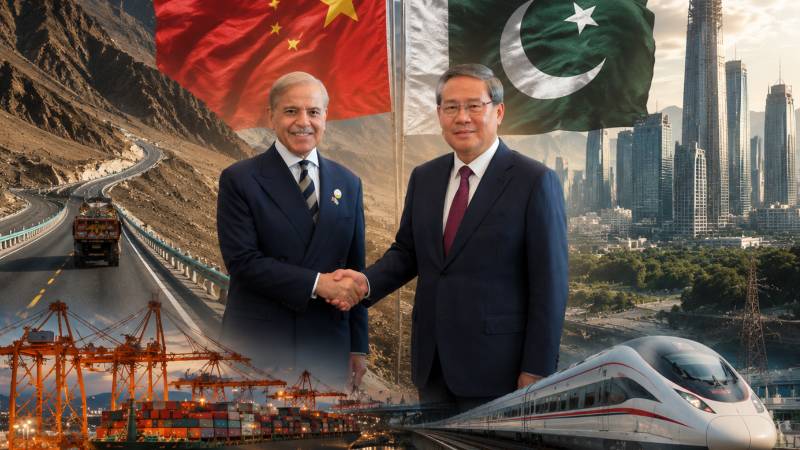
Certain shipping patterns reveal how a country is viewed by its neighbours. It is not the vessels that dock matter most, because the goods they carry already move quietly and profitably through someone else’s warehouses and customs terminals. For a decade, Pakistan has watched that traffic pass it by. Now, timing and policy have aligned in its favour for the first time. The question is whether Islamabad notices before the window closes. The trigger lies in the fine print of a Chinese Planning document, few in Pakistan will ever read. China’s Five-Year Plan, approved by the National People’s Congress in March, commits Beijing to deepen high-quality Belt and Road cooperation and names transport priorities for the next five years, including new strategic corridors into Tibet and Xinjiang. That last detail matters, because Xinjiang is the province through which the China-Pakistan Economic Corridor (CPEC) runs on its way to the Arabian Sea. Beijing did not write Gwadar into its national plan — it did not need to. It committed investment to the very province that connects to it.
This is unfolding just as CPEC itself is being rebuilt from within. At the 14th Joint Cooperation Committee (JCC) meeting in Beijing last September, Pakistan and Chinese officials agreed to advance the corridor into “CPEC 2.0” shifting focus from the power plants and expressways of its first decade toward five new pillars: growth, livelihood, innovation, green development and openness. The fifth, the Openness Corridor, is tailor-made for this moment, with a mandate centred on regional and global market integration, logistics and trade facilitation. It already has an institutional home within the JCC process and is being written into a revised CPEC Long-Term Plan due this fiscal year.
Scale deserves an honest look, since overstating the comparison would only weaken it. China’s Western Land-Sea Corridor — the rail-sea network linking Chongqing, Guangxi and the Beibu Gulf ports to Southeast Asia — moved 1.425 million containers last year, up nearly 48 percent year-on-year. That route serves ASEAN markets and is not, in its current form, a corridor to Gwadar. What the Five-Year Plan does offer is proof that Beijing is investing seriously in western connectivity, province by province. CPEC remains the only such corridor reaching open water on the Arabian Sea —a narrow but still credible claim, and one Pakistan does not need to inflate.
Geography gave Pakistan an opportunity. Policy will determine whether it becomes a gateway or remains merely a passageway.
That is a genuinely rare advantage. Northern Eurasian rail routes travel long distances before reaching a warm-water port; maritime routes lack inland penetration into Central Asia and western China; several regional alternatives have no reliable deep-water port at all. Pakistan has the Karakoram Highway running north into Chinese territory and Gwadar already built at the other end. Few countries can offer that combination of continental depth and unimpeded sea access. Dubai and Singapore did not have it either, they built their advantage through customs systems and logistics so efficient that shipping lines chose to route through them regardless.
That comparison points to where Pakistan keeps falling short. Gwadar now has a new international airport, handed to the Pakistan Airports Authority after its late-2024 inauguration, and this year’s planning documents name the port and its Free Zones as the centrepiece of CPEC 2.0, with a push toward commercialisation and investor relocation. That progress is real. But a port without warehousing, bonded storage or digital customs is still just a berth. Ships call at logistics systems that save time and money, not at geography and that mismatch, not any lack of Chinese interest, is what holds Pakistan back.
The fixes are unglamorous but familiar: complete ML-1 to remove the rail bottleneck throttling multimodal movement between ports, highways and dry ports. Although ML-1 is no longer being financed under CPEC framework and is advancing through an Asian Development Bank- supported financing structure, its strategic importance to Pakistan’s logistics networks remains unchanged and Pakistan should accelerate it rather than wait. Alongside this, it must modernise customs, so clearance is measured in hours, not days; build integrated border management as infrastructure in its own right; and strengthen logistics around Gwadar. None of this requires Beijing's approval. It requires Islamabad deciding, this year, that the Openness Corridor is a construction project, not a communiqué line.
The real risk isn't waning Chinese interest; it's treating "CPEC 2.0" as a rebrand rather than a deadline. The corridor has a name, a JCC mandate and a fiscal-year target. What it still lacks is a trade route that Chinese exporters, Central Asian traders or Gulf shipping lines would actually choose over existing alternatives. The next two years will decide that through ML-1, customs reform, and whether Gwadar becomes a port that ships actually call at, rather than one they're simply told to consider. Geography gave Pakistan an opportunity. Policy will determine whether it becomes a gateway or remains merely a passageway.