

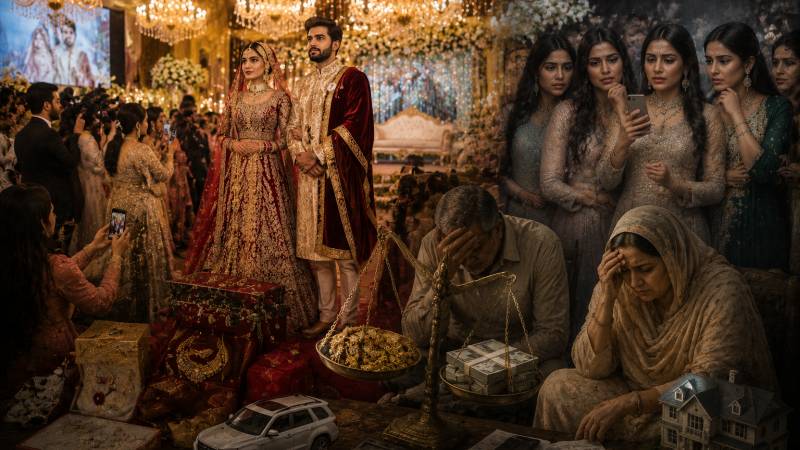
A Pakistani wedding no longer celebrates a marriage, it celebrates social anxiety. Somewhere between signing a Nikah contract and cutting a seven-tier cake, marriage stopped being about two people and became a national performance where success is measured by drone shots, designer outfits and buffet size. Parents complain about the expenses, young couples complain about the stress and guests complain about the food. Yet everyone continues acting in the same play.
The irony is remarkable. A Nikah takes about thirty minutes. Two adults agree to marry, two witnesses observe the contract, a Mahr is agreed upon and the marriage is completed both legally and religiously. Yet Pakistanis have transformed wedding into an exhausting calendar of engagements, Mayun, Mehndi, Dholki, Barat, receptions, bridal showers and endless photoshoots. A contract completed in minutes now demands months of planning and millions of rupees.
This transformation has also created one of Pakistan's largest informal industries. Industry estimates value the wedding economy at around Rs 900 billion annually, while Karachi alone reportedly generated Rs 33 billion during one recent wedding season. Marriage halls, designers, photographers, caterers, decorators, makeup artists and luxury car rentals all depend on a wedding calendar. Every new ritual creates another business opportunity. Weddings no longer mark the beginning of a marriage, they mark the beginning of another profitable season.
Economist Thorstein Veblen called this conspicuous consumption, spending money to display wealth rather than satisfy need. The extravagant stage is not built for the couple but for the audience. Flowers are admired for a few hours before being thrown away. Designer outfits costing hundreds of thousands of rupees are worn once before disappearing into wardrobes. Weddings have become advertisements disguised as celebrations.
Money, however, is not the real problem, social pressure is. Three simple words drive Pakistan's wedding culture: Log kya kahenge? Parents rarely admit they want extravagant ceremonies. Most privately acknowledge that they fear relatives more than the debt. Psychologists describe this as normative social influence, where people conform to social expectations simply to avoid rejection. Weddings have become less about celebrating love and more about avoiding gossip.
Ibn Khaldun recognised the same pattern centuries ago. He argued that societies imitate those they consider more prestigious. Pakistan illustrates this perfectly. Middle class families often plan weddings according to the wealthiest cousin, the successful neighbour or the latest celebrity wedding rather than their own income. One extravagant wedding inspires another until excess becomes the new normal.
The financial consequences are severe. Pakistan witnesses nearly two million weddings every year, with many middle class families spending several million rupees on celebrations lasting only a few hours. Some save for years while others sell jewellery, mortgage property or take loans they continue repaying long after the decorations have disappeared. Every unnecessary rupee spent on a wedding is a rupee that could have funded a home, education, emergency savings or a small business for the newly married couple.
The consequences are now visible across society. A 2023 Gallup Pakistan survey found that more than 40 percent of Pakistani men and women in their thirties remained unmarried, with wedding expenses among the major barriers. The greatest irony is that the celebrations designed to honour marriage have become one of the biggest reasons people cannot afford it.
If social pressure fuels Pakistan's wedding culture then dowry remains one of its ugliest products. What once served as a woman's financial security has become a shopping list for her parents. Furniture, jewellery, appliances and sometimes even a car are quietly expected before the bride enters her new home. A 2024 study in Punjab found dowry values over millions of rupees and showed that they often increased alongside the groom's family's wedding spending. One family spends more and the other feels compelled to match it. Marriage begins not with partnership but with a financial transaction. Pakistan restricted dowry through law many years ago, yet social pressure continues to overpower legal authority.
Every unnecessary rupee spent on a wedding is a rupee that could have funded a home, education, emergency savings or a small business for the newly married couple.
The obsession with appearances extends beyond dowry. Designer bridal dresses can cost more than a million rupees while luxury makeup packages exceed what many Pakistanis earn in months. Grooms are expected to arrive in expensive sherwanis, luxury cars and branded watches, many of them borrowed or rented. Leon Festinger's Social Comparison Theory explains why. People judge themselves by comparing their lives with others. Social media has intensified this instinct until every wedding online becomes the benchmark for the next. Marriage has become less about finding the right partner and more about producing the perfect picture.
Photography reflects this shift. Wedding albums once preserved family memories. Today they produce content for Instagram, TikTok and YouTube. Drone footage, cinematic films and staged entrances have become standard while couples often spend more time facing cameras than speaking to guests. Sociologist Erving Goffman argued that social life resembles a performance in which people carefully manage how others see them. Pakistani weddings have turned his theory into reality. Marriage halls have become stages, guests have become audiences and the bride and groom have become performers.
The performance continues at the dining table. Ask someone about the wedding a year later and they are more likely to remember that the biryani didn’t taste well, than the couple. Buffets with twenty or thirty dishes have become symbols of prestige even though much of the food goes to waste. Punjab and Sindh introduced One Dish laws to discourage extravagance but they are routinely ignored with confidence.
Many customs defended as religious are not religious at all. Joota Chupai, Doodh Pilai, showering the couple with currency notes and carrying the bride beneath a raised copy of the Quran are cultural traditions inherited from different parts of the subcontinent. Others are recent imports from Bollywood and social media. Yet repetition has given them an undeserved aura of religious authority. Society has become so comfortable confusing culture with faith that questioning these customs is often mistaken for questioning religion itself.
Islam presents a very different picture. The Prophet Muhammad (P.B.U.H) encouraged believers to hold a Walimah even if it meant serving only one sheep. The Quran commands believers to eat and drink but not to be extravagant. Pakistan's Supreme Court observed in 2005 that excessive spending on wedding functions amounted to Asraaf, the wastefulness condemned in Islam. Aristotle reached a similar conclusion by arguing that virtue lies in moderation rather than excess. Religion, philosophy and behavioural science all point in the same direction but Pakistanis continue marching the other way.
This is not an argument against celebration. Marriage deserves happiness and family gatherings. What it does not deserve is debt disguised as tradition or competition disguised as culture. Pakistan has confused the size of a wedding with the strength of a marriage and the applause of guests with the success of a relationship. We have perfected the ceremony while neglecting the commitment that follows it. A wedding lasts a day, a marriage is meant to last a lifetime. Yet we spend months planning the former and far too little time preparing for the latter. The culture has turned one of life's greatest blessings into one of society's most beautifully decorated curses.