

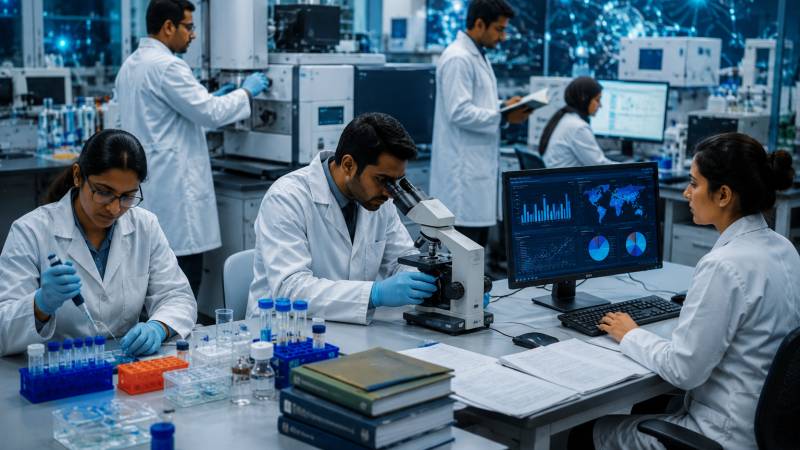
The Fulbright Program, The World Academy of Sciences for the advancement of science in developing countries (TWAS), the Commonwealth Scholarship Commission, DAAD (Germany), the Australian Endeavour programs, the Chinese Academy of Sciences, the Higher Education Commission (Pakistan), and many other international fellowship providers award post-doctoral fellowships every year. Collectively, these initiatives have played a significant role in developing scientific human capital across the developing world.
Yet, alongside this appreciation, an important policy question deserves discussion. For instance, in 2012–13, I received an acceptance letter from the Massachusetts Institute of Technology (MIT) for postdoctoral research in Biomedical Engineering. Although I was ultimately not selected for the fellowship, the experience prompted me to reflect on a broader issue. Even today, in 2026, not a single university in Khyber Pakhtunkhwa (with more than 30 private and public sector universities) possesses research infrastructure comparable to the laboratories in which many postdoctoral fellows receive training (in advance countries).
The challenge, therefore, is not obtaining an acceptance or award letter. Every year, many capable Pakistani researchers successfully secure invitations or acceptance letters from internationally renowned universities. The more difficult question is what happens after they return home.
Its worthy to note that the mandate of international fellowship organizations is to train researchers, promote international scientific exchange, and support excellence in research. They are not responsible for evaluating the financial condition or laboratory capacity of every university in Pakistan. It is entirely reasonable for them to assume that returning fellows will continue their research in adequately equipped laboratories or that their home institutions will gradually develop the facilities needed to support advanced research. Unfortunately, Pakistan's current reality is quite different.
For the past six to seven years, Pakistan's annual federal allocation for higher education has generally remained around Rs. 60–65 billion (approximately US$0.2–0.3 billion for the entire country). At the same time, many public universities are struggling (as of July 2026) to meet even their routine financial obligations, including salaries, pensions, utility bills, and other operational expenditures. Several institutions have publicly acknowledged severe financial crises. Under these circumstances, expecting universities to establish world-class research laboratories immediately after a scholar returns from MIT, Harvard, Oxford, Cambridge, or similar institutions is unrealistic.
This creates a difficult situation for returning researchers. They receive outstanding international training but frequently lack the equipment, technical support, and research environment necessary to continue the very work in which they specialized abroad. The financial dimensions of this issue are also worth considering. A typical Fulbright Postdoctoral Fellowship provide approximately US$3,300 per month, amounting to roughly US$40,000 for a one-year fellowship, including travel support. At an exchange rate of approximately Rs. 280 per US dollar (July 2026), this represents an investment of about Rs. 11.2 million in a single fellow.
USEFP supports approximately fourteen postdoctoral fellows in a given year, the annual investment approaches US$560,000, equivalent to approximately Rs. 156.8 million (15.68 crore). Over the last twenty years, this would represent an estimated investment of approximately Rs. 3.136 billion (313.6 crore) in Pakistani postdoctoral researchers through this single fellowship program alone.
These figures represent only one prestigious international fellowship program. Similar investments are made every year through numerous other globally recognized postdoctoral fellowships and funding organizations, including TWAS, the Commonwealth Scholarship Commission, DAAD, Endeavour, the Chinese Academy of Sciences, and several others. Collectively, these programs invest hundreds of millions of rupees annually—and many billions of rupees over the years—in developing the research capacity of Pakistani scientists. Given the magnitude of these investments, it is reasonable to ask whether sufficient attention is also being paid to the research environments to which these fellows eventually return.
The first question is involved in this discussion is how postdoctoral fellowships themselves are evaluated after they have been awarded. In most fellowship programs, applicants submit a detailed research proposal outlining the objectives, methodology, expected outcomes, and anticipated scientific contributions of the proposed work.
This is not an argument against postdoctoral fellowships; it is an argument for complementing them with reintegration grants, laboratory development, and stronger institutional research capacity.
There is no universally accepted framework for such evaluation, and approaches differ across funding organizations and academic disciplines. Nevertheless, several indicators are commonly considered when assessing the outcomes of a postdoctoral fellowship. These may include first-author or corresponding-author publications arising from the fellowship, collaborative publications with internationally recognized researchers, the scientific quality and impact of research outputs, successful acquisition of competitive research grants, development of innovative methodologies or technologies, supervision and mentoring of students or junior researchers, establishment of sustainable international collaborations, patents or other forms of intellectual property, technology transfer where applicable, contributions to institutional research capacity, and dissemination of research through conferences, workshops, and public engagement.
Not every fellowship recipient is expected to achieve all of these outcomes. Expectations should vary according to the discipline, institutional context, duration of the fellowship, available infrastructure, and the objectives of the funding agency etc. The discussion extends beyond evaluating individual fellows. For laboratory-intensive disciplines, should funding agencies also consider the research environment to which fellows will return? If a department lacks even basic laboratory facilities and has no realistic plan to develop them, can the expertise acquired abroad be fully utilized? Although there are no universal answers, the long-term impact of a fellowship depends not only on the quality of the researcher but also on the environment in which that researcher works.
From a financial perspective, a functional chemistry research laboratory equipped with approximately 20–25 essential instruments can be established for about Rs. 6.00 million PKR. Based on this estimate, the annual investment of approximately Rs. 155-160 million in Fulbright postdoctoral fellowships could establish nearly 26–27 research laboratories across Pakistan's public universities. Such facilities would benefit hundreds of students and researchers annually while strengthening research capacity, attracting competitive funding, and improving scientific productivity.
Possible complementary investments could include upgrading laboratories, providing reintegration grants, supporting shared research facilities, maintaining equipment, training technical staff, expanding digital research infrastructure, strengthening international collaborations, promoting technology transfer, and offering performance-based institutional grants. These measures should complement—not replace—international postdoctoral fellowships.
While fellowships develop highly skilled researchers, their long-term impact depends on the environment to which fellows return. Pakistan already has thousands of internationally trained PhD graduates working in universities and research institutions, many of whom continue to face inadequate laboratories, limited research funding, and shortages of equipment and consumables. This raises an important question: if researchers return to the same resource-constrained environment after postdoctoral training, will additional training alone be enough to maximize their scientific potential?
The broader question is who should communicate these realities to international fellowship sponsors. While donors understandably prioritize human capital development, only national institutions have a comprehensive understanding of Pakistan's research infrastructure and long-term scientific needs. A constructive way forward may be for the Ministry of Federal Education and Professional Training, the Ministry of Science and Technology, the Pakistan Academy of Sciences, the Pakistan Science Foundation, PCSIR, and the Higher Education Commission to consider forming a joint national task force. The task force could evaluate the long-term impact of fellowship programs and engage with international partners on funding models that balance researcher training with investments in research infrastructure and institutional capacity.
This is not an argument against postdoctoral fellowships. International training remains one of the most effective ways to build scientific expertise and global collaborations. Rather, the question is whether allocating a small portion of selected fellowship programs to reintegration grants, laboratory development, or institutional capacity could produce greater and more sustainable national impact. Pilot initiatives could test this balanced approach against the traditional fellowship-only model.