

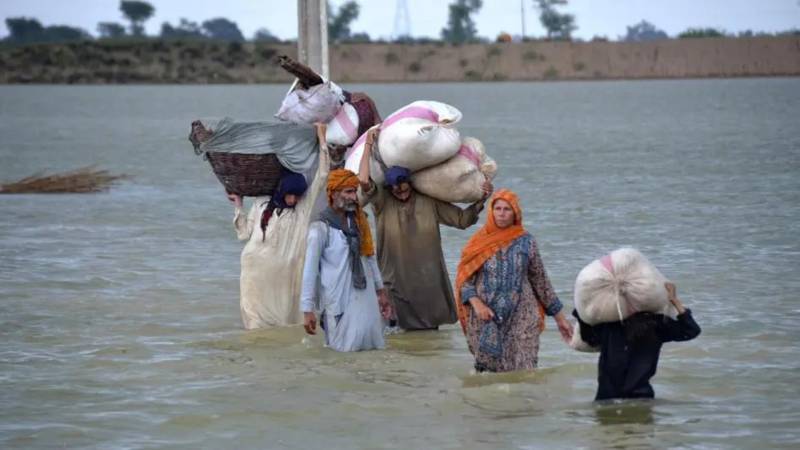
What I am witnessing in Pakistan's Punjab province is not just another seasonal tragedy. It is the grim, predictable culmination of a cycle of geopolitical fragility, institutional incompetence, and societal vulnerability. I have spent years studying the patterns of disaster and response in this region, and what I see today is a tragedy of unlearned lessons and broken promises. This is not a story of a natural disaster. This is a story of a man-made catastrophe, one where a nation's systems failed at every turn, leaving its people to drown.
The images are heartbreaking and familiar: more than 150,000 people have been evacuated from villages in Punjab as India released water from overflowing dams into cross-border rivers. The National Disaster Management Authority reported a grim national death toll of nearly 800 people since late June, with over one million individuals affected nationwide. An official confessed to me that while preparedness has improved, "the scale of flooding across borders is beyond what any one country can manage." That statement, I believe, is the central truth of this crisis. It is a quiet admission that domestic efforts are meaningless without a functional framework for regional cooperation—a framework that has been systematically dismantled.
When Diplomacy Drowns: The Peril of a Broken Treaty
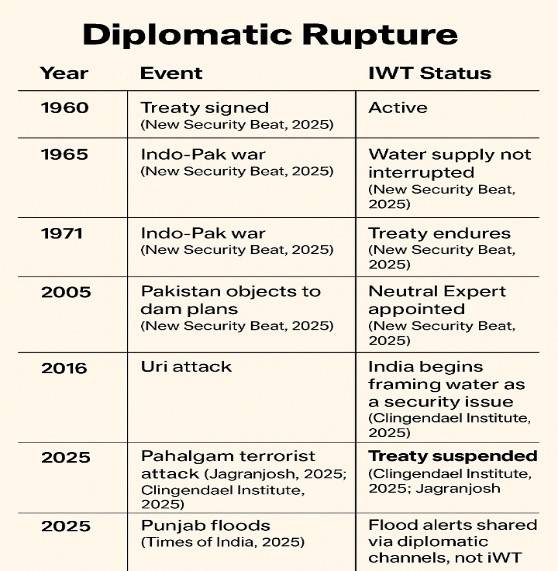
The first and most critical component of this catastrophe is the political rupture that preceded it. I have studied the Indus Waters Treaty for years, a document I always considered a near-miracle of post-colonial diplomacy. Signed in 1960, the treaty survived the India-Pakistan wars of 1965 and 1971, serving as a rare and reliable channel for functional cooperation between two nuclear-armed nations. This delicate and resilient framework, however, has now shattered.
On 23 April 2025, India temporarily suspended the treaty following a terrorist attack in Pahalgam, Jammu and Kashmir. The Indian government cited national security concerns and alleged support for state-sponsored terrorism from Pakistan as its reasons. This move was not merely a diplomatic freeze; it was an extraordinary act that transformed a long-standing instrument of cooperation into a coercive diplomatic tool.
The immediate consequence of this suspension was the halt of routine hydrological data exchange between the two nations, a protocol that is absolutely critical for accurate flood forecasting. India’s Ministry of External Affairs did send flood risk alerts to Pakistan, routing them through diplomatic channels on "humanitarian grounds." While a humanitarian gesture is laudable, I believe we must be clear about what this represents: it is a poor and fragile substitute for a robust, institutionalised framework. This shift from a rule-based system to a politically contingent one leaves a critical vulnerability in its wake.
A major international conference in Geneva after the 2022 floods saw the world pledge over $11 billion for Pakistan's reconstruction and rehabilitation efforts
Diplomatic Rupture
To understand the severity of this shift, I have created a timeline that illustrates the unprecedented break in the treaty's history, showing how a resilient agreement, which once endured wars, has now been put on hold for political reasons.
The Ghost of 2022: A Cycle of Catastrophe
The geopolitical failure, however, is only one part of this tragic equation. The other, and perhaps more damning, is the institutional failure within Pakistan itself. A major international conference in Geneva after the 2022 floods saw the world pledge over $11 billion for Pakistan's reconstruction and rehabilitation efforts. This was a remarkable show of global solidarity. But a report from the Economic Affairs Ministry, cited by the Finance Minister, revealed a shocking truth: Pakistan failed to develop “investable flood-related projects” to utilise the funds.
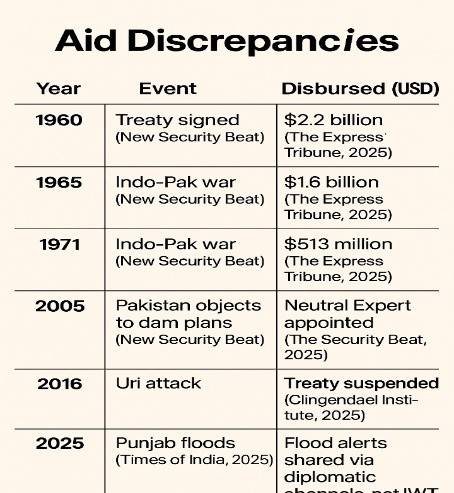
The numbers are an indictment of the system. Out of the $11 billion in total pledges, only $6.4 billion was allocated for project financing. But of that $6.4 billion, a mere $2.8 billion was actually disbursed. This is not a story of donor stinginess; it is a story of Pakistan's profound "sovereign capacity deficit." Major donors like the Asian Development Bank and China, which had committed $1.6 billion and $1.1 billion, respectively, disbursed only a fraction of their pledges—$513 million from the ADB and just $250 million from China—specifically because there were no credible financing projects to invest in. This reveals a vicious cycle: a disaster strikes, international aid is pledged, but the government lacks the administrative, technical, and political capacity to convert those pledges into an on-the-ground reality, leaving the country just as vulnerable to the next disaster.
The story of Punjab’s floods is not just about a distant nation; it is a chilling glimpse into our shared future if we fail to demand accountability and justice from our leaders and ourselves
Aid Discrepancies
This table visualises the startling gap between the aid pledged to Pakistan after the 2022 floods and the funds that were actually disbursed, revealing a fundamental failure of internal capacity.
The Unseen Victims: A Societal Collapse
While the international and institutional failures are at the heart of this tragedy, the ultimate suffering is borne by the most vulnerable: the farmers of Punjab. I have been tracking the socio-economic conditions in rural Pakistan, and I know that the floods are not the sole cause of their suffering; they are the final, devastating blow to a community already on the brink.
Farmers in Pakistan were already squeezed by a brutal combination of climate change and crippling economic policies. The price of agricultural inputs like urea and diesel has risen sharply, while the government has eliminated the wheat support price under pressure from the International Monetary Fund. A chilling detail reveals the extent of this desperation: the low uptake of relief camps. On the surface, this might seem baffling. But upon deeper examination, I believe it reveals a profound and heart-breaking truth. People are not shunning the camps out of a lack of need; they are doing so because they are unwilling to abandon their livestock, their last remaining assets, and their only lifeline to a future. This is not a logistical problem; it is a moral and economic one. The state has failed to provide a reliable enough safety net for its most vulnerable citizens to feel secure enough to seek shelter.
The floodwaters also bring a secondary, but no less deadly, crisis: a public health emergency. Health workers are already reporting surges in cases of malaria, fever, skin infections, and snake bites, which are stretching fragile health services beyond their capacity. With floodwaters contaminating surface water and destroying latrines, entire communities are left without safe drinking water and basic sanitation. This is not just a flood; it is a public health disaster unfolding in real time.
A Path to Resilience, Not Just Relief
The tragedy in Punjab's floodplains is not a singular event. It is a predictable outcome of a cascade of failures. It is the story of a fragile diplomatic framework being weaponised for political gain, of a government that cannot translate global generosity into concrete action, of a society so economically precarious that its people must choose between immediate safety and long-term survival. The floods are a symptom of a nation on the brink, and a warning to the rest of the world.
The path forward, I believe, must go beyond reactive humanitarian aid. We cannot simply respond to the next tragedy; we must address the underlying vulnerabilities that turn a weather event into a catastrophe. We must re-establish water diplomacy with India, ensuring it is insulated from political tensions. We must demand domestic accountability for the unutilised aid and build the sovereign capacity to create concrete, on-the-ground projects. And we must hold our leaders accountable for their failures in land use and infrastructure, which have placed our people directly in the path of destruction.
The story of Punjab’s floods is not just about a distant nation; it is a chilling glimpse into our shared future if we fail to demand accountability and justice from our leaders and ourselves. The time for reactive heroism has passed. The moment for proactive, integrated, and science-driven accountability is now.