

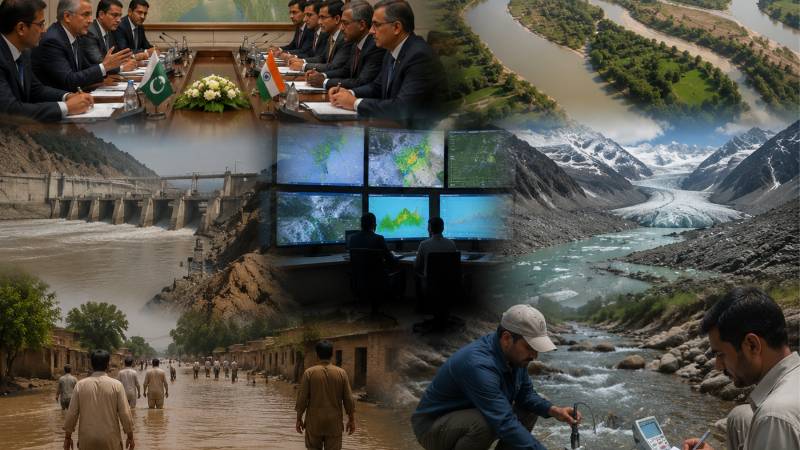
In late July 2026, the Ravi and Chenab are again testing the limits of everything built along their banks. At Abdul Hakeem, the Ravi is taking in far more water than it can release, backing up floods into standing crops and forcing the administration to open relief camps across southern Punjab. The Chenab is climbing toward medium-to-high flood levels at Marala, Khanki, and Qadirabad; the Sutlej, for now, remains at manageable levels at Ganda Singh Wala. Pakistan's National Disaster Management Authority (NDMA) has warned that flash floods threaten hill torrents from Dera Ghazi Khan to Khyber Pakhtunkhwa.
The Indus Waters Treaty—the 1960 compact that gave Pakistan the western rivers and India the eastern ones, but bound both to share data, inspect works, and coordinate—has been in suspension since April 2025. India halted formal hydrological data sharing and stopped commission meetings after the Pahalgam attack. Yet, this suspension is legally hollow. The Permanent Court of Arbitration has explicitly ruled that the treaty contains no provision for unilateral "abeyance," and that its dispute-resolution mechanisms remain fully valid and binding under international law. India cannot simply wish the treaty away. The compact is not dead, but it is in a self-imposed deep freeze. And that freeze has turned both countries into flood forecasters flying blind. When the Ravi and Sutlej swelled last year, that blindness proved catastrophic.
The Ghost of 2025
August and September 2025 produced the worst flooding in the Indus basin in nearly four decades. The Ravi, Sutlej, and Chenab were simultaneously in spate. On the Ravi, flows at Shahdara surged to levels unseen in a generation. On the Sutlej, the river swelled to its heaviest flows since the mid-twentieth century. The Ranjit Sagar Dam on the Ravi crossed its full reservoir level, with outflow exceeding inflow for days on end; Bhakra Dam on the Sutlej rose to the very brink of its danger mark. Indian authorities had no choice but to open the gates.
Because the treaty's formal channels were closed, India sent flood warnings through ad-hoc diplomatic backchannels rather than established hydrological protocols. Pakistan received alerts for the Sutlej, Ravi, Chenab, and Tawi. The Punjab Disaster Management Authority evacuated well over a hundred thousand people from the Sutlej belt alone, emptying entire villages in Bahawalnagar and Kasur. It was a humanitarian success born of improvisation. But improvisation is not a system.
The costs of that broken system were staggering. Across the basin, the floods left over a thousand dead and millions displaced. In Pakistani Punjab alone, hundreds of thousands were forced from their homes, while on the Indian side, thousands of villages were inundated. Satellite data confirmed vast inundation along the Ravi-Sutlej corridor on both sides of the border.
The Ravi's “miraculous return” to Lahore after decades of reduced flow exposed a deeper failure: unchecked construction on the dried riverbed. Housing societies, roads, and even the Kartarpur Sahib complex had encroached into the floodplain. When the water came, it took nearly 30 kilometers of border fencing with it. The river did not distinguish between Indian and Pakistani territory. It simply followed gravity.
A Basin Changed by Climate
If 2025 proved that non-cooperation is deadly, 2026 proves that the underlying risk is accelerating. The basin's hydrology is no longer the stable system the treaty assumed. In Himachal Pradesh, field researchers have documented diurnal surges in glacial streams feeding the Chenab basin—melt-driven pulses that build under clear skies and are growing more frequent and intense than historical baselines. Bhakra Dam began this season with inflows cut in half due to poor snowpack, only to face rapidly rising monsoon volumes by July. This is volatility without precedent in the treaty's lifetime.
Meanwhile, both countries have spent decades narrowing their rivers. Siltation, embankment breaches, and floodplain encroachment have reduced carrying capacity just as climate change is increasing peak flows. Indian Punjab has begun desilting the Ravi at Ajnala; Pakistan is racing to repair dykes along the Chenab. But these are unilateral fixes to a bilateral problem. A breached river training bund near Amritsar reshapes flood routing overnight, altering stage-discharge calculations down the entire Narowal–Lahore corridor. Rigid embankments at Qadirabad constrict the Chenab, pushing dangerous peak flows toward the border.
The treaty was never a favor. It was an engineering compact. It recognized that six rivers fed by the same Himalayan snowpack could not be managed by two separate nervous systems.
The Case for Shared Stewardship
The treaty was never a favor. It was an engineering compact. It recognized that six rivers fed by the same Himalayan snowpack could not be managed by two separate nervous systems. Its data-sharing protocols and commission inspections were the operational infrastructure of survival. Suspending them did not give India leverage; it simply made both countries less safe. Restoring the treaty is essential, but restoring it exactly as written is no longer enough. The basin has changed. What is needed is an upgraded framework of shared stewardship.
First, joint flood forecasting. Not the ad-hoc diplomatic phone calls of 2025, but a permanent, real-time data architecture that treats the Ravi, Sutlej, and Chenab as the single cascade system they are. Pre-monsoon reservoir drawdowns at Thein and Bhakra should be coordinated, not unilateral.
Second, floodplain recovery. Both countries must jointly map and enforce river boundaries. The Ravi's return to Lahore and the Sutlej's inundation of Kasur and Gurdaspur proved that encroachment on one side magnifies risk on the other.
Third, climate adaptation. A bilateral scientific panel should study the new glacial regimes and model future flow patterns. The Himalayas are changing. The Indus basin must change with them.
Pakistan has positioned itself as the treaty’s traditional defender, repeatedly calling for its restoration since the 2025 suspension. This gives Islamabad a unique diplomatic opportunity: rather than waiting for India to reverse course, Pakistan should lead the diplomatic effort to decouple the treaty's technical mechanisms from the broader political freeze. Propose a joint technical secretariat. Propose third-party monitoring if direct data sharing is blocked. Use the moral high ground to force the conversation back to engineering reality.
Critics will say this is naive. They will argue that after Pahalgam, after Mumbai, cooperation is impossible. But water is not a trust exercise. It is a physics problem. You do not need to trust your neighbor to recognize that his reservoir operations determine your flood risk, any more than you need to trust him to recognize that his house fire can spread to your roof. The 2025 floods cost both countries billions in destroyed crops, damaged infrastructure, and emergency response. The 2026 season is already extracting its own toll. The economic argument for cooperation is overwhelming. The human argument is unbearable.
The Indus basin is home to over 300 million people. Its glaciers are the water towers of South Asia. Managing it through suspicion and sporadic humanitarian gestures is like performing surgery with a blunt knife: you might occasionally succeed, but the patient suffers unnecessarily. The rivers do not care about our grievances. They do not read suspension notices. They respond to snowmelt and monsoon, to dam gates and siltation, to the laws of gravity and evaporation. The only question that matters is whether the two nations that share them will respond with the same realism.
In 1960, when the World Bank shepherded the Indus Waters Treaty into existence, the relationship between India and Pakistan was already scarred by partition and war. The treaty survived not because trust was high, but because necessity was higher. That necessity has not diminished. It has been amplified by climate change, population growth, and the hard evidence of 2025.
The next flood is not a matter of if. It is a matter of when. And when it comes, both nations will have a choice: they can manage it together, with data and coordination and shared infrastructure planning, or they can manage it alone, with guesswork and diplomatic phone calls and relief camps full of people who should never have had to leave their homes. The rivers have made their preference clear. They flow as one system. It is time we governed them as one.