

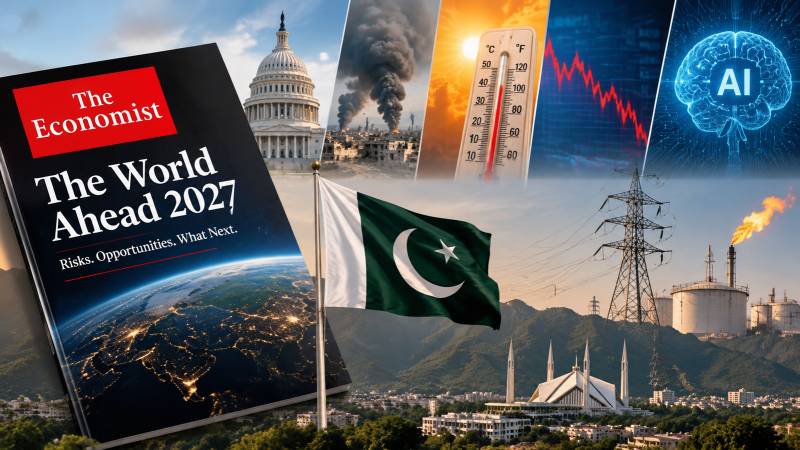
The Economist’s World Ahead 2027 highlights several external factors: America’s unsettled politics after the midterms, ongoing effects of the war in Iran, another year of record heat with a super El Niño, unstable bond markets, and the financial and cyber risks of rapid AI growth and hidden debt. These are worth noting, but for Pakistan, they are not the main concerns.
The main issue is that Pakistan enters this year with less flexibility than global forecasts suggest. Stabilisation has come at a cost. Reserves have improved since the early 2020s, and inflation has fallen from its peak. The external account is no longer in crisis. These are positive steps, but they haven’t changed how outside shocks become domestic problems. Energy still relies on limited channels. Agriculture and the power system still struggle with heat that is now common. The fiscal system still turns every external price increase into a bigger burden on the budget. The tax base is still so narrow that higher borrowing costs abroad quickly make things harder at home. In this situation, the magazine’s trends don’t just appear as distant geopolitics. They show up as higher diesel prices, urea shortages, power cuts during peak summer, and less time for commercial lenders to roll over Pakistani debt.
Energy is the clearest example. The Iran conflict will keep changing supply routes and keep fertiliser markets tight. Pakistan’s import bill is still mostly oil, refined products, and gas, and farm costs still depend on urea, so the impact is immediate. Any lasting rise in Gulf prices, shipping delays, or further squeeze on fertiliser supply quickly affects the current account, the budget, and food prices. Some diversification and better supplier terms have reduced the worst risks, but the dependence remains. The same is true for climate: the magazine points to a super El Niño year, but Pakistan doesn’t need another record-hot year to see that irrigation, city power demand, and disaster response are already stretched under normal heat. More stress increases relief costs and the risk of political fallout. Energy security and climate resilience are now linked. Both affect the budget and the balance of payments.
Debt pressures make things even tighter. When bond markets in wealthy countries repeat risky spending and the AI investment surge, the effects are felt quickly. Pakistan’s borrowing costs, lenders’ willingness to take risks, and the terms of official loans all change with global trends. The magazine notes that something has to give. For Islamabad, the real question is whether this period of relative calm will be used to fix the domestic problems that tend to break first: circular debt in the power sector, state companies that keep losing money, and a tax system that relies on a narrow base. Or will another year of stability just be used as an excuse to avoid tough decisions? History shows that delay is the usual choice. But it’s also the more expensive one, because each round of emergency loans weakens the credibility needed for longer-term borrowing at reasonable rates.
Pakistan enters 2027 with less flexibility than global forecasts suggest. Stabilisation has come at a cost, and the country remains vulnerable to external shocks that quickly translate into domestic economic crises.
The technology and AI story highlights a gap between global caution and local opportunity. The risk of a sudden drop in AI company values and more cyberattacks is real and will affect systems that are not well protected or funded. At the same time, these technologies are already lowering costs in logistics, farm advice, public services, and some manufacturing. Pakistan’s young population is often called a demographic dividend. In 2027, it will only be an advantage if there are enough skills, reliable power, and basic data integrity to use it for export growth or real productivity gains. This means setting data rules that protect privacy while allowing business use, improving power quality beyond occasional computing, and updating education to fit today’s job market. Without these steps, Pakistan will face the cyber and financial risks the magazine warns about, but gain little of the productivity. When the backlash comes, it will mean higher costs without real benefits.
Distractions in global politics do not automatically give Pakistan more freedom to act. With the US focused on its own political changes and Europe watching the French election, the environment becomes more transactional, not more forgiving. Security, energy, and financial support are now harder to rely on and more likely to depend on clear domestic results. The same is true for regional industry and tech partnerships. Cooperation announcements only matter if contracts secure local production, protect intellectual property, and guarantee export rights before any joint venture begins. Otherwise, they use up political energy without improving the current account or industrial base. Pakistan has experience in defence manufacturing and some agricultural and logistics sectors. Turning that into lasting export strength requires the kind of contract and institutional discipline that has often been delayed in favour of announcements.
None of this means Pakistan has to solve problems meant for bigger economies. But it does mean that outside forecasts shouldn’t be seen as distant or as easy excuses. The real agenda is smaller than the magazine’s ten trends but more demanding. It calls for finishing the commercialisation of the energy sector so changes in import prices don’t always trigger budget and inflation crises. It also means building climate resilience into farm water management and city power planning with the same urgency once given to short-term fixes. Now is the time to broaden the tax base and cut the circular debts that turn every outside shock into a local problem. And it means treating the young workforce and available technology as real assets, not just talking points.
The stabilisation of recent years has given Pakistan some time. The World Ahead 2027 shows how to use that time. The country’s margins are already slimmer than official stories suggest. They won’t get wider just because the world is focused elsewhere. They will only grow if the ways that turn outside pressure into local crisis are intentionally reduced. This work isn’t glamorous, and it’s technically and politically tough. But it’s the only way to turn a good global forecast into more than just another year of managed risk.