

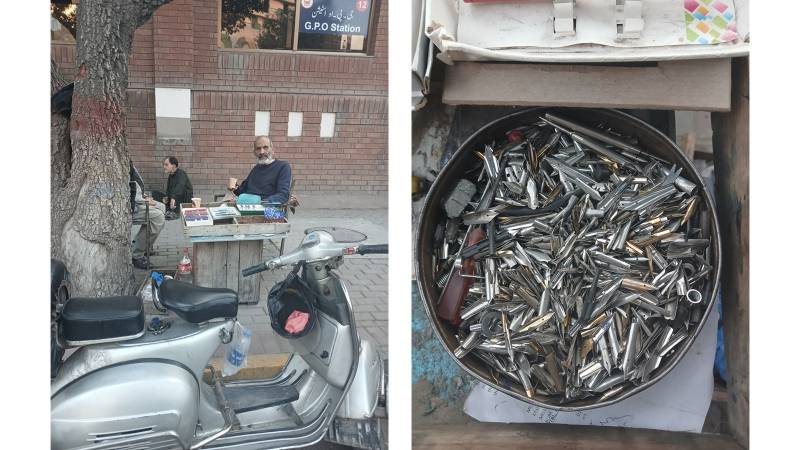
It was past 4 pm, and the faint darkness of an early winter evening was creeping in. The Mall, as usual, was bustling with traffic, while a shapeless flock of sparrows fluttered across the hazy sky, filling the air with a continuous chorus of chirps and cheeps. At the same time, an ambulance, its siren deafeningly loud, was stranded among the vehicles, unnecessarily turning one’s thoughts towards mortality. Having grown accustomed to such sirens and weary after a whole day’s work, people appeared oblivious to the unheard cries of the patient inside. They did not budge to make way for the ambulance, whose driver was desperately trying to save someone’s life.
I was on my way to Hall Road to catch up with a friend who had asked me to help him select a good pair of shoes. My eyes fell upon a silver-coloured Vespa parked by the kerb, with two ageing men sitting facing each other. I walked past them, only to retrace my steps and, narrowing my eyes, take a closer look. Sitting near the steps on the Lahore High Court side of the GPO Orange Line Metro Station, an old man was sipping his qahwa and gazing intently at the road. He seemed lost in thoughts known only to him. He looked thin and gaunt, like a man on whom the years had weighed heavily. He was bald, with thick, prominent wrinkles on his hollow cheeks. His beard was overgrown and appeared not to have been trimmed for over a month. It seemed as though a ghostly pallor had found a permanent refuge on his face. He was Hamid Ali Khan, the pen restorer whom I had seen on The Mall some months earlier.
After exchanging greetings, I sought his permission and sat beside him. His friend, with elegant grey hair falling to his shoulders, a full beard, and a Hungarian moustache, appeared rather sullen and genuinely concerned about him. "Boht log ande milaan enu, lekin ae othe da othe e ae" (Many people come to meet him, but his condition remains unchanged), he remarked. Smiling innocently, Hamid, in a low, raspy, and barely intelligible voice, threw a couplet my way. I requested him to recite it again, as I could not make out the words amid the surrounding noise.
"Muqaddar banaye si nahin banta hai insaan se,
Zamana kiyun pareshan hai hale pareshan se"
He did not know the name of the poet, but this time he recited the couplet in an unusually forceful voice, stressing each word. His voice was heavy with emotion, and his eyes were glistening.
By now, he had warmed up to me. He began sharing details of his personal life freely, seemingly unmindful of his friend. Born in Sukkur in a year unknown even to him, he came to Lahore with his family in 1973. When I asked him in which year he was born, he burst into a hearty laugh and said, "My parents were uneducated, and I had only just been born, so I cannot ascertain my age and tell you the exact figure." He was too old to hold his cup steadily; his hands were trembling. I was surprised when he said that he was only 70 years old. "I will be 72, maximum, not more than that," he said with conviction. Poverty and a lack of resources had apparently taken their toll, making him appear much older than his years.
"In this big city, my family settled in the quarters of Raj Garh, which lies near Sanda Road," he shared. "It must have been 1973 when we shifted to Lahore," he said, counting the years on his fingers like a child. "Yes, it was 1973," he declared. During his adolescent years, he began repairing all kinds of out-of-order machines. "I would do odd jobs to make ends meet." He appeared to be illiterate and had received no formal education.
As we talked, people flowed past us and entered the station, sweetening our conversation with the last notes of their perfumes. There were so many of them that each passing whiff of perfume stirred a different memory in me, making it difficult to concentrate on what Hamid was saying.
With my eyes glued to my phone screen, I was taking notes as a woman with her face covered approached us, brought out a few pens, and handed them to Hamid. He placed his cup on the stall and tried writing on a page on which he had already drawn some squiggly letters. Unable to write a word, he dipped the nib of the pen into his almost empty cup of qahwa and tried again. The ink flowed freely from the pen as he drew unintelligible lines. "You seem to be drinking a magical drink, Uncle G," she remarked before leaving without paying anything.
Hamid had a bowl full of used nibs. He rummaged through them and showed me some artistic ones. "There was a time when people would feel proud of possessing quality pens," he said. "Pens like Montblanc, you know," he added. "Aj kal ke logon ke pass to ballpoint bhi ni hoti, pen to door ki baat hai" (People these days do not even have ballpoint pens, let alone proper pens), he remarked, his face clouding with sadness.
In the beginning, he used to sit outside the Lahore High Court and make nameplates. "I can write in both Urdu and Arabic rasm-ul-khat. I also worked in the Saddar area of Karachi and did my best to take an interest in the work. But the years I spent there were of no use. I missed Lahore and, more than that, I missed my family. The memories I had woven here pulled me back towards it," he continued. "Mera dil nahin lagta tha wahan" (I did not feel at home there).
He has now moved his makeshift stall closer to the GPO, where he sets it up sometimes at 9 am and, on other days, at 11 am. He closes it around Maghrib. He is currently staying with his son in Shahdara, Lahore. In a low voice, he said, "My son, with whom I am living, is not doing too well either." His voice was full of fatherly concern and prayers for his son’s prosperity. "Meri zindagi to guzar gai, uske ke liye Allah asaani krde" (I have lived my life. May Allah make things easier for him). His voice choked as he uttered these words.
Fighting back tears, I said Ameen and looked at my mobile phone. The screen showed 15 missed calls. I rose to leave, but before I could go, Hamid thanked me for sitting with him. He seemed to feel lighter and much better.