

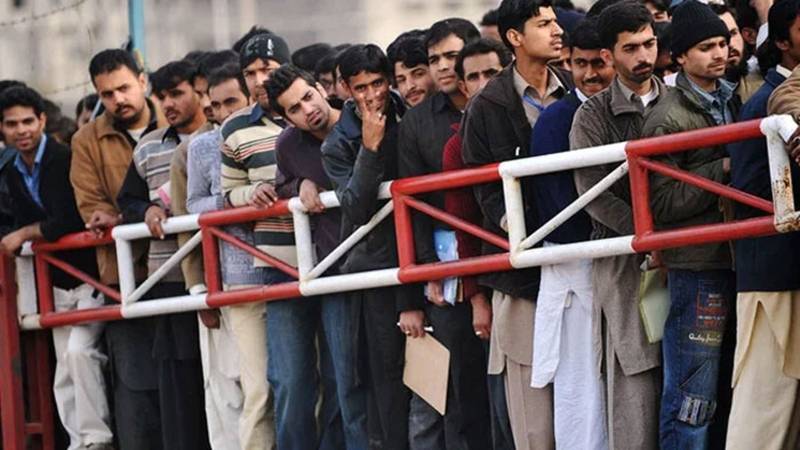
As various countries across the continents have been witnessing Gen Z-led protests over the rising cost of living, economic inequality, institutional indifference, underfunded schools, etc., the economic situation is worse in Pakistan compared to the countries facing the fury of the younger generation over political apathy and poor public service delivery. Despite this, there is no youth-led anger in Pakistan identical to the economic outcry in various countries in the Global North. The debate is revolving around the reasons behind this silence.
The truth is that there is too much social injustice in our dear country. However, those with deep pockets, business tycoons, the bureaucracy, ruling elites, and the middle class have enough resources to feed their families. The ruling elites have accumulated so much wealth that their next three generations can live off their accumulated assets. The talented and the wealthy leave the country for greener pastures in other countries. The former get opportunities abroad following their professional potential, and the latter leave on the wings of entitlement programmes and the wealth they possess.
They say that the voice of the middle class matters most since it gets heard in the corridors of power. Besides, it has a certain say when it comes to making various political and economic policies. The middle class in Pakistan still enjoys purchasing power. This is the reason why this section of society is silent. Once it rises to demand political space and economic justice, those in decision-making centres cannot afford to turn a blind eye to it.
Around 44.7 per cent of Pakistan’s population is now considered to be living below the poverty line, according to the World Bank’s newly updated global poverty threshold set at $4.20 per person per day and released this week.
And the salaried class finds it increasingly hard to live a decent life and afford standard private education for their children, given that public-sector schools are both underfunded and academically poorly managed.
"If your wages only allow to eat and sleep,its not a job; in the past that was called" slavery "." — George Orwell.
One can see restlessness in the eyes of children, hailing from this socio-economic background, due to deprivation, the education divide, and political apathy. They are young in terms of years but physically fragile following the rising cost of living. Their outcry emanating from economic pains caused by an extractive economic model cannot penetrate the ruling elites’ glass houses. After all, they do not matter to policymakers. Both institutional failure to deliver and institutional failure to stay away from politics have not only plagued Pakistan, but also undermined prospects for the youth, who see their dreams being crushed under the wheel of the long-standing status quo. Misreading young minds will prove to be fatal, as their disillusionment and consequent frustrations might morph into a full-blown countrywide protest demanding fair play and fair distribution of national wealth.
Economic deprivation and consequent disillusionment are a smouldering fire that may morph into political lava, ultimately rocking the ruling elites’ apple cart in Pakistan.
The youth in Pakistan are accused of being indifferent to the worsening socio-economic milieu. The truth is that the younger generation is hardest hit due to multiple economic crises and declining industrial activity. They are keen observers and commentators on political and institutional structures failing to deliver. Their utter dismay will take no time to turn into protesting energy on the streets and lead to demands for social security and economic justice, like the Gen Z of Nepal or the Gen Z of Bangladesh.
Without political and fiscal decentralisation, in the real sense rather than on paper, the dream of change will remain a pipe dream
Economic challenges; food, infrastructural, and life insecurities engendered by the climate crisis; political polarisation; and social incohesion caused by economic indifference to ordinary citizens call for resetting the mindset and subsequently wiring it to prefer multilateralism over unilateralism in every imaginable text and context. Introspection is needed to navigate the ongoing political unrest.
Once all doors are closed, the situation will be different. The public will choose to push for economic reforms. So, it is a matter of timing only. Just wait and watch.
The sages of the ages have said that revolutions germinate from hungry stomachs.
Good Governance and the Push for New Provinces
Political forces must join hands to rein in the authoritarian agenda advanced through pliant TV channels, anchors, and journalists. Independent minds and political commentators have questioned the rationale behind administrative restructuring through a carrot-and-stick policy in the name of good governance. Yes, this country needs good governance. Yes, mainstream political parties coming into power ensure public service delivery. If good governance is the reason behind this contentious project of creating new provinces, then politicians should be allowed to do their work. Ending interference in political and administrative matters should be the beginning of the end. Let the political process be allowed to evolve naturally in every imaginable context. Let the stick for the uncompromising characters and politicians and the carrot for the obedient individuals and politicians be brought to an end. Let politicians with vision and merit flourish in this pure land.
And last but not least, the small provinces continue to convey their concerns in no uncertain terms against the overarching nature of the federation, and it needs no elaboration. How will this end? The truth is that the movers and shakers have not learned from past controversial upstream water projects like the Kalabagh Dam and the Cholistan Canal.
In Sindh, across sections of society, people see this redrawing of geographical lines, i.e. creating smaller provinces in the province, as an encroachment upon their land, identity, and culture, whereas some critics call this redemarcation the underbelly of elite capture, i.e. the capture of the port city and coastal lands. The haste and speed with which the project is being coerced, without a constitutional route and parliamentary debate, into materialisation says more than this piece of writing can offer.
The people of Sindh have historically offered resistance against division, except for the ethnic group called the MQM, on the basis of ethnicity. Using their shoulders for the divide is an undemocratic exercise. The political and intellectual voice in the province has spoken, and loudly, against this new experiment in the name of resetting the system. The system in question can only be reset through political maturity and cool-headed policies.
When the federation cannot handle four brother provinces, how will the federation ensure smooth sailing among 12 emerging units?
Constitutional Questions Around a Referendum
Besides, legal minds have questioned the credibility of a proposed referendum.
Despite this, various PML-N leaders and some federal ministers have been insisting upon holding a referendum regarding the redrawing of provincial boundaries. With regard to the reconfiguration of provincial territories, the legal expert and former Attorney General Ashtar Ausaf, in his recent TV talk, said that a referendum is an expression of political will (opinion), and hence not binding. He is convinced that there is no route to reconfigure the boundaries of existing provinces other than the one given in the Green Book, the Constitution of Pakistan. He also said that a provincial assembly has the constitutional veto when it comes to creating provinces within a province. Adding further, he said a referendum is not a substitute for Article 239(4).
Mian Raza Rabbani, former Senate Chairman, after having condemned the insistence of a coterie of ministers, minced no words and said in his press statement: "A Referendum is not a substitute nor can it over ride the procedure provided in Article 239(4) , Constitution, 1973 for altering the territorial limits of a province. The rhetoric of referring the result of the Referendum, if in their favour to the court, will undermine the sovereignty of Parliament and will amount to placing fetters the Constitutional powers of a Provincial Assembly. "
Thus, a logical question that arises is: why do we need a referendum when there is a clear roadmap for the reconfiguration in question? The less said, the better.
Unity and cohesion come with justice.
Resetting the provincial boundaries under the garb of good governance is the product of divide-and-rule. And this has historically ensured elite capture and concentration of power in the hands of those who are bendable at desirable times.
Introspection, Decentralisation, and the Way Forward
Having said that, the political class needs introspection in every context. They should spare a moment to reflect on their character and modus operandi after their entry into the corridors of power. Their cupidity has made them slaves, ultimately undermining their governance. They need to revisit their internal party structures. They need to ensure democracy within their political parties, with merit as the sole yardstick for elevation to seniority and the parliamentary ladder, rather than wealth, intra-party political connections, and dynastic standing. Once the merit and political credentials of party cadres are based on ideological character, then the resultant crop of party members will be insulated from external pressures and be willing to stand like a rock in testing times.
Earlier, the PTI project was projected as a panacea for all problems that plague Pakistan, while other mainstream politicians were branded as plunderers of public money, political thieves, and bandits. "When the debate is lost, insults become the loser's tools." It has to be acknowledged, however, that with skeletons in their cupboards, politicians across the aisle were part of political games and controversial agendas forwarded by their powerful backers.
Truth be told, the country lives off bailout money lent by international lending entities like the IMF, and is debt-ridden.
Yet redrawing the provinces is being engineered to create new constituencies for those willing to accommodate undemocratic desires.
Divisive politics and patronage of political puppets have already undermined the political process and economic decision-making. As a result, state- and institution-building are still stunted despite the fact that we got freedom in 1947, because those in the decision-making centres forgot "Unity, Faith and Discipline," the guiding light provided by the Founder of Pakistan, Quaid-e-Azam Muhammad Ali Jinnah.
Without political and fiscal decentralisation, in the real sense rather than on paper, the dream of change will remain a pipe dream. Those in the ivory towers should come down to read the writing on the wall. Controversial political plans like the new experiment of creating new provinces through a high-handed approach will bear no fruit. This country needs social, political, and economic cohesion that can be cultivated through democratic principles and the democratic distribution of wealth. Sacrificing national unity on the altar of institutional arrogance has neither borne fruit nor will it be fruitful in the foreseeable future. Pakistan needs a healing touch.
No solution will be sustainable until a sustainable solution is prioritised, which is the separation of powers and the empowerment of Parliament.