

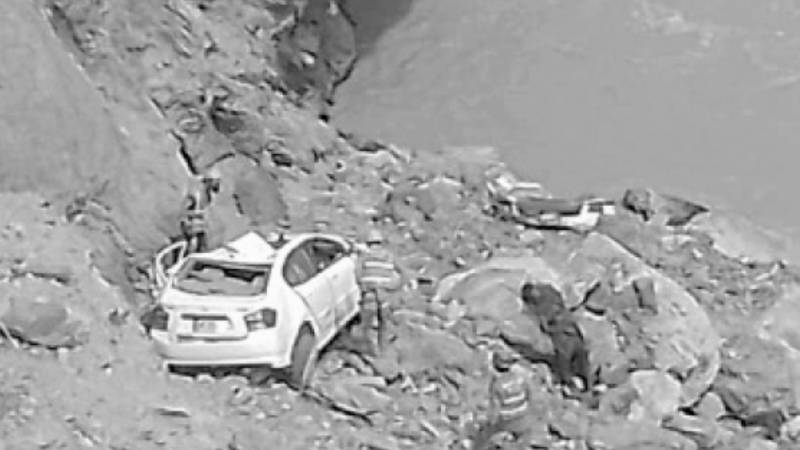
In mid-May, a routine holiday turned into tragedy on the Jaglot–Skardu road. Four friends from Gujrat, Punjab, travelling in Gilgit-Baltistan’s mountains, were found dead in a deep ravine near Satak Nala, their car having veered off the Baltistan Highway.
This was not a freak accident of fate.
It happened on a notorious stretch already described by police as a “dangerous” road. In moments, a fun road trip became a family’s nightmare: four young lives lost in what authorities confirmed was a high-speed crash into a gorge.
Pakistan’s mountain tourism is booming, nationally, visitors spent some US$16 billion in 2022, with revenues set to nearly double by 2033, yet the highways that carry these travellers are crumbling or scantily maintained. The Jaglot–Skardu Highway, Karakoram Highway (KKH), and other northern routes wind along sheer cliffs, subject to landslides, washouts, and fog. Rescue 1122 reports roughly 1,500 road accidents a year across Gilgit-Baltistan.
Until last week, these statistics were abstract; now they are faces in grief and empty homes.
The Skardu calamity fits a grim pattern. Just last July, four tourists – including two women – were killed when their car plunged into a river in Astore valley. In April 2025, a bus carrying foreign tourists from Skardu to Khaplu was struck by falling rocks; a Thai passenger died on the spot.
These incidents followed the same script: narrow road, steep drop, minimal safety features.
These losses cut across borders and communities. Last year, an out-of-control wedding convoy plunged 600 feet from a bridge in Diamer, killing at least 14 people (including a bride), highlighting that it is not just foreigners who pay the price of neglect.
In one haunting image, the smashed white car of the Skardu accident sits battered in rocks, chilling evidence that the asphalt ends abruptly and death awaits. We hear the grief and we see the wreckage; what we don’t see is the government bandages to stop the bleeding.
The stories of Wasif, Umar, Salman, and Usman should not vanish with the latest headlines; their deaths must spark reform
The Skardu tragedy and its predecessors demand concrete action, not more platitudes. Tourists and local commuters should not have to double-guess whether a detour or delay might save lives. The National Highway Authority, the Ministry of Communications, the Gilgit-Baltistan Tourism Department, and district administrations must collaborate on a strict overhaul of road safety in the north. Among needed measures:
- Seasonal Traffic Regulation: During high-risk seasons (winter snowfall, monsoon, and spring thaw), enforce daylight-only travel or limited convoys on critical stretches. Ban non-essential heavy vehicles at night or when forecasts warn of landslides. In many alpine regions worldwide, highways are routinely closed, or traffic is strictly controlled in winter; we must adopt similar convoy or closure rules on passes like Babusar and even on Gilgit-Skardu routes.
- Mandatory Road Risk Audits: Before each tourist season, independent experts should assess all major northern highways. Audits would identify weak bridges, unguarded curves, eroded cuttings and loose slopes, and force prompt fixes. The KKH and Baltistan Highway must be treated like any urban motorway: inspected regularly, hazard maps updated publicly, and with emergency response routes clearly planned.
- Emergency Infrastructure (Public–Private Partnerships): Strategically placed first-aid and rescue stations are urgently needed. Gilgit-Baltistan’s own relief workers have urged the establishment of first-aid posts along the Karakoram and Baltistan highways. These could be funded by partnerships between the government and tourism stakeholders (hotels, mountaineering clubs, development NGOs). A helipad here, an ambulance and medical responder there, supported by both the public purse and private donations, would dramatically cut response times when accidents happen.
- Basic Vehicle and Driver Preparedness: Finally, while infrastructure is key, travelers and transporters also need regulation. The Motorway Police have warned that “even a small issue with the car can turn into a major problem” on these routes. The licensing authorities should mandate driver training and vehicle fitness certificates specifically for mountain driving. Tourist buses and rental cars must meet stricter maintenance checks before beginning a northern tour.
The human cost of inaction is incalculable. In 2024 and 2025 alone, dozens have died in northern Pakistan’s hair-raising accidents. Each time, officials march out with condolences and cautionary advice, but those are no comfort to grieving families.
It is high time for accountability.
The stories of Wasif, Umar, Salman, and Usman should not vanish with the latest headlines; their deaths must spark reform.
On paper, the authorities claim to care. In May 2025, the NHA even sought funds to build “slide shelter structures” on the Jaglot–Skardu road, a welcome proposal, but belated. Why did such life-saving shelters come only after yet another tragedy? Why is there no similar plan for every known danger point?
Ministers must explain why our highways department can boast of hundreds of kilometers of new motorways, yet cannot guarantee one safe passage through the mountains.
Pakistan’s parliament, media, and public should now press for real change. Demand that the Ministry of Communications release emergency funds for northern roads. Demand that the Gilgit-Baltistan government invest in these safety measures, and that its Tourism Department devote part of its budget to rescue and maintenance.
After all, if the tourist dollars don’t make their way safely to our economy, they will only add to the ledger of lost lives.
Each year, Rescue 1122’s log of 1,500 Gilgit-Baltistan road crashes, and counting, should shame us into action. The indifference of the past must end. The next skidoo through the mountains might be a family outing or a deadly accident. It’s time to decide.
We must not wait for the next ambulance report; we must build the solution now, before more rupees for project proposals and reports are spent without laying a single meter of life-saving guardrail.
The beauty of our north must not become its curse. If Pakistan is serious about tourism and human welfare, the authorities will heed these warnings. We urge every stakeholder, from the National Highway Authority to local hoteliers, to treat safety as the top priority.
Our mountains invite travellers; let us not betray them with rotten roads and empty promises.
The human cost is too high.