

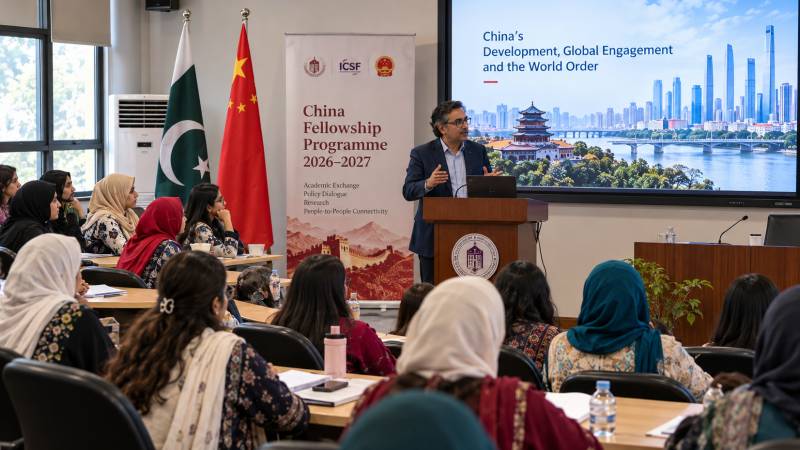
On 1st of October 2026 students gathered at the smart classroom of Shaheed Benazir Bhutto Women University Peshawar for the lecture by Mr Imran Bhatti about on “China Government Growth and Global Power”. It was not just another routine lecture, it marked the beginning of an academic journey that aims to connect the minds of young people through the power of soft diplomacy. The lecture was part of a three months academic activity “China Fellowship Programme” designed for the students of Social sciences offering them an opportunity to explore China development and its growing engagement with the world.
China’s soft diplomacy is moving beyond roads and trade, with academic exchange creating new connections between Pakistani students and the wider Chinese intellectual world. A classroom in a Pakistani university may not look like a place where diplomacy happens. There are no flags behind a negotiating table, no foreign ministers signing agreements and no cameras waiting for a diplomatic announcement. Yet, when Pakistani students sit with international scholars to discuss China, the Belt and Road Initiative and global cooperation, another form of diplomacy begins to take shape. It is quieter. It is slower. And perhaps, in the long run, it can be more enduring.
The China Fellowship Programme 2026-2027, being implemented in collaboration with Regional Connectivity Center (RCC) at Shaheed Benazir Bhutto Women University (SBBWU) Peshawar, offers a glimpse into this less visible dimension of China-Pakistan relations. The six-month programme is a collaboration between the Institute for a Community with Shared Future (ICSF), Communication University of China (CUC), Beijing, and the Embassy of the People’s Republic of China in Pakistan. It brings social sciences students into an extended programme of lectures, discussions, academic writing and international engagement.
China’s soft diplomacy is moving beyond roads and trade, with academic exchange creating new connections between Pakistani students and the wider Chinese intellectual world.
Dr Zarmina Baloch Director Regional Connectivity Center SBBWU expressed that for decades, the strongest images associated with China–Pakistan relations have been physical ones: highways, power plants, economic corridors and construction projects. CPEC, as the flagship component of the Belt and Road Initiative in Pakistan, has made economic connectivity a central feature of the bilateral relationship, but countries are not connected only by roads, they are also connected by ideas, education, culture and people, and this is where the concept of soft diplomacy becomes important.
China's international engagement has increasingly developed a human and intellectual dimension. The fellowship provides an example of how academic exchange can complement economic and strategic relations. Its participants are exposed not only to China and CPEC but also to China's development model, regional connectivity and international cooperation. The programme also introduces participants to China's major global initiatives, including the Global Development Initiative, Global Security Initiative, Global Civilization Initiative and Global Governance Initiative.
“What makes the programme particularly significant is that students do not encounter these themes only through textbooks but they hear from people.The fellowship brings together scholars, researchers, policymakers, diplomats and practitioners from Pakistan and different parts of the world. Weekly sessions provide opportunities for students to ask questions, participate in discussions and engage directly with experts. That interaction can change the way international relations are understood” Ishrat Bano a student from department of Political Science opined about the progrmme while attending its 1st lecture.
Perhaps the most interesting part of such a programme is not the lecture itself but what happens afterwards., student asks a question.,An expert responds,nother student challenges the argument.A discussion follows. In these moments, diplomacy moves away from formal statements and enters the realm of human interaction.For Pakistani students, direct engagement with Chinese and international experts can provide a deeper understanding of China's perspectives. At the same time, Chinese and international participants gain an opportunity to hear how young Pakistanis view regional and global issues.
That exchange matters because soft diplomacy is not simply about presenting a country's image. Its long-term strength depends on creating relationships in which people become familiar with one another's societies and perspectives. The fellowship goes one step further by asking participants to become writers and contributors to public debate.Academic writing is a core component of the programme. Each fellow is required to write two theme-based opinion articles every month during the six-month fellowship. Mentors from RCC and the PRCCSF team provide guidance and feedback, while outstanding articles may be selected for publication on the think tank's platform and in national and international newspapers.This turns students from audiences into potential opinion-makers.
A young Pakistani scholar writing about China's development experience, CPEC, regional connectivity or global security is not merely completing an academic assignment. Such writing can enter the wider public conversation about Pakistan's relationship with China and the changing international order.The fellowship itself recognizes this broader objective. It places emphasis on critical thinking, policy dialogue, cross-cultural understanding and academic collaboration.
The value of international academic exchange is greatest when students are encouraged to understand, question and analyse—not simply accept.The Belt and Road Initiative is usually associated with physical and economic connectivity. But there is another kind of connectivity that is harder to measure.It is the connection between students in different countries. The fellowship exposes participants to China's relations with Central Asia, Southeast Asia, Latin America, Africa, the Middle East, Europe and other regions.
For Pakistani students, this wider perspective can be particularly valuable. Pakistan's own geographical and strategic position means that its future cannot be separated from developments across neighbouring and connected regions. Understanding China's relationships with these regions can therefore help students think beyond bilateral relations and examine Pakistan within a much broader international environment.For students of political science and other social sciences, such encounters can bring diplomacy out of textbooks. Foreign policy, international cooperation, regional security and global governance are no longer simply concepts to be memorized. They become subjects that can be discussed with people involved in international affairs.
SBBWU, First Women University of KP, through its participation in such an initiative, becomes part of a wider network of academic and international engagement. Its students are given an opportunity to interact with experts from different countries while developing their own research and analytical skills. The fellowship lasts six months, but its potential impact can extend much further. Participants can develop relationships with academics, researchers and international experts. They can improve their writing, participate in discussions and potentially contribute to public discourse through published articles.
China–Pakistan relations have often been described through the language of strategic partnership and economic cooperation. Those dimensions remain important. But the future of the relationship may also depend on how well the people of both countries understand each other. CPEC may represent the physical connectivity between China and Pakistan. Academic exchanges represent something less visible but equally significant, the connectivity of minds. As China continues to expand its engagement with Pakistan, the most enduring bridges may not always be made of concrete and steel. Some may be built through classrooms, conversations, research papers and friendships, When a university classroom becomes a space where young people learn to understand another country while contributing their own perspectives, diplomacy takes on a distinctly human face.