

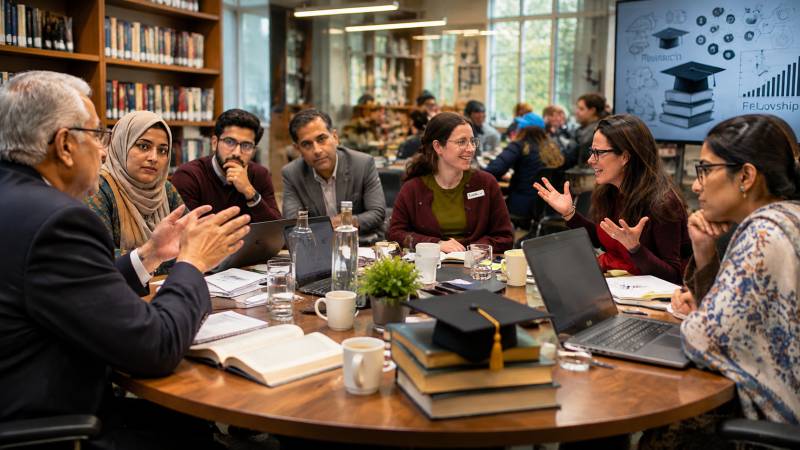
Each year, thousands of scholars from low- and middle-income countries, including Pakistan, apply for prestigious opportunities such as the Fulbright Program, TWAS, DAAD, and Commonwealth Scholarships. These programs depend on credible evaluation procedures, and applicants expect their qualifications and proposals to be assessed fairly, transparently, and on academic merit.
In many research systems, fellowship applications are reviewed by experts with diverse disciplinary backgrounds and career experiences. However, evaluation in some developing-country institutions remains concentrated among senior academics. Their experience, institutional knowledge, and scholarly judgment are invaluable, but rapidly evolving research demands additional forms of expertise. Fields such as artificial intelligence, genomic medicine, climate modelling, digital health, data science, and advanced materials have progressed considerably. Recently trained PhDs may possess direct familiarity with emerging methodologies, analytical tools, software platforms, open-science practices, and contemporary research standards.
Contemporary methodological awareness can make a practical difference. For example, a recently trained researcher familiar with reproducible computational workflows might identify missing code, inadequate data-management procedures, or weaknesses in a proposal's validation strategy. A senior reviewer may recognize its broader scientific significance but overlook technical shortcomings associated with practices that have evolved since their training. Conversely, an experienced scholar may identify conceptual weaknesses or feasibility concerns that a less experienced reviewer misses. Combining these perspectives can strengthen evaluation.
The objective is not to diminish senior scholars' contributions but to complement their expertise with the updated technical knowledge of qualified early-career researchers. Senior academics can assess originality, theoretical foundations, and long-term significance, while younger colleagues can contribute insights into emerging technologies and contemporary methodologies. Pakistan has invested substantially in doctoral education over the past two decades. Many scholars trained at internationally recognized universities have returned with exposure to modern research environments and collaborative networks. Excluding their expertise from fellowship reviews, research assessment, and academic governance risks underutilizing this national resource. Involving different career stages is not an entirely new concept. Some research-funding systems and national research councils accommodate diverse career backgrounds in evaluation. The central issue is not seniority versus youth, but how to combine academic experience with contemporary scientific knowledge. Including qualified early-career researchers alongside senior academics can strengthen methodological scrutiny, disciplinary coverage, and the quality of fellowship assessments.
Fellowship assessment should prioritise originality, methodological rigour, innovation potential, prospective impact, and applicants' capacity for independent research. Publication and citation indicators may provide context but should not replace qualitative assessment, particularly for early-career applicants.
Evaluation committees should include experienced scholars and carefully selected early-career researchers. Reviewer selection should prioritize relevant subject expertise, research competence, methodological proficiency, integrity, and familiarity with international standards rather than age or academic rank alone. International fellowship organizations could establish structured programs through which outstanding recent PhD graduates serve as associate reviewers under senior colleagues' mentorship. This would expand the reviewer pool, improve coverage of emerging fields, and develop future evaluators.
Panels should represent different career stages, institutions, research cultures, and, where appropriate, international backgrounds. Such diversity can reduce reliance on traditional disciplinary perspectives and encourage fair consideration of innovative proposals. Periodic training in open science, responsible research assessment, bias awareness, interdisciplinary evaluation, and contemporary research-impact frameworks should be available to reviewers at every career stage.
In low- and middle-income countries, joint reviews by local and international experts can combine contextual understanding and feasibility assessment with perspectives on global research standards. Ultimately, fellowship evaluation should serve not only as an administrative process but also as an investment in national research capacity. Combining experienced scholars' judgment with early-career researchers' contemporary expertise can improve research decisions, develop future evaluators, and make fuller use of doctoral education. This approach offers Pakistan and other low- and middle-income countries a practical pathway towards a more inclusive, transparent, and forward-looking research ecosystem.