

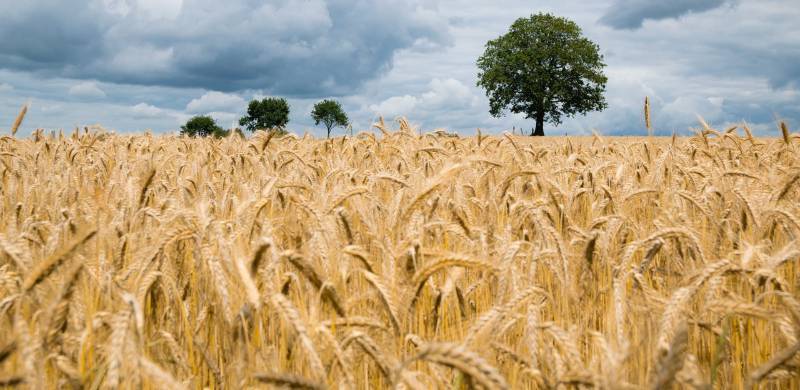
The farmer does not leave wheat out of sentiment. He leaves when the arithmetic forces him to.
In Okara, in Sahiwal, and in parts of Bahawalpur and Rahim Yar Khan, that arithmetic has already been done. Canola and mustard on the same acre, with similar input costs, have offered returns several times higher than wheat over the past two seasons, without the procurement uncertainty, without the benchmark price that functions in practice as a ceiling rather than a floor, and without the buyer who arrives after the price has already been set. The farmer who made that calculation was not abandoning Pakistan's food security. He was protecting his own.
That distinction matters. Because the nine hundred thousand acres that were left out of wheat cultivation in Punjab between 2023–24 and 2024–25 are being discussed in policy circles largely as a supply problem. They are not. They are a verdict.
Three consecutive seasons of the same failure — the system absent at harvest, the price undefended, and the liquidity reaching traders before it reached farmers — have produced a rational collective response from the people who carry the most risk and wield the least influence in Pakistan's wheat economy. The farmer has done what any market participant does when returns repeatedly fail to cover costs and the state repeatedly fails to honour its implicit commitments. He has begun to exit.
The danger is not that he is exiting. The danger is what he is getting into.
Pakistan has spent decades building institutional architecture around wheat. Storage systems, procurement mechanisms, transport networks, strategic reserves, price reporting, and seasonal credit cycles. That infrastructure evolved around one assumption: wheat would remain the protected centre of the agricultural economy.
Processing capacity for sunflower and canola is concentrated in limited industrial zones, not distributed across the production landscape. A farmer in Okara diversifying into oilseeds is not selling into a deep market with public benchmarks and procurement centres. He is negotiating directly with a private buyer who arrived early precisely because he understood that the farmer, without storage or liquidity, cannot wait.
The state that failed to defend the wheat benchmark will not automatically succeed in building oilseed markets, processing capacity, and storage systems unless it approaches that task with the discipline it has not yet demonstrated in wheat
The farmer who left wheat to escape that dynamic has not escaped it. He has entered a thinner version of the same market, with weaker information, no price floor, and no buyer of last resort.
And here is the compounding risk that Pakistan's policy debate has not yet absorbed. If oilseed acreage expands faster than processing and storage infrastructure, a bumper canola or sunflower harvest will do to those farmers exactly what the 2024 wheat glut did to wheat farmers. Prices will collapse at arrival. The buyer who came early will set the terms. The farmer, under liquidity pressure, will sell immediately at whatever price is available. Pakistan will have successfully transferred its procurement dysfunction from one crop to another.
Meanwhile, the crop being abandoned still feeds 250 million people.
Punjab's wheat surplus does not only sustain rural incomes. It stabilises flour markets in Karachi and Peshawar, supplies deficit provinces that cannot grow enough of their own, supports strategic reserves, and insulates Pakistan against the volatility of international grain markets. When I drove through Haroonabad in early April, the grain was stacked by the roadside, and the buyer was absent. That image was the failure of one season. When farmers across South Punjab recalculate what to plant next November, that is the compounding of three seasons of failure into a structural shift that will take years to reverse.
Food security is not created at the moment wheat is imported during a crisis. It is created several months earlier, in November, when the farmer decides what to put in the ground. That decision is now becoming uncertain in ways it has not been before.
If Pakistan reads the nine hundred thousand acres correctly, there is still an opportunity within the warning. Farmers are responding to incentives and attempting to diversify. Managed well, that transition could reduce a dangerous dependence on a single crop and expand domestic edible oil production. But diversification without infrastructure merely transfers distress from one commodity to another. The state that failed to defend the wheat benchmark will not automatically succeed in building oilseed markets, processing capacity, and storage systems unless it approaches that task with the discipline it has not yet demonstrated in wheat.
The 2027 wheat window opens in November. Not in April, when the harvest arrives. Not in March, when institutions scramble to assemble what should already exist. In November, when the farmer stands in his field and decides.
On that morning, he will not be thinking about policy frameworks, procurement models, or federal-provincial coordination. He will be thinking about what the last three seasons cost him, what he was promised and what arrived, and whether the system that failed him in April has given him any reason to trust it again.
That is the question Pakistan needs to answer before it plants.
Because if it does not, the harvest window of 2027 will open the same way as 2024, 2025, and 2026 did.
The grain is ready.
And the system is somewhere else.