

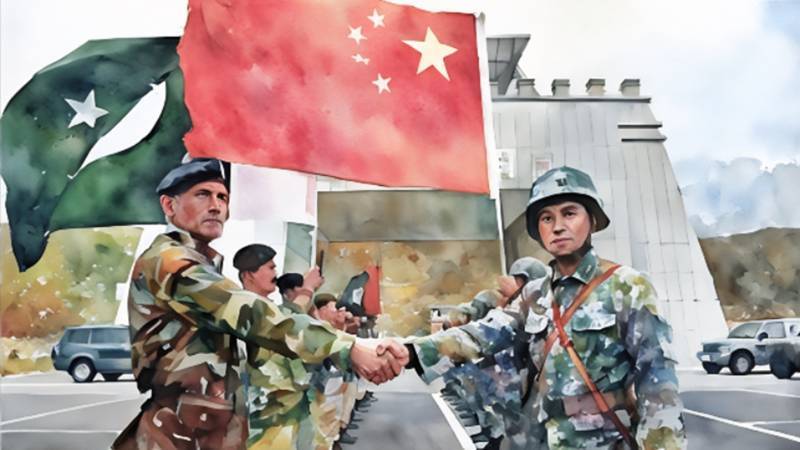
China’s long-standing policy of non-confrontation has helped it rise from the wreckage of colonial exploitation to become a global economic power. Whether in Cold War proxy conflicts, the Syrian and Ukrainian wars, or recent South China Sea tensions, China has consistently avoided prolonged military entanglements. Its restrained response during the ongoing trade war with the United States—marked by calibrated tariffs, WTO appeals, and quiet diversification of trade partners—typifies this approach. Rather than escalate, Beijing has prioritised internal stability, economic self-reliance, and diplomatic engagement. This commitment to restraint offers a powerful model for Pakistan, which continues to pay a high price for militarised foreign policy.
The risk of a nuclear standoff between India and Pakistan was starkly evident in February 2019, when a military escalation over Kashmir brought the two nations close to a nuclear crisis, as recounted by former U.S. Secretary of State Mike Pompeo in his memoir Never Give an Inch. The incident began after India’s airstrikes on alleged militant camps in Pakistan’s Balakot on February 26, following a suicide bombing in Pulwama that killed 40 Indian troops, prompting Pakistan to retaliate with airstrikes and the capture of an Indian pilot. Amid rising tensions, Pompeo, while in Hanoi for a summit, was awakened to learn from an Indian counterpart that both sides believed the other was preparing nuclear weapons for a strike, necessitating urgent U.S. intervention to de-escalate the situation and avert a catastrophic conflict.
Inter-state relations are not solely defined by ideology, as the deep friendship between Pakistan and China vividly illustrates. Despite China’s identity as an atheist, authoritarian state and Pakistan’s status as an Islamic republic with a democratic constitution, the two nations have forged a robust partnership rooted in mutual respect and overall cooperation. This exemplifies how pragmatic policies can transcend ideological divides, offering Pakistan a compelling model to emulate. Pakistan stands at a defining juncture, its future hinging on whether it can break free from a legacy of military conflicts that have drained its resources, stifled economic growth, and entrenched instability.
Pakistan’s aggressive posture, particularly on the Kashmir issue, underscores the need for a shift towards non-confrontation. In April 2025, Chief of Army Staff General Asim Munir, addressing the Overseas Pakistanis Convention in Islamabad, termed Kashmir Pakistan’s “jugular vein” and reiterated support for the Kashmiri cause, while dismissing insurgent threats in Balochistan by claiming, “even ten generations of terrorists cannot harm Pakistan.” This rhetoric, invoking the “two-nation theory” and framing Kashmir as an existential issue, risks escalating tensions with India and diverts focus from critical domestic challenges. Such statements reflect a persistent and unrealistic militaristic approach that prioritises ideological conflicts over pragmatic governance, contrasting sharply with China’s restrained diplomacy.
Strategic misjudgments by Pakistani elites often obstruct a move away from militaristic approaches, driven by unrealistic hopes for foreign backing. On April 25, 2025, former Defence Secretary Lt. Gen. (R) Naeem Khalid Lodhi absurdly proposed on X that Pakistan seek an “overt Defence Pact” with China. This ignores Beijing’s long-standing aversion to military alliances, seen in its non-intervention in Syria and Ukraine and preference for economic initiatives like the Belt and Road. Lodhi’s suggestion typifies a broader elite tendency to overestimate external military support, reminiscent of 1971, while neglecting China’s priorities and Pakistan’s urgent need for self-reliant, reform-driven governance.
Pakistani Defence Minister Khawaja Asif’s April 2025 Sky News interview exposed the flawed strategic mindset of the country’s elites. He admitted to Pakistan’s decades-long support for terrorism, blamed the West, and dodged questions about the recent Pahalgam attack that killed 26 in Jammu and Kashmir. His remarks echoed former President Musharraf’s 2017 boast of backing Lashkar-e-Taiba. Asif’s statement was both mistimed and misleading—while the West supported the Afghan jihad until 1989, Pakistan alone fueled Kashmir militancy, as Musharraf admitted. This ongoing denial of responsibility, amid rising Indo-Pak tensions, risks deepening the crisis.
China’s commitment to avoiding military conflicts is evident across numerous historical instances, showcasing a deliberate strategy to preserve resources for domestic development
Hamid Mir, a prominent Pakistani journalist, suggested on April 25, 2025, that suspending the 1972 Shimla Agreement could revert the Line of Control to a Ceasefire Line, potentially aiding the Kashmiri freedom struggle by enabling crossings under international law. However, such a move would dangerously escalate tensions, and Pakistan—facing greater risks of conflict, isolation, and economic fallout—has far more to lose than India.
Given Pakistan’s repeated foreign policy blunders, China’s trajectory is instructive because it demonstrates how non-confrontational diplomacy and a focus on domestic development can drive national transformation. By avoiding foreign entanglements and prioritising internal stability, China lifted over 800 million people out of poverty and emerged as a global economic powerhouse, offering valuable lessons for countries seeking sustainable growth.
Burdened by its history of initiating conflicts, Pakistan can draw critical lessons from China’s disciplined focus on internal progress to forge a path towards stability and self-reliance. As Air Marshal Asghar Khan, Pakistan’s first Air Force chief, admitted in a 2011 interview, “We started the wars… in ’65 and ’71, we were the ones who initiated the conflicts.” Historian Ayesha Jalal, in The Struggle for Pakistan, warns that Pakistan’s “obsession with military security” has diverted resources from social and economic progress, trapping the nation in a cycle of underdevelopment. China’s non-confrontational, governance-driven approach offers Pakistan a roadmap for a brighter, self-sustaining future.
Pakistan’s history of military engagement has exacted a devastating toll. Since 1947, conflicts with India—1947-48, 1965, 1971, and 1999 (Kargil)—alongside involvement in the Soviet-Afghan War and the War on Terror, have bled the nation’s economy and fuelled instability. These conflicts, often initiated or escalated by Pakistan, as Asghar Khan’s interviews confirm, have come at an immense cost. The 1971 war, culminating in Bangladesh’s secession, was a national catastrophe, costing tens of thousands of lives and 20% of GDP. Pakistan’s Afghan and Kashmir policies have fuelled militancy, claiming over 80,000 lives since 2001. Defence spending, at 2.80 % of GDP in 2023 (down from over 4 % in earlier decades), still vastly exceeds allocations for education (1.87 % of GDP in 2023) and total health expenditure (around 1% of GDP in 2023-24) leaving 26 million children out of school and 40% of the population in poverty. China’s non-confrontational model, prioritising domestic development through robust governance, offers Pakistan a lesson in redirecting resources to internal progress.
China’s non-confrontational policy, rooted in its “Five Principles of Peaceful Coexistence” articulated in 1954, emphasises mutual respect for sovereignty, non-aggression, and non-interference in internal affairs. This stance was shaped by the “Century of Humiliation” (1839–1949), when Western powers and Japan exploited China’s weaknesses, leaving a deep resolve to safeguard sovereignty and avoid external conflicts. After the People’s Republic of China was founded in 1949, early leaders like Mao Zedong focused on internal consolidation, but it was Deng Xiaoping’s reforms in the late 1970s that fully harnessed non-confrontation for economic progress. Deng’s philosophy of “keeping a low profile” guided China to sidestep Cold War proxy wars, prioritising domestic governance and economic modernisation. As Deng stated in 1990, “Observe calmly, secure our position, cope with affairs calmly, hide our capacities and bide our time.” This disciplined restraint allowed China to focus inward, transforming its economy and society.
China’s commitment to avoiding military conflicts is evident across numerous historical instances, showcasing a deliberate strategy to preserve resources for domestic development. During the Korean War (1950–1953), China’s involvement was limited to defending its borders against perceived threats, withdrawing troops promptly after the armistice. This restrained approach contrasted with prolonged U.S. engagements. In the Vietnam War (1955–1975), while the U.S. and Soviet Union fuelled proxy warfare, China provided material support but avoided direct military involvement, preserving resources for its nascent industrialisation. The 1979 Sino-Vietnamese War, a brief, localised conflict lasting one month, was China’s last significant military engagement abroad, marking a decisive shift towards diplomacy. Former U.S. Secretary of State Henry Kissinger, in On China (2011), praised this restraint, noting, “China’s strategy of non-involvement in foreign conflicts has allowed it to focus on economic development, a choice that has paid dividends in its global influence.”
China’s non-confrontational policy was evident during the Cuban Missile Crisis (1962), when it avoided aligning with either the U.S. or Soviet Union, issuing calls for de-escalation while focusing on domestic agricultural reforms. During the Bangladesh Liberation War (1971), China refrained from military involvement despite its alliance with Pakistan, opting for diplomatic support to maintain regional stability. Foreign Minister Zhou Enlai stated in 1971, “China respects the sovereignty of nations and seeks peaceful resolutions.” This approach preserved China’s resources during a critical period of internal reform. In the Gulf War (1990–1991), China abstained from military participation, advocating UN-led resolutions over unilateral action. Foreign Minister Qian Qichen declared in 1990, “Military solutions rarely resolve complex issues; diplomacy must prevail.” This stance maintained China’s neutrality and economic focus.
China’s non-confrontational policies are underpinned by domestic governance that prioritises stability, economic growth, and self-reliance
During the Yugoslav Wars (1991–2001), China avoided military involvement, contributing instead to post-conflict reconstruction through economic partnerships, such as infrastructure projects in Serbia. Nobel laureate economist Joseph Stiglitz, in a 2016 lecture, commended this approach, stating, “China’s refusal to engage in military adventures abroad has freed up resources for domestic investment, unlike the U.S., which has spent trillions on wars with little to show.”
China’s restraint was clear in the Rwandan Genocide (1994), where it supported UN peacekeeping efforts but avoided direct involvement, focusing on poverty alleviation programmes at home. In the Iraq War (2003–2011), China opposed military intervention, with Foreign Minister Tang Jiaxuan stating in 2003, “We believe that political and diplomatic means should be used to resolve the Iraq issue.” This allowed China to secure oil contracts in the Middle East while Western powers grappled with war’s fallout.
During the Libyan Civil War (2011), China abstained from UN resolutions authorising military action, advocating humanitarian aid over intervention. Foreign Minister Yang Jiechi emphasised in 2011, “External forces should not impose solutions on sovereign nations.” In the Syrian Civil War (2011–present), China vetoed Security Council resolutions for military intervention, with Foreign Minister Wang Yi stating in 2016, “The future of Syria should be decided by its own people, not external forces.” Former UN Secretary-General Ban Ki-moon, in a 2015 speech, noted, “China’s non-interventionist stance has contributed to its stability, allowing it to prioritise development over conflict.” Even in regional tensions, such as the India-China border clashes (1962, 2020), China has favoured de-escalation through diplomacy, avoiding prolonged conflicts that could disrupt its economic trajectory. These examples collectively underscore China’s deliberate choice to prioritise economic development over military overreach, a model Pakistan can emulate.
China’s non-confrontational policies are underpinned by domestic governance that prioritises stability, economic growth, and self-reliance. The 1978 economic reforms liberalised markets, incentivised entrepreneurship, and modernised agriculture, doubling rural incomes within a decade. Unlike debt-driven models, China’s growth was home-grown, fuelled by high domestic savings rates (over 40% of GDP) and state-led investments in infrastructure—158,737 km of railways (including over 45 000 km of high-speed rail), and nearly 50% of cumulative global solar capacity. Policies expanding education, with university enrolment rising from 1 million in 1980 to 47.63 million in 2023, created a skilled workforce driving innovation in AI, 5G, and biotechnology. Land reforms and rural electrification lifted 800 million out of poverty, reducing extreme poverty to below 1%. These achievements stemmed from disciplined governance: a meritocratic bureaucracy, anti-corruption campaigns, and Five-Year Plans ensuring long-term focus. Former World Bank President Jim Yong Kim, in 2018, lauded China’s approach, stating, “China’s governance model, prioritising domestic development over foreign conflicts, has been a key driver of its poverty reduction success.”
China’s non-confrontational approach extends to disputes. In the South China Sea, where territorial claims spark tensions, China has favoured diplomacy and joint development proposals over military escalation. Its participation in the ASEAN Regional Forum reflects a commitment to dialogue, ensuring regional stability conducive to trade worth over £4.5 trillion annually. This contrasts with the U.S.’s £4.5 trillion wars in Iraq and Afghanistan, which yielded instability.
China's military spending as a percentage of GDP has remained relatively stable, hovering around 1.6–1.7% in recent years, according to World Bank and SIPRI data. In 2023, it was approximately 1.67%, slightly down from 1.85% historically (1989–2022). This is notably lower than the U.S. (3.5%) and Russia (6.3%). China’s defence spending, at 1.7% of GDP, enables growth, while Pakistan’s historic 3-4% and the U.S.’s 3.5% drain resources.
Non-confrontation preserves resources for internal investment. Pakistan’s military budgets could fund education, address 26 million out-of-school children, or provide healthcare to tackle widespread poverty. Reallocating 1% of defence spending could double education funding. Non-confrontation fosters diplomatic stability, enabling trade. China’s partnerships contrast with Pakistan’s rivalries, limiting South Asian trade to 5% of its total. Avoiding conflict spares human and economic costs—Pakistan’s 1971 war consumed 20% of GDP, while China’s focus on the economy built resilience and turned into a global power.
Although China’s non-confrontational policy has been criticised for sidestepping human rights crises, like Syria or Myanmar’s Rohingya persecution, its diplomatic approach offers a compelling model for de-escalation, focusing on governance—strengthening institutions, curbing corruption, and ensuring equitable resources.
Pakistan, criticised for its Afghan and Kashmir policies, must navigate tensions with India with much greater restraint. Pakistan’s future lies in China’s non-confrontational, home-grown developmental model. As Ayesha Jalal cautions, militarisation risks instability. By prioritising governance—investing in education, modernising industries, and fostering innovation—Pakistan can meet its 250 million citizens’ needs, and follow a path that can prevent it from following the footsteps of Sudan or Myanmar. China’s rise shows the power of internal focus over conflict. Pakistan must choose this path, letting focus on development define its destiny.