

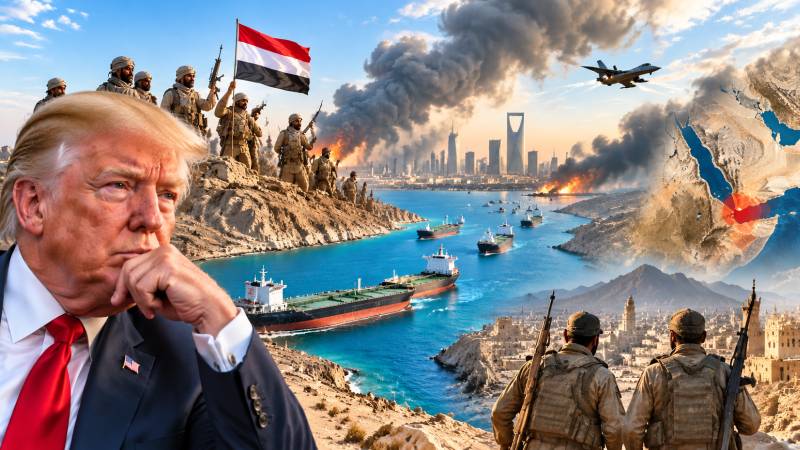
Thanks to Donald Trump's war of choice, the entire Middle East has been plunged into a geopolitical quagmire. What Trump, in all his capriciousness and faulted calculus, thought would be 'over in a week' has entered its seventh month. Most recently, what has sent frissons of alarm across energy markets is the seizure of Bab al-Mandeb by the Houthis. About 10% of global maritime traffic passes through this vital waterway. The dangers are particularly acute for Saudi Arabia, which had been relying on the chokepoint as an alternative for its oil exports, bypassing the Strait of Hormuz.
The Houthis hold a critical position in the strategic 'axis of resistance'—a powerful network of Iran-backed militias scattered across the Middle East. However, they remained largely absent from the Iran-US fray, triggering speculation as to whether the group had run afoul of its benefactor. As of late, the guessing game is over—with the launch of fresh airstrikes across the Saudi capital. With thick plumes of smoke rising from the vicinity of Riyadh airport, renewed hostilities are on the horizon.
The Houthis have advanced at a blistering pace, securing vast swathes of coastal land, including the port city of Mocha. Should the advance continue, it will not be long before the Saudi-backed government in Yemen is diminished to a cipher. Moreover, the human toll has been devastating, with around 125,000 people displaced since the resumption of clashes. Meanwhile, according to The New York Times, the Saudi prince beseeched Trump to intervene and send in airstrikes. Trump considered the prospect, ordered bombs loaded onto aircraft, and, just at the last moment, backed off—entirely typical of his erratic behaviour. The implications are twofold: Yemen, already ravaged by a long civil war between the Houthis and Saudi-led forces, confronts the deadly spectre of being thrust back into its former state, while the perception of the US as an ally to be banked upon has crumbled. Perhaps the Gulf has realised its dire folly in regarding US presence as an asset rather than a liability… an exorbitant one.
The conflict has placed Pakistan in an unprecedented strategic dilemma: balancing regional commitments with domestic security challenges and internal political sensitivities.
Furthermore, the impact stretches beyond the Middle East, putting Pakistan in a dangerous predicament. As a signatory to the trilateral Mecca Pact—signed barely two months ago—Islamabad is obliged to respond if a member state comes under attack. Yet the clause clashes with internal realities; the country hosts the world's second-largest Shia population outside Iran. Military action, therefore, is concomitant with fierce domestic backlash. Pakistan is already battling two ferocious insurgencies: the TTP in KPK and the BLA in Balochistan. Both have intensified their assault, perpetrating 3,145 terrorist attacks since the start of the year while accounting for 83% of all militant-related casualties. Against this backdrop, the country cannot afford to open another front of war without risking further crises.
The geopolitical landscape stands punctuated by perilous ambiguity. The rules-based international order that characterised the post-World War Two era has withered. Longstanding relationships have unravelled. Europe's conception of the US as a reliable ally to be counted on has buckled, not least because the country is headed by a capricious megalomaniac. From explicitly threatening to 'annihilate' the 'civilisation' of Iran to slapping tariffs on key allies and brazenly floating ideas of annexing Greenland, an autonomous territory of a NATO member, Trump has scarcely made an effort to mask his hostile ambitions. It is in this context that Europe is musing on new ways to navigate the increasingly volatile terrain. Lately, the EU has proposed forming a security council while also considering extending an 'associate partnership' to Canada, a prospect Trump has openly rebuffed. The upshot of it all is a marked shift in the global order's fundamental architecture. States are hedging their vital partnerships, weighing alternatives, and moving past the American umbrella.
In the midst of such great flux, it is tenable to argue that we may very well be past the days of US hegemony. The cracks have surfaced, and Putin is already capitalising on them. Across Europe, a range of 'hybrid' attacks has come to light, with suspicions pointing to Russian involvement. Explosive-laden drones were found at Leipzig airport, Germany, and the nabbed suspects who loaded and launched them were Russian; an explosion struck the warehouse of a defence firm in Italy; and fires broke out in Poland—one at the drone maker WB Group and the other at a manufacturer of helicopter components. In the former case, a masked man was seen on CCTV footage throwing incendiary devices, with the Prime Minister of Poland calling it a 'continuation of Russia's escalatory activities'. The aim is starkly clear: to test Europe's commitment to defending Ukraine while it has fallen foul of its powerful ally, the US.
With the Middle East stuck in a morass, Pakistan gripped by a double-edged sword, and a decisive rupture between Europe and the US, we might be witnessing a radical shift in the great geopolitical game; one in which the US no longer dictates the terms. America did not stumble into the fallout; it walked in with its eyes open.