

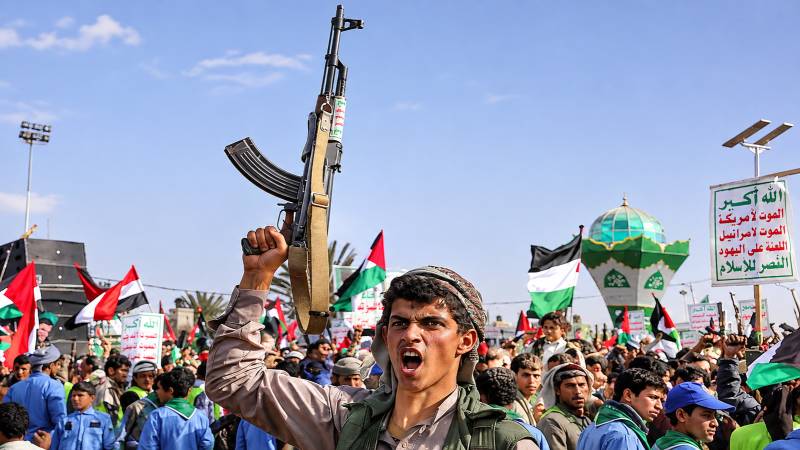
For several days now, the Houthis have been attacking Saudi Arabia in a coordinated way. Their targets have included a Saudi Aramco facility at Yanbu, King Khalid International Airport in Riyadh, Abha International Airport, King Fahd Airport in Dammam, and a number of radar installations and military bases. Houthi military spokesman Yahya Saree says the attacks will go on. He calls the sites legitimate targets and says the operations answer Saudi air strikes in Yemen.
The escalation comes after weeks of fighting between the Houthis and the Saudi-backed Yemeni government, and it has effectively ended a four-year informal truce. In September, the Houthis claimed control of Perim island in the Bab al-Mandab strait and of several nearby islands along the Red Sea coast. This month, Saudi-backed forces said they had retaken key positions around the strait. The attacks on Saudi airports and energy sites followed. Elsewhere in the region, the US-Iran war has settled into an uneasy pause, but in Yemen the fighting is getting worse.
To understand why, it helps to know who the Houthis are. Officially called Ansarullah, they are an armed political and religious movement from northern Yemen, and they follow Zaydism, a branch of Shia Islam. Zaydis make up roughly 35 per cent of Yemen's population. Hussein al-Houthi founded the movement in the 1990s to revive Zaydi traditions and to protest poverty, corruption and Saudi religious influence. After the Yemeni army killed him in 2004, his brother Abdulmalik took over, and he still leads the group today. The political chaos that followed the Arab Spring in 2011 gave the Houthis room to expand, and in September 2014 they seized the capital, Sanaa. They now effectively govern the north, where 70 to 80 per cent of Yemenis live.
Analysts say Iranian military support has changed what the Houthis are. A local insurgent group has become a regional force that can disrupt Red Sea shipping and hit Saudi Arabia and Israel with long-range drones and missiles. They belong to the Axis of Resistance alongside Iran and Hezbollah, and intelligence reports allege that Tehran supplies missile and drone components, guidance systems and training. Revolutionary Guard personnel are also reported to have operated in Yemen. The reports say Iran has lately been sending parts that can be assembled locally rather than finished weapons.
Even so, calling the Houthis an Iranian proxy would be a mistake. They are an autonomous actor whose interests happen to overlap with Iran's, and their political ambitions remain rooted in Yemen's own history and grievances.
Even so, calling the Houthis an Iranian proxy would be a mistake. Dr Muqtedar Khan, a Middle East specialist at the University of Delaware, describes them as an autonomous actor whose interests happen to overlap with Iran's. In his assessment, Hezbollah is less independent of Tehran than the Houthis are. He traces their grievances back to 1962, when the Zaydi imamate ended, and says the resentment grew as Saudi Arabia kept interfering in Yemeni politics and promoting Salafi Islam there. Zaydis are theologically close to Sunnis, he notes, and their daily prayers differ little. As evidence of Houthi independence, he points to the ceasefire the group negotiated with the United States in Oman. That deal was struck separately, even as the war with Saudi Arabia continued and Iran and America remained unreconciled.
Geography matters too. Regional affairs analyst Rashid Hussain Syed points out that Saudi Arabia shares a border of about 900 miles with Yemen. He compares it to the porous frontier between Pakistan and Afghanistan, and says Riyadh has never managed to fully control the threat that comes across it. For Tehran, the Houthis are a cheap way to put pressure on Bab al-Mandab, to unsettle regional rivals like Saudi Arabia and to keep options open as wider conflicts unfold. For the Houthis, the war is about Yemen first.
Saudi Arabia's reasons for fighting are different. After the Houthis took Sanaa in 2014 and pushed out the internationally recognised government, Riyadh saw a hostile armed group on its southern border taking over its neighbour. It intervened militarily in 2015 to restore that government. Many expected a quick result, but the war has dragged on for years. Syed says many observers, Pakistan among them, warned from the start that it would become a quagmire. He adds that Mohammed bin Salman, then defence minister and still consolidating power, wanted to present himself as a strongman and to play a decisive role against Iran.
The wider regional war has changed Riyadh's calculations. During the US-Israeli war on Iran, Iran struck American installations and interests across the region, and Saudi Arabia was among the countries hit. Gulf states had long relied on Washington for their security, but a perception has taken hold that America will defend Israel before it defends them. US bases, meanwhile, made their hosts targets instead of protecting them. Saudi Arabia responded by looking elsewhere. It first signed a bilateral defence pact with Pakistan, and in August 2026 it signed the Mecca Accord with Pakistan and Turkey. Under that agreement, an armed attack on one of the three counts as an attack on all.
On 5 October, after a surge in Houthi drone and missile attacks, the three countries formally invoked the pact, and Pakistan and Turkey announced they would deploy forces. What that support will look like in practice remains unclear. Khan believes the two countries will stay in a defensive role and will not join offensive strikes on Yemen, although they could be drawn in if the Houthis keep crossing into Saudi territory. Britain has also deployed Typhoon fighters to help protect Saudi cities, which shows how quickly the confrontation has become an international one.
Lost in all this is the toll on Yemenis themselves. Between 2015 and 2022, about 377,000 people died in the war, most of them from hunger and a lack of access to hospitals. Around 20 million people now need aid. Millions have been displaced, and the latest fighting has added some 100,000 more. Saudi civilians are now being hit as well. This conflict is tied to a larger regional one, and for now there is no sign of an end to either.