

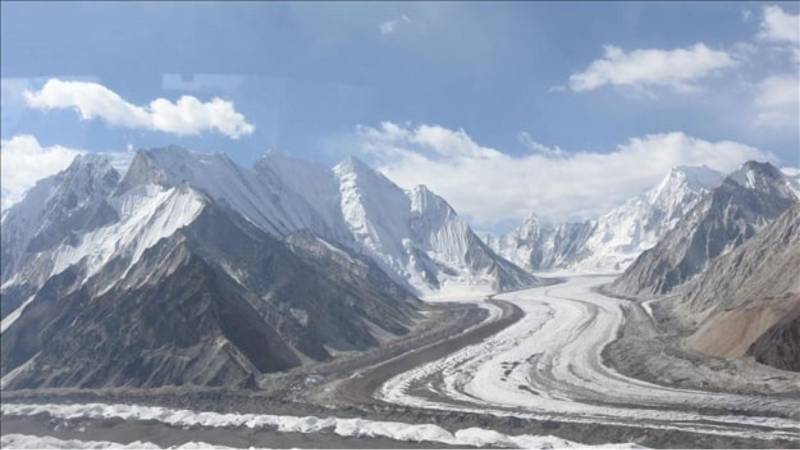
Termed as a regional environmental catastrophe, the fast melting of the Siachen Glacier is putting the future of two billion people of South Asia at stake. Having a length of 70 kilometres and called one of the world’s largest non-polar glaciers, Siachen came into the limelight in 1984 when India occupied the upper part of that glacier, resulting in the outbreak of war with Pakistan at the world’s highest altitude conflict zone.
How far the militarisation of the Siachen Glacier since 1984 is a cause of the melting of the glacier, having lethal environmental ramifications, is not difficult to gauge. The deployment of Indian and Pakistani forces at the Siachen Glacier was discussed when the then Indian Prime Minister Rajiv Gandhi visited Pakistan in July 1989, and an agreement for resolving that conflict was almost reached with his Pakistani counterpart Benazir Bhutto, but it was the Indian army which vetoed the withdrawal of its forces to the pre-1984 level. Siachen was also discussed as an item in composite dialogue between Islamabad and New Delhi, but with the suspension of that track-one diplomacy, any possibility of resolving that conflict failed to materialise.
Several proposals were presented by Pakistan to resolve the Siachen conflict, like restoring the status quo to the pre-1984 level and converting that glacier into a peace park. Every year, India and Pakistan spend millions of dollars to maintain their forces in the Siachen Glacier. More soldiers die because of frostbite in the biting cold of Siachen than by actual fighting. On 7 April 2012, an avalanche in the Gayari sector of the Siachen Glacier killed 129 soldiers and civilian contractors of the Pakistan army. It was a wake-up call for both India and Pakistan of an impending environmental catastrophe, that the two countries must demilitarise Siachen before the Glacier melts and causes enormous calamity.
According to Abdullah Kiyani writing in South Asia Times issue of 7 April 2021, “Several experts blamed the harsh weather for the avalanche incident. Others blamed heavy Indian military activity in Siachen for melting ice, thus causing an avalanche. A conspiracy theory blamed the Indian KALI (Kilo Ampere Linear Injector) project for melting ice near the camp. The incident caused a wave of shock and mourning through the Pakistani public.” According to the reports, “One hundred and thirty-five individuals, including 124 soldiers and 11 civilians, were trapped under the snow at an altitude of approximately 13,000 feet near the Siachen Glacier region, following an avalanche that struck an army base in the Gayari sector.”
The military activity on Siachen Glacier, considered the highest battleground on earth, has resulted in the reduction of the volume of the glacier
According to AI Overview, “The Siachen Glacier's melting serves as an environmental time bomb in South Asia, threatening regional water security by depleting freshwater resources, causing increased avalanches and temperature rises due to both climate change and constant military activity. This ongoing environmental degradation, compounded by the immense military presence and waste dumping on the glacier, could trigger cross-border water disputes and exacerbate existing national security concerns. To mitigate these risks, South Asian nations need to collaborate on demilitarisation, implement better water management strategies, and transition to renewable energy.”
One needs to face the consequences if the Siachen Glacier, with a length of 70 kilometres and a width of 8 kilometres, melts. It will certainly diminish the flow of water resources emanating from that glacier in India and Pakistan. The same is true with other glaciers in the northern parts of India, Pakistan, Nepal and Tibet whose melting will have adverse implications on water resources, industry and agriculture.
India and Pakistan must look beyond a parochial vision of sticking to military deployment and seriously look for options which can save the Siachen Glacier from further depletion and convert that huge piece of ice into an international ‘peace park’ which can become a source of a multi-billion-dollar tourist industry. Unfortunately, it was the Indian military which vetoed an understanding reached between Prime Minister Rajiv Gandhi and Benazir Bhutto during their negotiations in Islamabad in July 1989, arguing that withdrawing forces to the pre-1984 position would be against national security and provide leverage to Pakistan. Since then, negotiations on Siachen under the composite dialogue have remained inconclusive.
The melting of the Siachen Glacier as an environmental time bomb needs to be examined from three sides. First, the April 2012 Gayari incident in which a major avalanche in Siachen took the lives of hundreds of soldiers and civilians, should have been an eye-opener to India and Pakistan. Both countries engaged in the world’s highest altitude conflict zone are vulnerable to Gayari-type avalanche but even after that unfortunate incident, India and Pakistan are unable to resolve that conflict. Military activities in that glacier also contributed to its melting at a faster speed.
In March 2007, the Pakistan Meteorological Department launched a study on “melting of Himalaya glaciers, particularly Siachen, due to human intervention”. The study, which was released much before the Gayari sector incident of April 2012, argued that Siachen Glacier is a natural dam and needs to be saved for future generations.” It is lamented that “the military activity on Siachen Glacier, considered as the highest battleground on earth has resulted in the reduction of the volume of the glacier.
It is essential that controlling the release of fossil fuel in the form of automobiles, air conditioners, factories, and industries will also help control the melting of glaciers
Global warming has had one of its worst impacts on Siachen in the Himalaya, with the glacier melting at an unprecedented rate.” Mr Arshad H. Abbasi, strategic consultant on water, environment and renewable energy, carried out the study on behalf of the PMD and revealed that, “due to much lower activity on the Pakistani side, western glaciers are stable, as shown by recent independent studies by researchers from the UK and Italy. While vehicular traffic from the Indian side and heat generated from activities on this 21,000-ft high glacier have led to unprecedented melting and diminishing of this 72-km long glacier.”
Sanity demands that instead of consuming millions of dollars in that conflict, India and Pakistan should seriously think of demilitarising that conflict zone and declaring it as a peace park, which will promote international tourism and generate billions of dollars of revenue. Chartered flights can be planned for Siachen, which could be a source of enormous foreign exchange earnings benefiting the two countries. It all depends upon the leadership of India and Pakistan as to what extent they are amenable to such innovative ideas. Second, glaciers in Pakistan are located in the Himalayan, Hindu Kush and Karakorum mountainous range. Siachen is certainly a test case of global warming and climate change. Unfortunately, beyond rhetoric, the elites of Pakistan are unable to take concrete measures to prevent further melting of glaciers. Record temperatures during summers and heatwaves cannot be delinked from deforestation, unplanned construction and unchecked release of fossil fuel. As a result, a decline in snow and the fast melting of glaciers is an outcome of challenging Mother Nature.
Had the plan of planting 10 billion trees in Pakistan when Prime Minister Imran Khan was in power from 2018–22 been implemented, much of the melting of glaciers would have been averted. During the first term of PTI government in KPK, the plan to plant 1 billion trees was almost executed, and after its successful completion, it was extended to the rest of Pakistan in 2018. Regime change, which took place in April 2022, around two years before the completion of term led to the incompletion of planting 10 billion trees. The link between reforestation in the mountains and its slopes is a natural barrier against floods and the melting of glaciers. Unfortunately, unlike 25% requirement of forest area in any country, Pakistan has 4.2 million ha of forest and planted trees, which equates to 4.8 per cent of the total land area.” The timber mafia is held responsible for deforestation, leading to adverse climate change and the rise of temperatures.
Finally, in order to deal with Siachen as an environmental time bomb, not only the state but also society needs to be mindful of deforestation and its lethal implications. When reforestation is a policy of the state and society is also on board, one can see its positive implications to control floods, heatwaves and melting of glaciers. What is happening to Siachen and other glaciers of Pakistan is just the tip of the iceberg, and one can expect drying of rivers and lakes if serious measures are not taken to increase the forest area from 4.8% to at least 25% in the coming five years. Furthermore, it is essential that controlling the release of fossil fuels in the form of automobiles, air conditioners, factories, and industries will also help control the melting of glaciers.
Saving the Siachen Glacier, like other glaciers, should be a priority for both India and Pakistan because if the melting of ice on glaciers continues at a faster pace, the day is not far when water resources will cease to exist.
Demilitarisation of the Siachen Glacier and converting that huge piece of ice into a peace park is the need of the hour.