

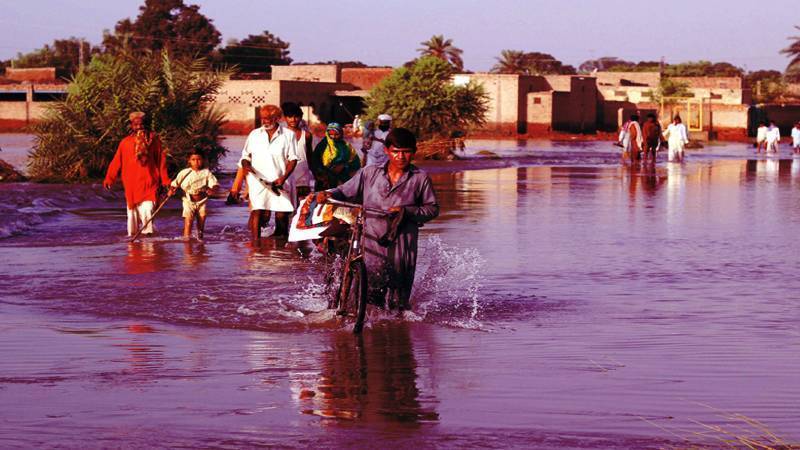
The recent, tragic and unprecedented destruction caused by floods in Buner, Swat, Bajaur, and Shangla has turned us all into climate change experts. Numerous articles are being written and perhaps read in large numbers on social media. Apparently, this is a good trend. However, whether this temporary awareness will transform into any lasting action remains a big question. After the floods of 2010 and 2022 in Swat, neither at the public nor governmental levels has there been any evidence that such disasters could lead to learning lessons. Where the floods of 2010 demolished settlements along the rivers and reclaimed their natural course, later, in the name of new settlements, the rivers were further narrowed.
In 2022, floods once again swept away these habitations. Still, people did not refrain from encroaching upon the rivers, while governments usually do nothing more than sending heavy machinery to demolish a few buildings after each tragedy, as if to cleanse their faces of the mud the floods had thrown upon them. An example of this is the death of 18 members of a single family near Mingora Bypass in Swat last month, followed by the government’s demolition of a few buildings in response.
Geologists divide the changes in Earth into epochs. The first is called the Pleistocene, lasting from about 2.5 million years ago until 11,700 years ago. The epoch from 11,700 years ago until the present is called the Holocene. Many scholars now argue that the current epoch, beginning in the mid-twentieth century after the Second World War, should be recognised as the Anthropocene. It refers to the period when humankind has had profound impacts on the Earth’s environment, climate, and biodiversity. This influence has accelerated the process of climate change. Global temperatures are rising, and seasonal patterns are undergoing unusual shifts.
The major driver of climate change is the emission of greenhouse gases, which are warming the planet. Industries, which have expanded rapidly in the past 75 years, play the most significant role in producing these gases. Industrialisation has transformed human lifestyles, making them faster and more uniform worldwide.
Since the mid-twentieth century, after the Second World War, many historical transformations have occurred across the globe. These included the spread of democracy, social welfare programmes, and the promotion of women’s education. Industrial and commercial globalisation reinforced these changes, while both international and national institutions regulated the process, whether in the Communist bloc or the West, as both were competing for power. Following the Second World War, international institutions were established through frameworks of international law, such as the World Trade Organisation (WTO), the International Monetary Fund (IMF), and the World Bank. Globalisation accelerated across almost every sector, while technological progress boosted agricultural production and contributed to the rapid population growth of the world.
Evidence is clear that Earth’s temperature is rising, with greenhouse gases—particularly carbon dioxide (CO₂) from human activities—responsible for most of the warming since the mid-twentieth century
This gave rise to new questions for anthropology, political theory, international law, and ethics. For instance, what are the implications of human forces dominating life and natural processes? People worldwide have been grappling with an altered Earth system, which different cultures experience, interpret, and respond to in their own ways. The expanding “Technosphere”—the dominance of technology—emerged to provide energy, food, shelter, and clothing to the growing human population. But it also widened global inequality, as the poorest classes saw little improvement in per capita GDP. The neoclassical economic belief that growth is limitless is now being challenged by a finite and deteriorating Earth system, where limited resources are rapidly becoming unstable.
Climate change is a striking manifestation of global changes driven by human activity. Evidence is clear that Earth’s temperature is rising, with greenhouse gases—particularly carbon dioxide (CO₂) from human activities—responsible for most of the warming since the mid-twentieth century. Human-made greenhouse gases have already absorbed enough infrared energy to potentially raise Earth’s temperature by more than 2°C.
For over 90% of their 160,000-year history, Homo sapiens lived as hunters and gatherers. During this time, our ancestors left noticeable marks on their environment, sometimes even at continental scales—for example, through fire-stick farming (using fire to clear land for cultivation) and hunting large animals during the late Pleistocene. Yet, these human impacts remained relatively minor at the global scale, and the Earth system functioned largely unchanged.
About 10,000 years ago, with the beginning of the Holocene, agriculture emerged in four different parts of the world. This eventually led to more settled lifestyles, the building of villages and cities, and the rise of complex civilisations that spread across large regions. Clearing land for agriculture affected vast areas of Earth’s surface, but the pace of this clearing was limited because only human and animal power was available at the time. Early agricultural activity did affect the Earth system—for example, by increasing atmospheric CO₂—but not to the extent that levels exceeded the range of natural variability. Despite these early impacts, the Earth system remained within the Holocene state.
Around 1800, the industrial era began, with a dramatic increase in the use of fossil fuels. Land clearing accelerated rapidly, and ecosystems shifted from mostly natural states to being dominated by human influence. By the early twentieth century, this transformation had surpassed 50%. Industrial fixation of nitrogen, enabled by fossil fuels, facilitated the large-scale production of fertilisers, thereby removing a major barrier to food production.
Sanitation systems improved, bringing great benefits to human health and urban environments, though waste was displaced to downstream ecosystems. These ecosystems were able to absorb it for decades, but in recent times, they, too, have come under stress. Populations rose quickly, along with life expectancy and human well-being. Fossil-fuel-based industrial systems increased material production, and with growing populations, consumption also surged.
At the time, human societies were unaware that the rapid use of fossil fuels was steadily increasing atmospheric CO₂ levels. By the early twentieth century, CO₂ concentrations had already risen beyond the upper limits of Holocene variability.
Economic systems heavily dependent on trade, transport, and communication, and with little reliance on local agriculture, have fundamentally altered vulnerability profiles
The sharp rise in human activities around the mid-twentieth century marks the second stage of the Anthropocene. After the Second World War, nearly everything accelerated dramatically—a phenomenon sometimes referred to as the “Great Acceleration.” Human population tripled, but the global economy and material consumption expanded at an even faster pace. Since 1950, human connectivity has risen astonishingly, reflected in foreign direct investment, international tourism, and the proliferation of motor vehicles and telephones.
Debate still persists about whether rising temperatures in the Northern Hemisphere and the increase in extreme floods are entirely due to human activity. However, there is overwhelming evidence that the rise in temperatures is primarily linked to the growing levels of greenhouse gases caused by humans.
As terrestrial creatures, humans tend to focus on changes occurring on land—such as deforestation and land degradation—or in the atmosphere, such as climate change, rather than in oceans or polar regions. Yet, from the perspective of planetary stewardship, oceans are more significant than land and air because they regulate various dimensions of climate, provide moisture for rainfall that sustains agriculture and cities, and store much more carbon than land and atmosphere combined.
Greater insight into the twenty-first-century challenges for humanity can be gained by analysing how societies in the past interacted with their environment. Such analysis reveals three types of societal responses to environmental stress: collapse, migration, and creative invention through discovery.
Collapse refers to the uncontrolled decline of a society or civilisation, involving population decline and reductions in production and consumption, leading to a sharp deterioration in human well-being. Many societal collapses occurred in history (before the Anthropocene), usually caused by complex interactions of environmental, social, and political factors.
Some hypotheses about the causes of past collapses are particularly relevant to the Anthropocene. For example, increasing societal complexity in response to problems may initially be an adaptive strategy, but as complexity grows, resilience is eroded, making societies more vulnerable to external shocks. Another hypothesis suggests that societies collapse when their core values become dysfunctional as the external world changes, leaving them unable to recognise emerging problems. Such societies remain locked into outdated values, preventing transitions to new values—such as reconnecting with the biosphere. A core value of post-Second World War modern society has been ever-increasing material wealth, generated by a growth-oriented economy based on neoliberal principles. This value fuelled the Great Acceleration, but now climate change and other global transformations are calling it into question.
The extent to which collapse might occur in today’s world under environmental stress remains uncertain. Economic systems heavily dependent on trade, transport, and communication, and with little reliance on local agriculture, have fundamentally altered vulnerability profiles. The nature of human-environment interactions has also shifted across dimensions of scale, speed, and complexity, creating new vulnerabilities.
The growing global scale of environmental degradation in the Anthropocene has generated some partial solutions, such as international agreements and market systems, but the distribution of ecological and economic impacts remains highly unequal. The critical question is whether local effects could become so severe that they trigger collapse, and whether such collapse could cascade through the interconnected global human system, as seen in the global financial crisis. Conversely, interconnected systems can also facilitate the sharing of knowledge and adaptation strategies to prevent the spread of local collapses.