


Iran will collapse in a few days, once its leadership is wiped out. It was on that premise that on the 28th of February it was attacked jointly by Israel and the US, even though the latter was still negotiating with Iran on how it should end its pursuit of nuclear weapons.
Israel took on the task of wiping out the Iranian leadership. It did that once the CIA passed on their location to it. Simultaneously, the US hit multiple targets in Iran, hoping to demoralize its military and hoping to create an uprising that would lead to regime change.
None of this happened, verifying yet again the veracity of what Prussian Field Marshal Moltke had said in the late 19th century: “No battle plan survives the first 24 hours of contact with the enemy.”
The Iran War is now in its fourth week. Contradictory statements keep out from Washington: The war has been won, Iran’s defeat was the most spectacular in world history, the war is in its final phase, the war has just begun and you have seen nothing yet and Iran’s power plants will be obliterated within 48 hours unless it reopens the Strait of Hormuz.
The war is already taking its toll on consumer pocketbooks. Even though the US does not import any oil from the Strait of Hormuz, gasoline prices have risen by nearly 32%. This means the average U.S. household will spend an additional $740 on gas because of the jump in oil prices.
The Strait of Hormuz is a vital waterway, which carries approximately 20% of global oil production and serves as a major vulnerability to the global energy supply. It is considered the world’s most crucial energy bottleneck. While pipelines exist to bypass the strait (via Saudi Arabia and the UAE), their capacity is limited to about 3.5 to 5.5 million barrels per day, leaving a significant portion of traffic vulnerable.
It does not matter whether the US imports any oil from the Strait of Hormuz. There is only one price for crude oil on the globe. Crude oil prices have surged by approximately 40% to 50% since the conflict began, with Brent crude spiking over $110-$120 a barrel, up from around $70 before the war.
In response to the rising price of crude oil, the S&P 500, an indicator of the US stock market, has dropped for four straight weeks and sunk to a 6-month low. According to one study, the 20-day correlation between the S&P 500 and U.S. crude oil prices stood at -0.89 as of Friday, 20 days after the war began. This means that rising oil prices have a very pronounced negative impact on the stock market, not just theoretically speaking but based on real world evidence. Stock traders consider oil prices a key indicator of financial markets.
Analysts at UBS Global Wealth Management said the latest developments were “pushing markets to price in a higher risk of prolonged conflict, deeper infrastructure damage and higher-for-longer crude prices. While a less damaging outcome in the Strait of Hormuz remains possible, recent events have narrowed that path and heightened the risk of continued volatility,” the UBS analysts said.
Historical oil shocks have repeatedly forced the world to adapt, driving innovations in fuel efficiency and a gradual shift towards renewable energy sources
Rumours are afoot that the US is going to send a detachment of Marines to capture Kharg Island in the Straits of Hormuz. There is also an increasing tension between messages coming out of Washington and Tel Aviv, with the latter saying the war will only end when Iran’s nuclear assets and ballistic missile production and storage facilities are obliterated.
To dodge the obvious criticisms of the Iran War, senior members of the US administration have begun issuing a remarkable series of statements. One said a rise in the price of oil is a good thing, because the US is a net exporter of oil. Another, concerned about the impact of higher gasoline prices on consumers and on inflation in general, tried to put a positive spin on these developments by saying that prices must increase in the short term so they can decrease in the long term, evoking the expression: “putting lipstick on a pig.” A third said the US has lifted sanctions on Iranian oil, a counterintuitive move against an enemy in war, because they will help keep the price of crude oil under $100 a barrel. When the interviewer failed to understand the logic, the expert went on to say that without the sanctions the price would rise to $150 a barrel.
Of course, no one knows what the future holds, not just for energy prices, but for economic growth, inflation and employment. The Chairman of the Federal Reserve Bank, arguably one of the most knowledgeable experts on the US economy, said he just does not know how the war would impact the US economy, because he does not know how long it will last and how severe will be its fallout. Even before the war, he was concerned about inflation, the job market, the path of interest rates, AI, tariffs, and the housing market.
A governor of the Fed, who had earlier called for a quarter point drop in the interest rate has changed his mind. He is concerned about inflation and wants rates to stay unchanged. Mortgage rates, a key barometer of the housing market, have begun to rise.
Powell and the governors of the Fed are not the only ones voicing their concerns. A broad range of economists are increasingly worried that companies may pause their hiring plans and consumers may rein in spending.
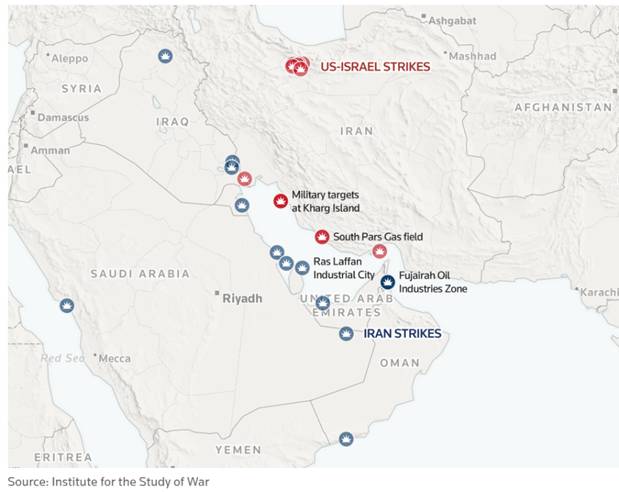
Since the war began, at least 39 oil refineries, natural gas fields and other energy sites in nine countries have been damaged. The US, reeling from the impact of the blockade of the Strait of Hormuz, is threatening to bomb all power plants in Iran unless it reopens the Strait. But there is no sign that Iran is yielding. Instead, it has threatened to hit all major energy infrastructure sites around the Middle East if the US carries out its threat.
This is not the first time the world has experienced an energy crisis. On the 6th of October 1973, Egypt and Syria launched an all-out offensive to regain the Sinai and the Golan Heights which they had lost to Israel in the Six Day War of 1967. Their offensive triggered a 19-day war, which historians would term the Yom Kippur War.
The war ended when Israel surprised Egypt with a counterattack that brought it uncomfortably close to Cairo. To overcome Israeli losses, America flew US$2.2 billion worth of arms and ammunition to Israel aboard its giant C5 Galaxy planes. The airlift brought 22,000 tons of tanks, artillery, helicopters and ammunition to Israel over a one-month period. Involving more than 560 sorties, it was the biggest such operation since the airlift to Berlin after the end of World War II.
In retaliation, eleven Arab countries led by Saudi Arabia’s King Faisal imposed an oil embargo on October 17. They agreed to cut production by five percent from the September level with a pledge to continue cutting five percent a month until their results had been achieved. They also imposed a total ban on oil exports to the US, the Netherlands, Portugal, South Africa, and Rhodesia. The embargo reduced oil supplies in the “free world” by nine percent and world trade in oil by fourteen percent. The embargo ended in January 1974 once Egypt and Israel agreed to cessation of hostilities.
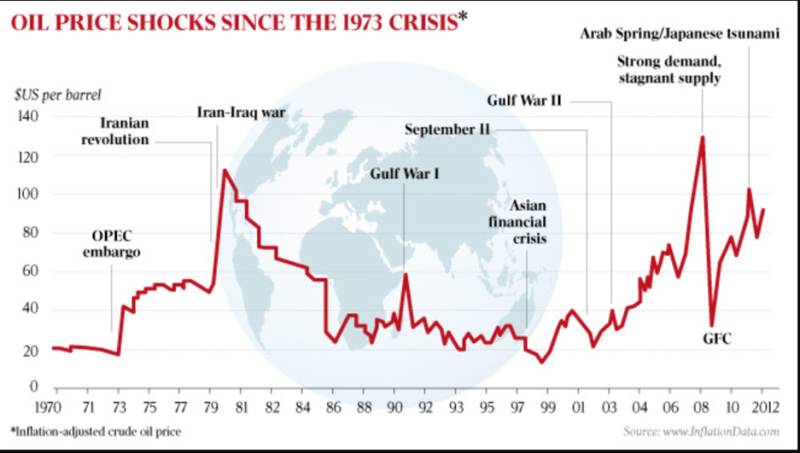
The price of oil shot up by a factor of 4. This triggered severe inflation, high unemployment, and a major recession in Western economies. In 1980, after the Shah of Iran was overthrown and replaced by a regime headed by Ayatollah Ruhullah Khomeini. The price of oil doubled. So, in less than a decade, the price of oil had gone up by a factor of 8. It continued to fluctuate as the decades passed, as seen in the graph.
There was an acute shortage of gasoline in the US. When I arrived in the US as a graduate student in 1974, the crisis was very visible at gas stations when cars lined up to stock up on gasoline. A speed limit of 55 mph was imposed on highways and freeways. California created its Energy Commission in 1975 under the leadership of Jerry Brown. The agency sought ways to reduce dependence on fuel oil.
In 1979, California imposed a rationing scheme. If the car’s license plate ended with an odd number, it could only be refuelled on an odd date on the calendar. If the license plate ended with an even number, it could be refuelled on an even date.
The world began to adjust to the new realities by shifting away from the use of oil for generating electricity by using natural gas, nuclear, and hydro. Car makers started making more efficient cars, partly in response to higher petrol prices and partly because in countries such as the US fuel efficiency standards were developed for cars. Similar standards were developed for appliances and buildings, notably in states such as California.
The Oil Embargo had the desired effect. It directly contributed to the normalization of U.S. relations with Arab nations and facilitated the Camp David Accords in 2000, as the U.S. recognized the need to take a more active role in Middle East diplomacy. Unfortunately, little came out of the accords, just as precious little had come out of the Oslo Accords in 1993-95.
In addition, the US stepped up oil production and began reducing its dependence on oil imported from the Middle East. Strategic petroleum reserves were created. World oil prices began to drop, only to skyrocket again in 2008. At one point, they hit $145.31 a barrel. The spike was driven by growing demand for oil from the Newly Industrializing Countries.
Just a few years later, in 2011, they spiked again, driven by the wave of pro-democracy protests, called the Arab Spring, in the Middle East and North Africa, and as a civil war broke out in Libya. U.S. crude oil prices hit $113.39 per barrel and hovered around $100 per barrel until the end of the year.
In January 2012, the U.S., along with European countries, imposed sanctions on imports of Iranian oil. This disrupted oil shipments in the Strait of Hormuz, the critical sea lane connecting the Persian Gulf to the Gulf of Oman, and oil prices rose to $109.39 per barrel.
In August 2013, U.S. crude oil prices soared to their highest level in 18 months as threats of U.S. strikes in Syria drove up oil prices. In September 2013, oil prices reached $110 per barrel and continued to stay within the $100 range until October.
During the past four decades, the world has adjusted to the fact that oil prices are highly volatile and in response has begun to manufacture highly fuel-efficient cars. In addition, it has dramatically reduced the share of fuel oil in power generation. Renewable energy resources such as wind and solar now account for a significant share, along with nuclear and hydro, but natural gas still accounts for a big share. This change has been driven in part by rising oil prices and partly by a desire to reach net zero emissions of carbon in a couple of decades.
The crisis in the Strait of Hormuz is in some ways like previous energy crises, but it is also different. The Oil Embargo of 1973-74 took place after the war had ended. The current crisis is taking place while a war is underway, with no end in sight.
There is no way to know when the war will end, and the US has openly said that it wants to retain the element of surprise.
As long as the war lasts, Iran will do its best to keep its blockade of the Straits of Hormuz in effect. The US and Israel will do their best to limit Iran’s capability but whether they will succeed or not remains to be seen.
Pakistan is being really hit hard, and several energy conservation measures have been announced by the Government. One piece of good news is that Iran, in a show of friendship, has allowed Pakistani tankers to pass through the Strait. The first one to do so was named Karachi. However, about 99% of its LNG imports come from Qatar. Before the war began, Pakistan had curtailed its LNG imports, and some of that was being redirected to Italy.
Now, faced with an LNG shortage, Pakistan may have to turn to more expensive and dirtier furnace oil as much as possible to generate electricity if the war persists.
The silver lining in the dark cloud is the presence of extensive solar generation in Pakistan, a relatively recent phenomenon. Most of it is located at customer sites, on rooftops. But a barrier to continued expansion of rooftop solar installations is the end of net metering, which was announced last month. It should be restored.
The Government should provide additional financial incentives to encourage customers to pair batteries with solar panels, move ahead with large scale deployment of advanced metering infrastructure, and begin rolling out time-varying rates. It should also provide incentives for car drivers to replace their petrol-fuelled cars with electric vehicles. And, of course, it should also deploy grid-scale solar and grid-scale batteries to lower the amount of fossil fuels in power generation. That percentage, which currently exceeds 50%, needs to be lowered to 20%.